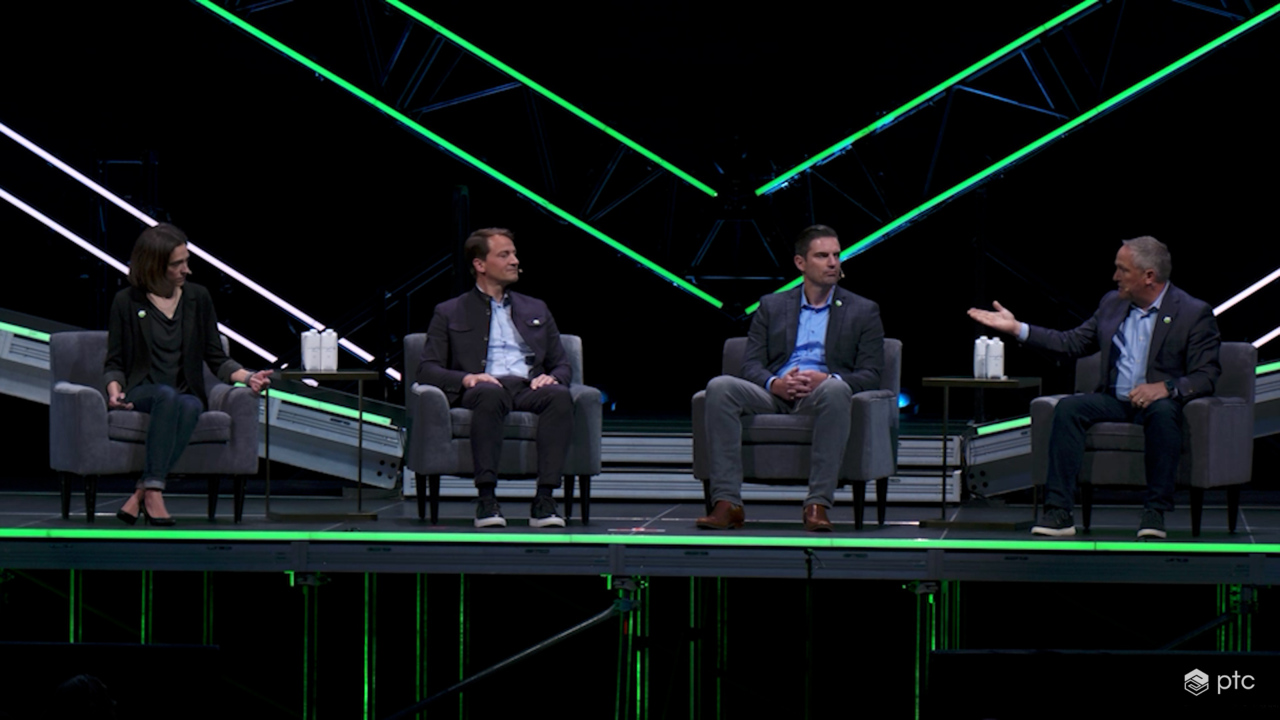
Extending the Value of the Digital Thread with ALM, IIoT and AR
00:09 Please welcome Senior Vice President Digital Thread Portfolio and General Manager Kepware at PTC. Abby Eon Joined by Senior Vice President and General Manager of ALM at PTC. Christoph Grisha, Senior Vice President and General Manager of AR at PTC. JJ Legleiter Division Vice President and General Manager. Thing Works Iot Solutions at PTC Howard Hepplemann.
00:47 Excellent welcome. It is very exciting to be back here at LiveWorx. It's been so fantastic finally getting to see people face to face again, hearing about how they're using our products, hearing about some of the opportunities they're seeing and challenges in along those lines. Let me just state a few of those, because there's a lot of common themes we're hearing. We have disruptions for the supply chains. We have component shortages when it comes to the workforce. We have skill set mismatches or we may not have workforce at all.
01:21 We have a lot of scarcity of labor there. And so all of that, combined with the fact that these after effects of this pandemic are actually accelerating the digital transformation journeys you were on before the pandemic or even beginning to start. So add in complex market requirements and all of a sudden the complexity to our products and processes. It's really demanding much more effective business processes that are spanning across
01:53 both functions and spanning across disciplines. So it all involves change and it's transformative change and it's hard. I will stop stating the obvious now and I'm going to shift into what we were going to talk about in the next 20 minutes around the digital thread and how we see that as very foundational and helping you change and be successful in your transformation. So nearly 20 years ago, Clive Hamby coined the term data is the new oil,
02:24 and it's drawing the analogy that data is very valuable, but it's not really useful if it's unrefined. And if you fast forward to today, I think there's a very large recognition that data is some of the most valuable assets of modern companies, but it's often siloed and it's difficult to access. And the context for that data, it lives usually within a function, maybe within a team. It's probably based on a disparate process in a disparate system,
02:55 or maybe it's not digitized at all. So to make that data useful, we need to be able to share that and enhance it throughout these traditionally siloed functions that are working throughout the product's life cycle. So a digital thread is anchoring on this concept of a model based closed loop life cycle. And you heard Jim say it's really bridging the digital and physical words together, and a thread is providing that integration that we need to cut down those silos
03:25 and be able to actually have that productivity, efficiency and quality. So let's talk about PCC's digital thread strategy and really it starts on our left side over there. It starts on the digital side with Kat and PLM, and we're building the foundation because with CAD and PLM we're able to go in, we're going to define how the product is done, we're going to manage that, we're going to optimize that, and we're going to think about managing complexity. We're going to think about how to foster collaboration and efficiency and ultimately how do we speed time to market.
03:57 But at PTC, we're now taking that foundation beyond there, and we're thinking about doing that with a broad set of technologies that come together to support customer needs and answer your needs. So if we think about how that product and process data flows throughout the different stages of the lifecycle and it would need to be changed and updated with the expectations of the product being not just built but used. So the folks here with me today on stage are going to tell us about
04:28 the value that that can bring to your business. So, Christof, let's start with you. So continuing in on that left side, engineering on the digital thread. Can you talk a little bit about how use cases like digital traceability, product traceability and requirements management are really key to reducing complexity and risk management? Sure. As I just listened to Stephen Johnson's talk and he mentioned this phonograph example that was just totally misaligned with
05:01 the needs, that shows me that the digital thread starts with a deep understanding of the market needs, the customer demands, but also nowadays regulatory requirements and companies that do a good job investing there and resolving the well, inevitable ambiguities and inconsistencies on that level. They have a solid basis for all the engineering activities, but also manufacturing and service activities and their products.
05:34 Just meet the customer needs and typically comply with the regulations globally also in their regional markets. Now, when we look outside in the Codebeamer area at this electric SUV, the Volkswagen Id4, this is what Volkswagen calls a software defined vehicle. Well, sounds big, but it basically means that the software defines and controls the functionality, and the hardware provides the electronic
06:07 and mechanical components to support the features. Now, that requires managing specifications and tests with complete traceability, because understanding the breakdown into the individual components and also understanding what has been reused, that is just a necessary element to provide the compliance with safety regulations, cybersecurity topics as well that become more and more important as the vehicles
06:41 and other products are getting connected and updated over the air. But it's also important to see the test coverage and monitor the implementation. Now we see software and hardware converging. And as both converge, companies start adopting scaled agile with value streams, managing agile release trains that then have product increments across the timeline.
07:15 So the key is actually this shift. It's a massive shift from sequential development manual and late integration. And oh, by the way, if you still manage this kind of traceability in giant sized spreadsheets and you find yourself in the position that the software is ready, but the hardware does not support the software defined functionality, then it's maybe time to think about modernizing your tool environment to drive
07:45 also more automation, continuous integration and continuous deployment. Because worst case, right, you are ready with a product design, you have validated everything you think, Yeah, good. We released to manufacturing, but manufacturing is absolutely not ready to start. So therefore this paradigm of continuous integration, continuous deployment with full visibility for the manufacturing side, that is what I see. A solid start of a model based digital thread.
08:15 Awesome. I have a Volkswagen ID for every time I seriously I feel like I'm in the future. So very cool out there. I'm glad security is a big, big thing for them. Indeed. You bet. So, Howard, as you know, Christoph is just talking about how the requirements being born out of ALM are flowing down for validation and traceability. So like, what's the next big stop as we're on that product lifecycle and how does that impact manufacturing in that journey? Yeah. Well, I think picking up where Christoph left off around requirements,
08:48 management, traceability and validation, ultimately that feeds what become these rich 3D product models. And you've heard about that at the show. And those rich 3D product models then are leveraged by PLM to determine what are all the configuration possibilities that could actually be manufactured. So the, the the product models can be leveraged in PLM to determine the appropriate configurations. But we don't stop there.
09:19 In a digitally thread enabled world, we take the product configuration and we transform the bill of material, including the various sites where those products can be produced into their associated manufacturing and service bills and material. And while that might sound like the end of the digital thread train, it's actually just the beginning because then we further build on that
09:50 and we use the bill of process that is derived from each of those manufacturing bills and material to determine what are the routings, what are the control characteristics, what are the critical quality control plans, what are the cycle times, the skills, the resources that we need at every work cell in the factory? And that digital thread then enables this digital continuity that started in
10:21 requirements, management and validation to span all the way down into the front lines of manufacturing. The power of this concept is that the digital thread then allows us to reuse that same content. So the next time we're going to build a product, we're able to reuse all of that product content and process content in the form of the digital thread. We're able to use that data to both improve
10:52 the accuracy to enforce standard work on the front lines and to shorten our relative time to market. We also, though, can see that by having that associative connection all the way from requirements through design, through PLM down to the manufacturing line. One of the benefits that we also get is now anytime a product change happens, which happens frequently, we're able to instantly understand
11:22 the impact of that product change and where it shows up in our supply chain and our manufacturing processes. So that's big and it's pretty incredible, right, when we're talking about transformative change. Do you have. In terms of Iot. How is how is that playing into the picture here? How do you see that? Yeah. Well, if you think of Iot, Iot is really the convergence technology that allows IT data systems PLM Mas ERP in OT data to be
11:53 combined together to enable new processes, new innovative processes and new innovative applications. So in this context, Iot provides the application that synchronizes the digital twin of the process with its physical counterpart in the execution status of that process on the manufacturing floor. And it does that by integrating the bill of process, including the control characteristics, the quality control plans,
12:23 the high Fidelity 3D and augmented work instructions that an operator needs on that front line into an execution framework that embodies the tools, the equipment and the resources that an operator is using in the work cells in the factories where they're they're working. By doing this, though, Iot also allows us to surface a vast amount of data that can then be used to do analytics. And this is where we begin to understand what are
12:56 the principal differences between what we intended, the manufacturing process to look like and what the actual reality of that process is. And we can use those analytical insights to either feed back into operations itself, to improve the process, to go back to the process itself, how do we better engineer the manufacturing process or in some cases go all the way back up to the product and ask the question, Is there a better way to enable design for manufacturability in the product?
13:28 So this is an important concept. Not only is it model based digital thread, but in this context, it's closed loop engineering to manufacturing model based digital thread that allows for the continuous convergence between what did we model, what did we want to have happen in the factory and what's actually happening in the factory? What are the sources of disconnect and how can we drive those to a more converged and ideal relationship between the twin digital twin and
13:58 the actual physical reality in operations? So what kind of examples come to mind of customers who are what the concept you're talking about right now, who are actually getting value out of it? Do you have a few of those? Yeah, I mean. There's probably many of you in this room that have embarked on this journey. There is a tremendous amount of benefit that customers are seeing by connecting this thread. One customer that comes to mind, though, is ABB Electrification,
14:29 and I'm going to use them because you can actually go on the internet and search under ABB Electrification and Nucleus research and you will find a case study that they published about this entire journey of model based digital thread. Now I won't go into all the details, but some of the really key and exciting highlights is they were able to take the engineering to manufacturing time from six months down to just a few weeks.
14:59 They were able to completely eliminate any errors in production orders. And by enabling this digital thread that spanned the functions of the organization, they also achieved a 45% improvement in collaboration. So you can get at that that study. There's a lot more detail in it defining their entire process. But to me that's pretty exciting. And I think many of you who have probably embarked on the same journey are seeing similar kinds of impact and results.
15:31 That's very impressive metrics. That's what it comes down to. So that's really good insights. If we think about the the diagram we have there of the Infinity sign, though, one of the things in the produce section and now knowing we're in service, it's all blacked out. But I think what I really want to key on here just to highlight is what Howard is saying. Thanks. When you were thinking about that process and we're going through the life cycle, we're not saying you have to flow all the way through the life cycle in order to get information back that's useful to upstream
16:03 and that informs things upstream At any time. We are enhancing our digital model and we're able to pass that information for insights back up. So if that's in production, we can send it back up or we can go continue through our service life cycle. So I'm going to look over to JJ for that. Can you talk about that next step as we go into service on the digital thread? Yeah, absolutely. It's obviously a big topic at the show. There's a there's a huge opportunity. You know, the first point I'd make is that that same initial investment,
16:36 the same digital thread, can actually create a tremendous amount of value, you know. So there's a lot of overlap in the enablement to, to, to enable benefits on the shop floor and then out into the field, you know, and that's where technologies, capabilities and solutions around Iot and augmented reality can start to get, you know, even more interesting. There's additional benefits that the workforce can realize to to drive efficiencies at the end of the day, because service organizations today are facing a lot of challenges.
17:07 They have high turnover. It can be hard to backfill positions. Most service orgs are facing that same problem. They have increasing service costs, they have declining margins as a result. So it's a it's a challenging landscape to navigate. And the equipment, you know, the upskilling, the requirements for these technicians are more engineering centric than they have been in the past. And that's because the the machines, you know, the jobs at hand are more more variable, more complex than in years past.
17:40 So it's getting it's getting there's a number of challenges that are coming together. And, you know, Forrester actually did a ran a report and they talked to frontline workers and they asked them, do you have access to everything you need, all the technology that you need to do your job, to do it effectively, to do it optimally. And 77% said, you know, we actually no, we don't. You know, there's more that more that we need. And that's because they don't have the luxury to sit behind a desk, to look at a to look at a computer to to search for everything they find.
18:10 They need it in the context of the job that they're doing on the front line. And that's what that's what are. And Iot can promise, you know, we can bring digital information to the front line in the context of the problem at hand. And so, you know, what what we're seeing now is that the problem isn't so much how do I access that information, but it's how can I access that information at scale? How can I get augmented work instructions for all of the different variations of these highly complex machines?
18:41 And that's a challenge, but that's also an opportunity and that's where where the digital thread can provide a tremendous amount of value. You know, following that infinity diagram around, you're now using that that 3D product data downstream in the context of service for configuration specific service instructions. So there's a lot of value to be generated there. That's awesome. Can you give us a few examples for customers? Yeah. Yeah, there's some great examples. I'm sure at this point everyone has been out on the Xtropolis floor.
19:13 And first let me just key in on one really high value use case, a very simple use case for a service technician. So I explained the dynamic. There's technicians that are new, they're changing jobs, they're hopping, and they need to be to be learning on the job. They might encounter a very complex machine or a variation they haven't seen before. Oftentimes they just need to know where the component is, that they're there to service and how to access it. Very big machine, big vehicle. So they need a service instruction to disassemble to access the component
19:46 so that they don't make a mistake. They don't take apart the wrong panel. They don't have to make a repeat visit. Ultimately, the end customer is happy. These are metrics that that if you're if you're in service, probably resonate pretty strongly. So there's a big opportunity there. And specifically some examples out on the floor, you've likely seen the giant Volvo semi truck in the middle of the floor. You haven't seen the demo. It's hard to miss. Yeah, it's hard to miss. Check it out. But what that is what we're showing there is that Volvo's actually launched
20:17 an application for first responders, first responders that arrive on a scene where there's been an issue. There may have been an accident, there may be even a person that needs help. And so they've created an application that leverages augmented reality to understand how to troubleshoot. How to safely access that electric vehicle because there's high voltage in certain parts of the of the vehicle that they that they need to avoid and with with ah technology, they can find out exactly how to get in there, how to be safe and how to how to complete the task at hand. But what, you know, while I think it's just a really cool use case,
20:48 what's what's really relevant here is that there are currently 1500 different variations of that truck that are delivered through that application and no one sat down and created 1500 different experiences. They connected the digital thread. We've talked about Volvo a lot at the show and what they can do when they when they connect that thread is programmatically generate all of these work instructions from an existing investment that they have in their product data. That's the really powerful concept that use case can scale to hundreds of thousands
21:19 of different variations of that truck and likely will. So it's the it's the investment to establish that digital thread and then a ton of downstream benefits. One other quick example is Peterbilt. Peterbilt has used ah in a similar use case, but for a service technician to work with what's notoriously pretty troubling or difficult wiring harnesses, complex wiring harnesses in their vehicles, and they found that they were able to take a 40 page instruction manual, translate that into simple experiences and
21:49 on average save 20 minutes per per service procedure, you know, as high as a whole day. If it's something that's really hard to troubleshoot. So that that mapping, that visualization and that downstream data coming to augmented reality is very, very powerful. And then the last example I'd give, which is another exhibitor out on the floor, is Loma. So they create equipment machines for factory operators. And Alma has really digitized all aspects of their go to market and they're
22:21 a great customer. But what the example I'd like to give here is that they are extending the value, the service value value even further downstream to their end customers Who are the operators that use their equipment in the factory can add as a service value add instructions that they can distribute along with the sale of the machines so that the operators can perform the simpler tasks themselves. Saves on service visits. It's a value add happier customers, the same types of benefits. Yeah, and I love that the hard pack in general,
22:51 because they are a manufacturer who is making a product that is then part of a process. So you have this multi-tiered and it really is opening up a lot of customer thinking on how manufacturers can leverage a thread, how their customers can leverage a thread, and even how other vendors participating in that ecosystem supply chain can vendors can share that as well. So having that information and those results accessible really back upstream, like the example we just gave with our pack, I mean, it provides a ton of value, right?
23:21 And it's a very critical advantage, especially from a PTC standpoint of how customers are able to close that loop and bring that information back in. So talking through all of that, Christophe, we're going we're going to have you we're going to bring it back. You're going to you're going to close this, okay? Yeah, you're going to close the loop. Are you ready? So can you explain the importance of having that data? Like how does that really impact engineering Yeah, this is actually it comes down to the question,
23:51 how do we make good products to be great products? And that is only possible with actual insights on product performance, on product utilization, on any potential issues during the production process, during service procedures or, you know, operating products like, Oh yeah, we see an MRI here. So, you know, the therapists might encounter some issues during the diagnostics process
24:24 and feeding back that kind of information from the field into the engineering is inevitable. To make a good product, great. But too often we see those telemetry data, those connected product insights not being made actionable, and with that they just evaporate in some big data. Lake Okay. So therefore, the the synthesis of those insights with new design ideas,
24:57 with new emerging technology, needs to be again in the engineering space with a consistent set of specifications designs, a model based product definition. And then we yeah, go for the next program, increment along our value stream. With the Agile release trains, it comes back to being agile to be fast, be innovative. Now, however, one thing cannot be compromised and yeah,
25:28 you picked on that already with a cybersecurity. I do not want to be in a medical procedure with a device that got hacked. And I think the legislation here in the United States just a few months ago also came up with new requirements that will be effective October 1st. Right. To monitor and fix any postmarket cybersecurity vulnerabilities. So that is no longer just a good practice. It's now.
26:02 Law, not only in the US but also in other regions in the world. So in order to be ready for this, you have to be in an environment that connects this digital thread and also not only in a in a position to fix the software vulnerabilities, but also make it work with the hardware and then deliver the updates ideally over the air with some Iot edge connectivity.
26:34 Talk to Howard about that or, you know, some service instructions to update this most frequently modified part in any connected product, which is the software nowadays. Yeah. And I mean, it's really key just to go back to where we started thinking about there's a ton of data out there, but what we're really talking about is refining that strategy and making it useful and making it useful around that life cycle. So thank you to all three of you for joining and thank you to all of you for joining. We hope this discussion just helped you understand more about what
27:08 a digital thread can do for your company and thinking about how technologies like ALM R Iot all fit into that and really provide a seamless flow of data. And ultimately this is talking about top line growth. We're talking about enabling or mitigating risk and thinking about operational excellence and how our workforce can be productive. So to learn more about all of this great news , we have a ton of things out there.
27:39 There is a Volvo truck, yes, but there are also a bunch of booths around Codebeamer, around Kepware, ThingWorx and Vuforia. So I encourage all of you to go check that out and hopefully we can get any questions you have answered or follow up from there. Okay. Thank you so much, everyone. We appreciate it.