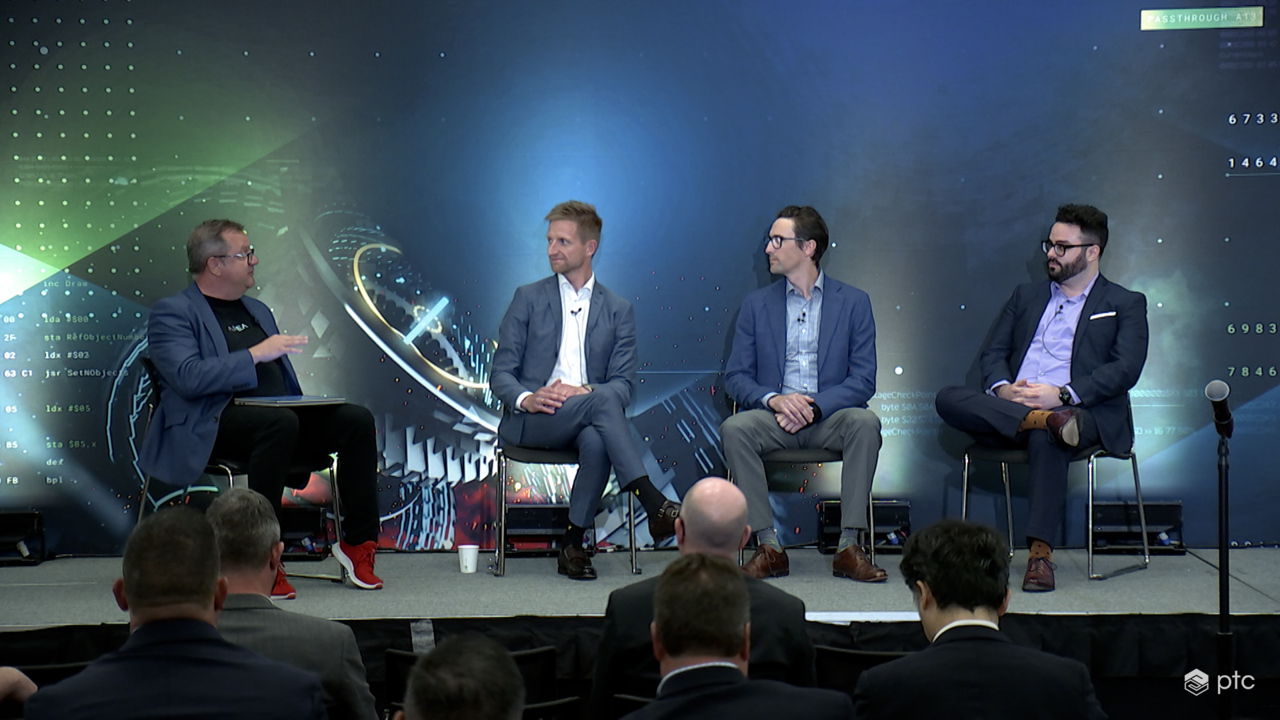
Connecting the Frontline to Drive Workforce Efficiency
00:00 You're very lucky. You've come along to the best panel and the best part of the whole show. Honestly, let me put a startup timer on. Okay. Well, good afternoon, everybody. My name is Mark Sage. I'm the executive director of the area, which stands for Augmented Reality Enterprise Alliance. And if you don't know about the area, please, not when we're talking, but afterwards we're going to have a look at the area.org. We're a global membership funded, not for profit alliance helping to accelerate the adoption of enterprise.
00:31 AI and PTC have been a sponsor member for a number of years, but we have a whole bunch of companies deploying the technology. Raytheon, Lockheed Martin, Boeing, Newport News Shipbuilding. A bunch of companies deploying the technology like the PTC, DSO, Teamviewer, and on the hardware side, the Magic Leap's Vuzix and a whole bunch of other ones. So we're really helping to accelerate the adoption of enterprise AI. But enough about me because we have some amazing people and I've been lucky enough to speak to all these gentlemen over
01:01 the last few weeks before this kind of panel as well. So we're going to be talking about connecting the front line to drive workforce efficiency. Okay. I'd like to make it as interactive as possible. It might be a problem trying to get these lights to shut up, to be honest. But we're trying to get a little bit of time at the end. Okay. So I'd like to do to start with and we'll start with Eric. If you could introduce yourself, Eric, and talk a little bit how you got into immersive tech. Yeah, absolutely. Thank you, Mark. My name is Eric Abruzzese. I'm a research director with Abi Research.
01:31 Market research firm covers a lot of innovative technology. I head up our augmented and virtual reality research coverage, so that includes a lot of industrial manufacturing, logistics, energy, really anything you think of with Enterprise, AR and VR, I hopefully know what I'm talking about with it. My background, I started out at university at Abi Research. My background is in human computer interaction. I did a thesis in HCI and neuroscience, and so I dove into the research and analyst side after that.
02:02 But I've been with Abi for almost eight years now and I've been doing AR VR 98% of that time. Fantastic. Thank you. Simon. Yeah. I'm Simon. I'm from Vestas Wind Systems. I'm a product lead for something called digital product lifecycle. And yeah, if you've been to the main stage, you've probably seen a bit about Vestas, but a few words about that and my reason for being into immersive tech. So first, as we do wind turbines, pretty complex, heavy engineered products,
02:32 and that's a lot about a complex product and for being able to manage that complexity, we've been working with different kind of technologies as part of the PLM area and last years also. AR And pretty glad about that. I'm Rick Newell. I'm with Horizon Aerostructures. We build complex subassemblies for commercial and military aircraft. And as innovation manager, I've sought out the best ways to convey information to our frontline workforce,
03:05 and I've worked with mixed reality, augmented reality CAD systems and tried to develop a number of different work instructions. And augmented reality has been a game changer for us. So I'm excited to get to talk a little bit about that today. Perfect. Thank you, gentlemen. So I've done a few panels in the AR space over a number of years and I try and keep it quite simple. So the first question I'm going to ask is about what problems can you solve? And we talk about the connected workforce so slightly,
03:36 a little bit more than they are. But again, what I'd like to understand from you is what is the connected workforce and what problems are being solved today. And Eric, let's start with you, if that's okay. Sure. So it means different things to different companies. Broadly speaking, you're looking at keeping a connection to a human, a worker, and AR VR is a very nice user facing technology For that. You have Iot and Cloud all in the background, but AR, AR VR is sometimes physically hands on and at least theoretically hands on with
04:07 the user. So it's a direct touch point with what's what's going on for the frontline worker. So in terms of what that can be for the broader workforce, now you have a nice two way data feed. You have the user on the ground getting information from, say, an Iot ecosystem for real time data. That user can also push data back for training purposes, for remote assistance, things like that. So there's this really wonderful synergy with an AR headset or
04:37 an AR enabled tablet on the ground that you really can't get otherwise. Either you have paper instructions for training or you have a phone call or a teams call for remote assist and you're missing a visual element. If you get really detailed down to mixed reality and what that can do spatially, there's nothing else that can that can serve that sort of. Spatial content like AR VR can. So as part of a connected workforce, it really works very well as keeping
05:07 the user part of that data conglomerate that can sometimes get a little expansive and lose the user. AR VR serves as a nice touch point for that. Thank you, Eric. Same question to you, Simon. But do you use the term in your business, the connected worker, or is that something you've actively been talking about? Definitely. We've had a program actually where I've connected worker has been a stream, so we've worked with that for I think five years now. And as you said perfectly, Eric, I think it's much about at least what we've looked to is the beauty of getting information when needed,
05:39 where needed and how it's most effectively needed for that worker. So it's not the answer and the only answer for us, it's kind of a complementary thing. So for some workers it is a good answer for some of the complex processes. So so if you look to kind of the business problems that we're trying to address. So we installed turbines in 88 countries around the world and the workforce is quite rapidly changing workforce. So imagine the one of the key problems we have is time to competence and actually getting workers quickly to be able to do that process effectively
06:12 and within, you know, specified and with the needed quality and needed safety. And that we've really seen a problem that we believe we can solve with AR. So helping some of the engineers to make instructions in a very effective way that frontline workers can use as a tool to do training on the job, in contrast to needing to do a lot of training pre job. So traditionally we've actually tried to make training centers all the way around
06:43 the world, and naturally that's both costly and also very difficult to do that in time. So so one of the key problems is time to competence. And then another challenge that we're trying to address is the efficiency and making sure we do processes with quality and that we really believe that getting these tools out there, we don't need somebody to sit, look over the shoulder or we don't need to have people following a rigid checklist. We can actually have the tool to support on the on
07:14 the job doing quality verification activities So that's kind of two of the key business problems we're trying to address. And it's interesting you said that connected work is part of a bigger program. Maybe we'll touch on some of those other streams in a minute. So, Rick, I'll get the name right. Sorry, Rick. Yeah. Over to you. So we don't use the connected workforce term, but I think Eric and Simon hit on two things the time to competency and the synergy of data. So what what big problem we're trying to resolve right off
07:46 the bat are our C-suite wanted it to be bottom line dollars right and we we do see that. But the thing that I think we've come to notice even more than that is the confidence that new users have in building these exceptionally complex assemblies. And when they have that confidence in knowing this is where this part goes, this is the type of sealant, this is the type of drill that I use. Those workers, they're happier. They show back up to work day after day.
08:21 They don't have that level of stress where they don't feel confident in what they're doing. And then the synergy of data to it allows us to capture information that then we can go out to the floor and say, you know, you need a little bit more training or you're doing great. And, you know, it allows us to focus on those types of problems and it builds quality into the process rather than us building a product
08:51 and then going and checking for the quality afterwards. If we have to put a part back in a tool later on that's expensive and there's probably somebody over there pulling their hair out about it because they know they're the reason it's back in the part. And I just am astounded with user confidence and our mechanics are loving using are we want. To stop there, isn't it? Thanks Loving using AI When you talk about
09:21 the problems that you're now solving, when you first started on your journey, are you kind of achieving those problems or are you finding there's a whole bunch of new problems that you didn't know or you've not actually solved the problems you were going out to, but you've solved some different ones. How do you feel just again, as a high level, was it a perfect 100% match or you found some other really good problems that you've solved, I guess Eric and Simon But Eric, why don't you start?
09:51 I'll start anyway because I'm higher level than these guys. That's who I speak to, to learn what's going on. So, yeah, what I'm hearing is. I think there's a pretty good understanding of what AR and VR can solve. I mean, you're looking at error reduction, increased efficiency and everything that comes along with that. If you're a company that suffers from very high cost of downtime, well, can your downtime go from days to hours with augmented reality and remote assistance? That's a cost savings of thousands to millions depending on on
10:21 the company you're talking about. I use this example a lot, but Ford makes an F 150 every minute. So if they have an assembly line go down for an hour, you can equate how many trucks they're missing out on the side of that in terms of like what what's really unique and new and maybe not talked about as much is flexibility and and user experience flexibility in how these workers can get the data you guys are collecting, how they can process it,
10:51 how they can capture their own data and upload it again to a cloud or an Iot solution. That's all pretty unique to to an augmented or virtual reality solution, usually augmented reality. And we're talking about like frontline workers. So when you're in AR, you have once you're sort of familiar with the solution and trained on how to use augmented reality, theoretically it's more efficient than you could ever be without it. And so when you're looking at capturing data and using that data, you get that efficiency increase, you get that error reduction, scrap cost reduction.
11:24 There's some really interesting use cases in rapid prototyping and design. If you're an automotive OEM and and doing clay modeling, maybe you can do that 10% as much as you used to because you're using AR or VR to do that. So there's a lot of unique applications of of XR that really we haven't explored in the past because it hasn't been possible. And then the user experience portion, that's what my background is in, in HCI. And so being able to streamline a process as best as possible keeps worker morale up
12:00 and it's a big problem. And I know we'll get on to some of those barriers we talked about with integration and culture I'd love to speak on, but once it is integrated and once you're familiar with it, the user experience can can be very positive. You know, you're interacting with the content in a much deeper and more engaging way. If you're talking about training, there's great efficiency, retention and recall improvements with XR training versus traditional manuals or videos. So there's even new data types that you can work with, spatial data,
12:32 for instance. Those are all pretty novel with XR and being explored now. And I think I'm going to kind of add to the question we talked about the problems, but now and this is my favorite and I always like doing the saying it's show me the. Money, show me the money. You know, as we all know, that the C-suite and to be honest, the organization needs to see the efficiencies that you gain from it. So can you talk maybe start with you, Rick, what you did in terms of the efficiencies or the benefits that you found and how you measured that? Did you have some plan beforehand?
13:04 What kind of process did you go through? And then we'll ask Simon afterwards. Yeah. So I'd say that that initially was kind of a big a big issue. The C-suite wanted something extravagant and right there in the front and on the floor on a new product line as our pilot for augmented reality. And that's great for tours. It's great for selling high level people. On the idea of how augmented reality can be a powerful tool in an industrial application.
13:36 But one of the things that I think we quickly came to find out was that we needed a really solid data set on a product line that had a good history. And so we identified a product line that we had built over 1000 units on, and then we said, All right, we're going to transition from this show off piece to let's actually look at something that we know how we're performing at the peak of what we can be with our existing infrastructure.
14:08 And the the disparity in the number of hours in those builds is distinctly visible from the time a production ready augmented reality experience goes in to out to the floor. We see those hours condense and just become so much more consistent. And we have a product line that is it's basically the left hand of this part that we didn't run AR on. And we compare these to each other and it is readily apparent not only in those numbers,
14:45 but also just in in the users out there on the floor asking questions, being involved. And I would say, too, is one of the things that we learned right off the bat was if you're going to roll out augmented reality. You shouldn't roll it out from behind a desk. It you need to be on the floor and you need to learn that process hands on with with a subject matter expert. Because when we built it behind a desk,
15:16 our user adoption was terrible. But when we spent time out there learning this is how it goes together, working with them every day, and then brought them a solution that they felt that they had a hand in. Holy smokes, they loved it. Some of the best ideas we get come straight from the floor. So I would always encourage you all to take the time to go out there and hold a wrench for a minute. The anchor Point. Simon Before I make some comments, your insights into Show Me the Money, the measurement side of I.
15:49 Yeah. And to be honest, we are very early days on this journey. So so I think bringing up to the to the sea level as you talk to, I think that that's probably not yet we're there. I think we're right now building the understanding, the use cases, basically what are the use cases where this makes a lot of sense and where we will go at scale? And then what are the use cases where we would go for other methods? So we're still building the data and learning how to do this effectively. There's also we'll get to that, but I think there's also a few things technically we need to get solved before we
16:19 can do this at scale at best across all of our products, all of our sites. I think one of the things we've succeeded with to ask for benefits is really much about the remote support. So obviously we have a lot of workers on remote servers in the turbine, offshore servicing in turbine in the middle of a desert, and it's quite costly if you need to go there once again. So the ability to make a remote support session with back office effectively, that's one of the use cases we've seen really well understood
16:51 and we haven't actually done a whole lot of of benefit capturing and taking it to numbers. It's been more a pool that we really need to do that and of course Covid and the whole pandemic was also a season that actually just pushed that right at the forefront. We really needed to do something. So I think it's still to be done, to be honest. And is that in the plan? Are you looking to do these measurements? We are with good help from our PTC colleagues, actually doing some some work at as we speak to collect those learnings to to bring it up and also to be to be honest,
17:26 also to understand where it's a good investment and where would we actually maybe benefit more from just utilizing digital work instructions or other digital checklists that might not be so enriched? So so I think it's yes, to answer your shortly. Yes, we are to do it for sure, but it's about getting the data and being able to do it also informed. And before I come to Eric, Rick, I think you made a good point in Simon. You've just emphasized that about getting the data. Certainly before you start the measurement part.
17:58 The companies that I've seen being successful with measuring ROI measure how they did the task first. I know it sounds silly and obvious, but quite often companies have gone, Hey, we've done R that's great and look how well we're doing. You say, Well, how long did it take to do it before they went? Well, we don't know. We never kind of measured that. So before you start on the journey, you take that time. If it's a time in motion or be able to measure how you do it, then you have a nice benchmark to be able to measure how are really helps. I think the other thing we've actually through the area worked on
18:28 an ROI calculator which any companies out there please it's free to use on the on the area website because there's just not enough information out. There was a question of where to go over to you Eric, and all your kind of analysis. Do you see much of companies talking about the kind of benefits and using proper out of percentages or dollars or numbers in your research? Have you seen. Much of that? Increasingly so, which is I'm very thankful for because it makes my job a little easier. You know, I spent years just saying, believe me, it's helpful.
18:59 But now there's actually case studies out there and those case studies have sort of scaled up from one user to ten users. And we're starting to see actually hundreds and thousands, hundreds to thousands of users for a company. And so I look back and I compare again to like academia and what you need, you need a control, right? You need to compare it to something. And so having a control and getting that end value, that number of users that you're that you're measuring as high as possible adds validity to the data you're capturing.
19:29 So we know this works with one user, we know it works with five users. Does it work with 100? Especially when you start talking about advanced, augmented and mixed reality where devices are thousands of dollars potentially, that's a high upfront cost. The operating expense is also high for platform costs. We know the return is high and there is a break even point to be calculated, which is why an ROI calculator is helpful, but it varies per company. So you really need to know not only how many users you're targeting, what device they're going to be using, what your.
19:59 You're targeting remote remote assistance looks very different than training. Looks very different than step by step in terms of a potential return. And every company is different in terms of how complex that is, what integrations are required to make that happen with Iot PLM, whatever it may be. So it varies, but it helps to do your research. And so, yes, increasingly so. Companies, I think, are becoming aware of that that need. And I think that's partially thanks to just maturation in the market.
20:31 People were not asking much anymore what is augmented reality? I think people have a pretty good understanding what this is and what it can do. So there's flexibility and room to start asking more probing questions and more granular data around what these devices and what these solutions can actually provide. I agree. And I think as an ecosystem, we need to do it more. And I ask you out there, if you are working on an R project and you're measuring the ROI, then share that. Let's get that out there because it helps everybody.
21:03 It helps the whole ecosystem. And just finally, when we finished the the benefits part, and I think both you both mentioned about it, about people coming in happy to work and stuff like that. I often talk about the intangible benefits organizations are getting partly to do with kind of culture and things like that. But also we know lots of organizations that retirement profile is quite high in that there's lots of people are going to be retiring soon. There's a huge amount of knowledge that will walk out the door when they retire. So that's one challenge that companies are having to deal with.
21:34 And the flip side of that is they're trying to recruit young people into the industry, which, let's be honest, the kids want to be on their computers and phones and things like that. But using this technology is a great way of encouraging. In fact, I can see the stage where they say, well, let's I'm using some latest tech in my new role. We're kind of not interested. I'll go to an an organization or an industry that is. So I think there's also some what I call intangible benefits that we'll continue to see, which will really help us as an ecosystem. Okay, so enough about show me the money.
22:05 Talk about the challenges. Okay. We know and even through conversations today, there are some challenges. Rick, I think I'm going to start with you and I'll come to Simon and and Eric will finish. So some of the challenges that you've encountered. Yeah. So I would say some of the the biggest challenges that we we encountered kind of right off of the bat was figuring out how we're going to host just software and stuff locally, how we communicate with our engineers on changing processes
22:38 and how we kind of avoid siloing engineers, quality production and getting a good buy off on procedural changes. You know, with the ease after we were able to build a framework for collecting data, us being able to go in and change animations or rev roles is something that can happen pretty quickly. And you know, the engineers, you know, they see that process and they say,
23:09 You've just made my job easier because now I don't have to go sort through a 200 or 500 page work instruction and adjust it, or I don't have to go out to the floor and redline something. So, you know, communication between those hubs and the business initially was a challenge. I think once we were able to show them sort of a product, show them that, yes, this is something that can replace the paper and that can, you know,
23:39 really cut down on the number of hours and and increase the quality. And it was easy to sell that internally then, you know, some of the other challenges which I already sort of mentioned, is choosing the right pilot. Like we chose something showy at first that didn't have enough units. And, you know, we fortunately went and chose a pilot that actually was going to work out for us and has worked out fantastically.
24:10 Yeah, I think those challenges have those are some of the challenges. Maybe another one of the challenges is just getting the end user involved, right? Because the way I think about it is that any experience that I build is for the the mechanic, the person who's there with that iPad. And if they're not sold on using that piece of equipment, they don't feel that you or that you care enough to learn their process,
24:41 then that can be a challenge as well. So and I couldn't agree more, Rick, to be honest, because I see a lot of projects that are fantastic up to that bit where they've not really involved the end user and it literally goes from putting it onto their head for a minute or two and taking it off their head, saying, Well, that's no use for me, right? You know, and that just. Going to hell, Yeah. Simon Yeah, I totally agree to that point from Ricky. I think there's a people side of the challenge. It's, to be honest, I think many of our users . What's the value of that? I can I can do the work without that.
25:11 So really finding the use cases where it makes sense and it's not just a fancy thing, but actually something that's really needed and helpful. I think that's one of the key challenges to be able to compellingly convince and actually also talk to the value. So that's the one side of it. Of course, also the cultural elements of being used to working with paper and all of a sudden needing to work with the headset or an iPad or whatever in the job. That's that's also a challenge.
25:41 And then finally, I think there's a tech tech side of things here that's also a challenge, to be honest. The infrastructure behind it, at least for us, our product is is 5000 part product with many processes and doing this at scale, it's easy doing it at one at a pilot or at a few products. But, but, but to be honest, to be able to do this for all of our processes, we need to connect the data from the process plans and Windchill to to the to the Vuforia. If you use that or the the place where you generate
26:12 the instructions, right? So it's not something you need to do manually as it is today. We kind of have a broken digital thread from our CAD data to to the authoring of these instructions. So I think that that's really one of the key things at least that we need to solve technically. And then I think lastly, getting it integrated into whatever client environment that our techs work in, if they use Salesforce Pro or whatever tool. So it's not another app that they need to open up, but they can actually natively, while they work, consume this instruction if they want to.
26:46 I think that's some of the key challenges that we are addressing. And then of course, what I mentioned before, just finding out where to do this, where to actually start and what use case to address and where to scale. And I think that's some of these initial challenges that we have. So before I come to you, Eric, summarizing, so we've got making sure there's a problem. Yeah. Ticking the box culture and making sure that everybody is involved in the end users involved. I like that there's the integration into the core processes and unfortunately most of the pilots I see don't actually do that.
27:18 And I think PTC have a great story, an example of how to do that. And then we talked a little bit about infrastructure, even stuff like Wi-Fi connectivity and things like that. It's kind of a summary. Any other kind of things in your research that you see are often challenges. Okay, might not be big ones , but challenges that you see. Yeah, integration and culture are one and two . So these guys covered it perfectly. I guess I can expand maybe a little more philosophically on on that. There's a sweet spot with integration. Ideally, everything you ever touch is in the system practically.
27:51 That's not going to ever happen. You know, there's connected torque wrenches which can download exactly what specification you need for exactly what bolt you're working on, and then upload it for verification that you did it right. But that can run into. Oh wait, I need an update for my torque wrench before you actually start working on something. So there's a sweet spot and again, it's going to vary by company and vary by use case. And that's something that you really can only figure out with pilots and with on the ground experimentation. So it's not necessarily
28:23 a rush to digitize everything possible because while that might deliver the best ROI overall, it's also the most expensive and most costly to do that. So it's finding a middle ground with your platform operator or internally with with how that might look for your organization. The other challenge I've heard quite a bit is finding the right person to talk to. You know, if you're, say, PTC trying to sell to a company or you're a hardware OEM trying to sell to a company,
28:53 who who's your point of contact in this organization for hardware OEMs, a lot of the time it's it and now you're working with it regulations and security and having to go through all of that. And then C-suite might not approve. They might not give budget for it and vice versa is also true. If the C-suite is involved first in a platform partnership, it might be blindsided by it and say, Whoa, we are not ready to integrate HoloLens or whatever it might be. So finding the right entry point is also really crucial.
29:27 And that's really, again, down to time in the market and familiarity with product. I will say that's improved quite a bit over the past few years because that's our time, because the maturation, as I mentioned, has has expanded quite dramatically and companies aren't necessarily confused as to what these products are. So the point of origin for these conversations is starting stronger. So that's becoming less of an issue. But if you're talking about a large organization, especially multinational,
29:57 you're dealing with. Regulations across the across the continents, different groups, across the continents, even within even if you have contacts in the IT team, it can be on the ground, it versus office and back end it. Those are two different conversations and two different touch points. So being able to have both for the company looking to buy and looking to sell, ensuring your basically path to market and your conversation entry points is really critical. Thank you, guys. And just finally, from from my work or or the areas work,
30:29 there are three other quick ones that we find come up time and time again. Security. Okay. And perhaps in your industry is the security isn't quite in some of the it's coming in with a device has got loads of sensors on picking up a whole bunch of data security is a big issue and that also manifests itself a little bit about getting the device into the infrastructure as well. So security is often the big issue. Safety is another one. We have safety committee. So making sure that the are is deployed safely, safely, but also being used in a safe way. Okay.
31:01 So we have a committee and we've done a bunch of work on that. And then finally, kind of human factors. It's still I still think and I'm a little bit biased, but some of the user experience could be better and we're kind of designing that in A2D way where we've actually got A3D opportunity to do that. But that will develop as like you said, Eric, in terms of the usability and stuff like that . Thank you very much for your time. Hopefully you found that useful and my thanks to the gentleman there. And carry on, carry on, implement it and talk to us about it.
31:31 So thank you very much, guys. Enjoy the rest of show. Thank you.