Bobcat Industrial Innovation - Market Research
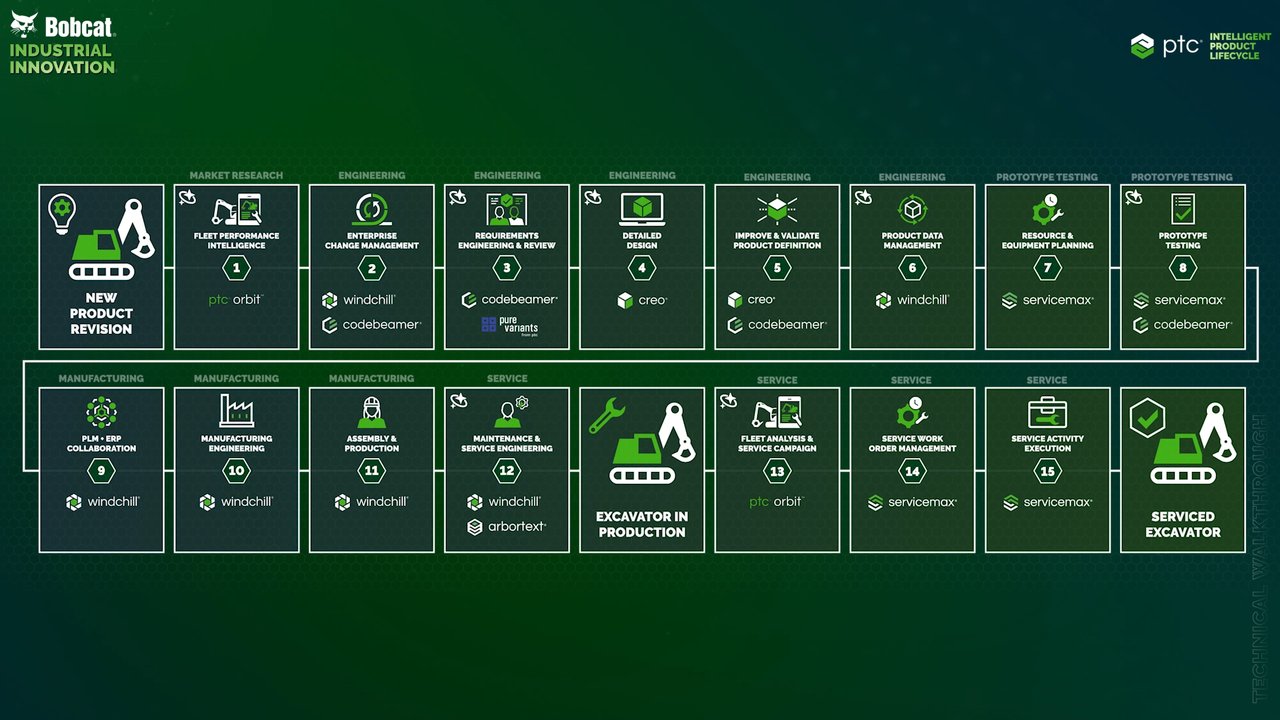
00:00 The Bobcat demonstration begins in market research and with PTC's newest solution, PTC Orbit. PTC Orbit is a connected asset intelligence layer that brings together installed base and service data to deliver a unified view of each asset's configuration, condition, and history across its life cycle. Its value is faster, more informed decisions, helping teams identify recurring issues earlier, prioritize the right actions, improve uptime and service efficiency, and feed
00:30 real-world insights back into engineering to reduce rework and accelerate continuous product improvement. We'll start from the perspective of a product manager in PTC Orbit, where we consolidate customer feedback and real-world field insights from Bobcat's global dealer network and customers. By combining connected fleet signals with service history, we can quickly see where downtime, repeat repairs, and cost to serve are trending in the wrong direction. These insights help our team focus on the highest value opportunities for reliability
01:04 and serviceability improvements. From the PTC Orbit fleet dashboard, we can slice performance by model, region, dealer, hours of operation, and usage profile to understand the scale of the issue. Here, we can distinguish isolated incidents from systemic patterns, quantify impact in terms of uptime and service cost, and build a data-backed improvement backlog that engineering can act on with confidence. Next, we'll leverage PTC Orbit AI to accelerate our analysis and pinpoint the
01:35 biggest cost drivers behind these fleet trends. By detecting anomalies and revealing correlations, like higher failure rates tied to specific serial ranges, configurations, or operating conditions, PTC Orbit AI helps estimate business impact and prioritize the improvements that will reduce downtime, warranty exposure, and repeat service events. This AI-assisted view shortens time to insight and makes the decision process more objective, so teams can move from "we think" to "we know" before triggering a
02:07 controlled engineering change. With the opportunity identified, we'll also use PTC Orbit AI to drill into part-level performance and understand exactly which components are driving repeat repairs and service cost. Because PTC Orbit can relate service events and failure codes back to the product structure, the team can connect real-world issues to the specific design of our hero part, the swing frame, and its variants, rather than relying on manual data cleanup and spreadsheets.
02:38 Here in the part intelligence view, we can capture evidence, quantify impact, and initiate a change request for engineering to improve the swing frame design, creating a closed loop workflow where field performance continuously informs product improvement. In this first section, we've seen how PTC's newest solution, PTC Orbit, helps customers capture and analyze service and product usage insights, so engineering teams can make faster, better-informed decisions, and pinpoint the highest impact improvements for the next
03:10 product revision, all while achieving product line diversity and scalability, implementing new technologies, and providing better business support.