Service Lifecycle Management and Sustainability
Download the slides here.
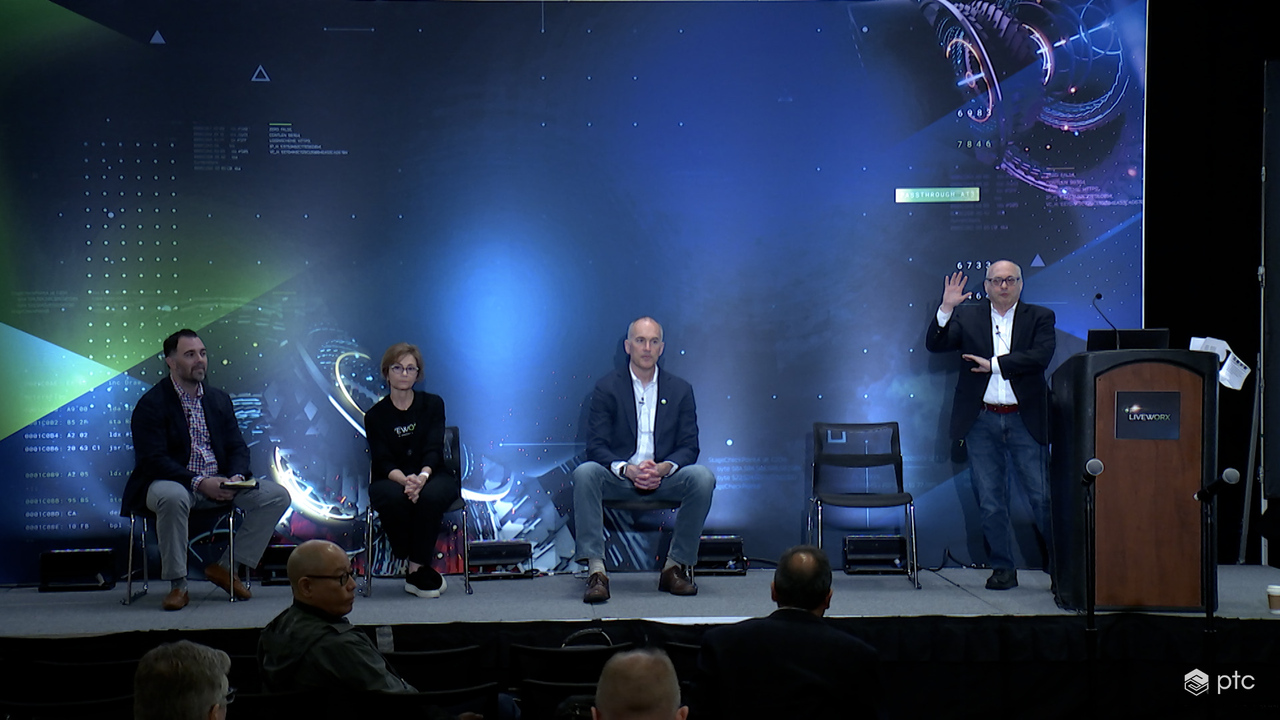
00:00 My name is Michael Blumberg. I'm the moderator for today's discussion. I have a long background in service lifecycle management. I started working in the field in 1985. I went to work in my dad's management consulting firm where we built a practice around service lifecycle management. Over the years, I had a good fortune of working with many leading OEMs like IBM and Schneider Electric and ABB and also with some really great vendors, including PTC and Servigistics.
00:31 So I'm happy to be here to moderate this very important discussion. And I have a great panel with me here with us. We have John John Carroll at the end who I've known John. I've known John for years. He's the founder and CEO of the Service Council, Sarah Ceruti, who's we just met, but very experienced, very knowledgeable expert on service lifecycle management management coming from ServiceMax and now with PTC and Dave Duncan, who I've also known for years as well.
01:03 He's a VP of Sustainability. Dave, I think I met you when you were at service when it was Servigistics Yeah, yeah. I came to PTC through Servigistics and then led the Arbortext business unit for a little while as well. So yeah, Well, welcome panelists. Yeah, so we really want to hear your opinions on this topic. Sustainability has become a very critical topic in all fields of business and manufacturing service lifecycle in particular. I think it's many people that are in service lifecycle management may say that, well,
01:36 we've always been focused on sustainability. Some of the initiatives and some of the best practices, like trying to avoid truck rolls and improve first time fix rates. Aren't those all part of sustainability? But it's much more than that. I think it's much more nuanced these days, what sustainability means and how it impacts service. So I want to ask the panelists. Sarah, let's start with you. How has sustainability changed over the last two years? It's really changed a lot and I apologize for my voice. I hope you can hear me.
02:10 So I think really what's happened in the last two years is there's been a real evolution in services, in great part driven by the technological evolution that there's been in services, everything from service management solutions to AI to connected assets. Smart assets have really driven a step change in the role of service organizations in driving sustainability. And service companies have really started to become a lot more predictive in
02:44 the way that they can drive sustainability because of these solutions. So you see a much greater ability from service organizations to send the right tech into the field with the right parts at the right time, reduce things like first time fix rates, improve things like first time, fix rates and reduce truck roles, and then be able to evolve from there and to really having the information about their assets that allows them to be.
03:14 A lot more predictive. And it seems with the focus on sustainability, we're now forced to really take an audit and inventory of our sustainability metrics, but also what processes and tools and systems do we have in place to manage sustainability? We might have some tools, there might be gaps and we need to answer what do we need and how do we implement it and when. So, Dave, maybe you're right in the middle of this. Yeah. Head of Sustainability. So give us your perspective on how the importance of sustainability.
03:44 I think the biggest thing that's changed recently is the commitments that companies have made, some voluntarily, like we announced the other day. But more and more regulations are requiring it like CSR and the US can require next year for anybody. European manufacturer. Guys. So you're going to have to start in 2024. And for the rest of us, even if we're based in North America or Asia, if we do more than €150 million of business in the EU, you're also going to have to account for it as well.
04:16 So what that means for importance and SLM is much like financial accounting. There's also environmental accounting through the greenhouse gas protocol. So things like truck rolls or embodied carbon of service parts, expedited parts, returns, all those things will be accounted for not only financially but also in terms of their footprint in the other accounting standards and usually in SLM. The advantage is, is that. As you say, footprint.
04:51 You usually saving money as well. They generally don't conflict. So it's a great story for your customers. So was wondering in the audience, how many people here believe that their organizations have a very clear sustainability strategy, initiatives in place for service lifecycle management? Or are you just kind of trying to figure it out where to go? Okay. So how many think they have a really clear, well defined initiative initiatives in place for sustainability within service lifecycle management? Well, I guess I don't see any hands going up,
05:23 so I guess we're all trying to figure this out, right? John, why don't you talk about what you're seeing from service leaders about. Yeah, yeah, happy to talk about that. So just to frame my viewpoints grounded in research data. So the Service Council is a primary research firm. We have a global membership so representative of all continents. And we have the benefit of hearing firsthand from service executives in terms of how they're defining their strategy, how they're evolving their strategy, so on and so forth. Anecdotally speaking, when we talk to our advisory board,
05:56 our members, there is more and more a prevalence of service executives that are being measured on sustainability, sustainability metrics, in fact, not just being measured but gold. So some of their personal MBAs are tied to sustainability metrics that link back to the organization's approach to to sustainability. We did do a recent survey of service leaders, about 150 vice president level plus service executives on ESG, and 52% of those that responded prioritized environmental,
06:29 over 32% who prioritize social over 11% that that are prioritizing governance. So environmental appears to be one of the greatest emphasis in terms of sustainability efforts amongst the service leaders that we're talking to and leveraging other analyst firms in terms of who are covering the same space. Gartner predicts that two thirds of global 2000 companies will have defined sustainability KPIs and
07:00 IDC by the year 2026 suggests that nearly half of the global 2000 will report sustainability data within their annual reports, their ten KS and so on and so forth. So it's quite prevalent. It's becoming more and more important and there's a tremendous opportunity for organizations to line up with the interests of their customers because customers are choosing based on the practices of of their organizations. Absolutely. Absolutely. So we heard a lot at this conference about sustainability,
07:30 obviously, and that I think yesterday it was Jim Hepplemann talked about that 80% of sustainability initiatives or 80% of sustainability issues are determined at the design level and that determines downstream and upstream processes, which you talked about in your session earlier. What I hear a lot, a lot of discussion is on is the product. How do you manufacture products that are better for the environment? How do you have manufacturing processes that are better for the environment?
08:01 Whereas when we talk about service, I think there's a lot of uncertainty. And we also know from yesterday and we've heard this, I've heard this number before, that you spend ten times more on the life on service than you do on the purchase of the product. Right. And the reason that is, is because services are stacked over the life cycle of the product. So if you have a product that's ten years old, it has installed base life cycle of ten years, You're adding services every every year and every year and every year. And that number can be as high as 20% .
08:32 But my question is, are we at a point are companies getting to a point where they have actual metrics, just like you can look at the example you showed us today about the part about how much the titanium and how much carbon it produces. Can we get those real time data in service, life cycle management or field service? Is that something? It's not there yet. We have to work towards it. Yeah. You want me to take that, or. Okay. Yeah. The date is going to evolve over time.
09:03 The supply chain data for like, the embodied carbon of a part, a lot of that is based upon global averages as opposed to supplier specific. Like for a certain grade of steel, you could have like a score of 5 to 50 in terms of how much carbon is is abated for steel, for example. So there's still a lot of data that needs to be curated and volunteered from the supply chain to be able to do that. But when you think of service, there's a lot of stuff that you can measure within service, or at least comparatively,
09:33 if you don't have like the source data all the way from the mines and the material processing, such as avoided truck rolls, avoided no fault found parts, return rates, you know, many more. And those are metrics that service organizations are starting to share with their customers as well. And I think the good news is that's something many service organizations have already been tracking, right? It's part of their performance. Sara, can you talk a little bit about what you've seen in terms of how sustainability
10:06 is changing for field service? And what are some of the how is success being measured by these organizations? So so I think, you know, a lot of time so so an asset that's in the field is going to stay there for a very long time. So clearly, you don't have the luxury of building a new asset that meets sustainability targets I was at a conference earlier this year where it was an energy conference where the speakers, what they were saying really resonated with me, Right?
10:36 Yes, we have to achieve net zero targets as an example. But when you have a power plant with hundreds of millions of dollars worth of equipment and there and it's running on a on a on a fuel source, that's not necessarily very clean. You can't just throw away all of that equipment and start all over again. So I think the one thing that services has always done well, even when we haven't had all of the data at our disposal, it's really being able to say, you know, let me understand how this asset is running today and let me understand what are
11:10 the modifications, what are the updates that I can apply to that asset to make it function better? So for example, what the example they were talking about there in terms of the turbines was how do we convert them to hydrogen fuel as a first step, right? Then we'll start designing the better turbines. But how do we convert them for now? And so just finally, I guess I look at it in two different ways. I have a colleague who used to always refer to poor man's Iot, so even if your assets aren't connected, you still have field service technicians going out there to maintain those assets. You can still start collecting data. What parts did I change out?
11:42 You can send out those parts back to your reliability engineering teams, your quality organizations and determine what failed. Why did it failed and how do I build a design, a better part, a more reliable part, a more sustainable part next time around? So I think we're getting there. But it's it's incremental as opposed to. Just we did a study last year on sustainability and it was mostly in the reverse logistics supply chain. But I think some of the lessons apply in field service and service lifecycle management broadly, and that's that many of the leaders,
12:13 the executives knew the sustainability was important, but they didn't want to invest a lot of their own capital and time building sustainability programs. They wanted to come down from management, from sea level. Um, John, wondering what you're seeing along that. One of the. Surveys we do annually is our KPI and Metrics benchmark survey, and we ask a whole range of questions around what are the priority metrics by class, what are the priority metrics within each class. And one of the things that we found from the research was that there's this movement
12:44 and shift from lagging indicators to leading indicators, meaning the cause to the effect, right? So from a metrics standpoint, an example of that would be on time delivery of parts is a direct cause of first time fix rate triage and diagnosis. Accuracy or dispatch efficiency is a causal effect to achievement of first time fixed rate as an outcome. So we see a lot of organizations kind of shifting their attention from that lagging to leading indicator mindset.
13:14 And there's many examples in terms of, for example, the cost of dispatch. Our research shows that it ranges from $250 to $2500 plus, depending on the sophistication and location of assets. So if you're inaccurate in your dispatch and your diagnosis and no fault found is the arrival point, or you send the wrong technician with the wrong skill set or they don't have the right part, well, that's a repeat visit. And there's fuel savings and emissions that happens every time you dispatch.
13:44 So there's there's a number of different indicators that we're looking at. So intuitively, we know that those those tactics improve sustainability are better for the environment. Indeed, we're not really at the point yet where we know exactly what impact that action took on reducing carbon emissions. Today, we might know at the end of the year and the end of the quarter when somebody in the sustainability office runs the calculations. Right. And the other piece that really helps with that data that's collected is you heard Jim say 80% is the term by design.
14:14 That's not a design engineer sitting in an ivory tower that involves a lot of collaboration with service leaders and service engineers to figure that out. With data driven design coming back from service because you want to understand what our randomly failing parts as far as parts that have limited life and how do you develop remanufacturing programs around those you want to understand when are you sending trucks and how can you avoid those by having over-the-air updates or remote assist capabilities.
14:45 No fault found parts where you need to improve your documentation for parts identification as well as diagnostics. ET cetera. ET cetera. So all the data that you're collecting to be able to estimate both business as well as environmental impact, that's all the stuff that has to feed back into engineering to contribute to that 80% . And what's great is all those activities you mentioned are within our control as service manager and service leaders, and the data is probably available in an asset centric solution. Right.
15:15 Michael, Just to build off of some of Dave's points, we talked yesterday, Dave, about avoiding expedited shipping, right? So when you get in this pinch where you don't have parts and parts availability, by the way, we do an annual survey amongst Frontline, not just service executive leadership and we ask them what do they need in terms of capability in the field to be effective. The number one, three and five response was parts, inventory, visibility, parts ordering and the ability to transfer truck stock from trunk to trunk. Right.
15:47 So they're they're starving for parts in many instances. And so we wanted to do some research behind that to understand parts availability and how are you measuring parts effectiveness. And and there's a shift there's a there's a big shift happening where elasticity is being built into the supply chain. So insourcing, Nearshoring, Onshoring there's a lot of strategies and movement and shift towards sourcing of products and parts and looking at where can you house
16:17 and warehouse those, whether it's at the supplier, whether it's at the customer site, whether it's at other locations that might be within the vicinity of high populations of customers. So we've even heard strategies where there's lockers at seven elevens. So there's all sorts of instances where parts are a big critical factor in terms of issue resolution. And our engineers are telling us that they need more visibility, transparency and accessibility of parts in terms of that process.
16:47 So so we were talking about some of the metrics and some of the initiatives. So I wanted to direct everyone to these. It's only a one. Some, some rooms have slides on both sides, but we'll go over here, some of the initiatives we looked at, the initiatives that supply chain service, supply chain professionals might might be pursuing. And as you can see here, that when it comes to carbon emissions, almost one half of them say that it's completely or mostly they have they're prepared to handle those objectives.
17:20 But some of these other ones, there's big gaps between those who say they're. We live mostly versus those that are slightly or not at all. So I'm curious in the room, where do you guys think you are? How many of you think on at least one of these these initiatives, you're completely prepared to meet those objectives? Come on, don't be shy. So what'd you say? How about moderately? Not at all. Okay. So thank you.
17:50 And that's normal because in our business, we never say we have a sustainable product. We just say we're improving sustainability in our products. Like we're we're in manufacturing. It is still dirty and has a ways to go. So it's a. Little bit like a first time fix rate. Holy Grail. You keep pursuing it, but never really get to the end. You just get to make it better and better. Exactly. I mean, it's not all doom and gloom like the first half of the abatement by 2030. That's achievable and commercially practical ways with existing technologies. But yeah, that second half, we're all figuring out how we're going to do that.
18:22 But there's a lot of innovation for the 20, 30 to 2050 path, but it's fairly new for most organizations. And from our study, these are some of the metrics that companies were tracking. And again, you see not even 50% are tracking these these metrics. The most frequent ones are volume of units refurbished and volume of units recycled. And again, this is just environmental metrics that are related to sustainability. If we look at other issues like governance and societal impact, sustainability,
18:57 there's even more. So again, how are we doing here in terms of having these metrics in place in our organizations? So let we look at but we can't just wait. And that was the point I was trying to make earlier, that we can't really wait to. The CEO says, let's go do this. Service leaders, I think it's incumbent upon them to start thinking and educating their teams, their management of what they're doing to achieve sustainability goals. You want to share any more on that? Can you elaborate a little bit more, Sarah? Yeah, no, I was just going to mention that one of the things we're seeing more
19:30 and more frequently is really, yes, you have that top down approach of the executive leadership, the board who is trying to drive sustainability targets. But I think it's even more important for it to come bottoms up from the service organization when you're talking about sustainability of the equipment that we build. And we've seen a lot of customers that are really starting to, for example, collaborate with their end customers and say, what's important to you in terms of sustainability? And then they're they're taking
20:00 a two pronged approach to help their customers out with that. One is how can we drive more sustainability to the existing products that you have? And the second is how can we ensure that we're building new products for the future that meet your sustainability sustainability targets as opposed to our thinking of what they should be. So we're starting to see that dynamic really take hold as well. Good. Good. Michael. Our research is also showing that there's a heavy emphasis on the encouragement of
20:31 the return of defective old, obsolete parts that can come back into the organization in a circular nature. And there's a strategy called upfitting, which is an incentive that's layered into your suppliers, your customers, to get that old product back so that it can be remanufactured refurbished, redistributed or recycled. And there's a lot of value to the dirty core inside some of those products that can be reused, repurposed for the for the point of view from the point of view of serving
21:03 and supporting future customers and being available. So actually one of your customers, Cummins Alex Ward from the Hydrogen Supply Chain Group, is on our advisory board and we did a podcast on that very topic and he talked about the incentive programs that they've layered out to their suppliers. And it's a pretty impressive focus. And and we're seeing that prevalent amongst many of our members. Thanks for providing that example. I appreciate that. Yeah. So let's look at some of the conflicts that must be overcome. So, you know, on one hand, we think about all the things that service executives do,
21:37 service managers do, and we could say, yes, they contribute to sustainability, improve the environment, like trying to avoid a truck roll, trying to resolve calls remotely, doing a better job at parts planning and forecasting. But there could be other things that are in conflict, right? For example, we may have to decide to postpone something versus getting a technician out there right away. If getting them out there right away really has a big negative offset on on on the environment. So, Dave, can you talk a little bit more about some of the conflicts? How do you avoid them? Yeah, I.
22:07 Mean, there's technical ones for sure, but I think that the elephant one is the commercial relationships that you have with your customers through the life cycle all the way to end of life. So when you think of even post warranty, period, and for the majority of the life of the product, it's often difficult to have a good close relationship with the customer and capture that service opportunity. We've been talking about product as a service for decades and thinking that it would ramp up quickly. And frankly, it hasn't yet.
22:40 But we see some things on the short horizon that will make that more likely. An example is how many have batteries in their products that they. Okay. So like the European Union is going to have a battery directive by 2026. And the reason for that is they it's under sustainability. But the real reason is, is for security reasons like rare earth metals are not dug out of the ground in most industrialized countries. So industrialized countries are putting circularity rules in place to tell
23:13 manufacturers, hey, if you use these minerals, thou shalt make sure that it gets returned. So you will have mandates where you can be much more intimate with your customers and maintain that relationship because the laws will require it. And you should embrace that because that's that's upside and that's more contracts for you and longer lasting relationships. So I think the commercial barriers will erode pretty quickly. Yeah, we're doing some work with Cummins right now on their extended warranty program
23:43 and anyone's done work with engines, you know that they're changing the admission standards. So you have to provide a warranty for a longer period of time on that emissions which eats into your extended warranty revenue base. So we have to really rethink about what's included, what's not included and what additional revenue sources can they can they generate once the engine is sold because of that new initiative, that new policy? Yeah, we've seen some failures in that, too. BMW with their heated seats, I think that was a failed feature roll out.
24:13 But we so I think one of the conflicts that we see is, you know, 87% of service leaders are moving towards or plan to increase remote resolution this coming year. But when you start to think about sophisticated assets, you know, health care in the health care industry, medical industry, industrial manufacturing, you can't remotely resolve those Some of those issues, the presence of field service is going to always be there. So that's just a natural sort of conflict that exists. We're all trying to move left in terms of meeting
24:45 the customer where they want to be met, but there's still the requirement for field dispatch. So now where do you turn your attention to greater throughput, right? So how can you make your teams more efficient in terms of route optimization, in terms of number of jobs completed per day In our voice of the Field Service Engineer survey, we asked the technicians and engineers, what do they dislike most about their job, paperwork and admin and the time they spend finding information? So we see a lot of focus on upskilling,
25:15 reskilling and providing the information and the capabilities required so that you can have a sustainable service organization. Because right now service leaders are charged with capacity issues in terms of meeting the the customer capacity issues that are out there from in terms of demand. So that's another sustainable element of service leaders sort of plight, if you will. So yeah, yeah. Let's kind of look into the future. So what is the future look like for sustainability in service lifecycle Management wants to go first.
25:47 Sarah, you're volunteered. Yeah. So I think that I think it's sort of we've said it here today, right? I think service organizations are going to have to become a lot more thoughtful about how they are delivering against sustainability initiatives. I think more and more as service organizations are able to leverage the data that is coming off of the assets, they're going to be able to be much more predictive about how they are maintaining those assets and keeping them up and running and driving things like uptime,
26:21 availability, reliability even within the, you know, the existing realm of the asset base. And then from there, I really think that we need to think in the long term, which is how I think John was saying, referring to it earlier. So how do we get away from designing these more these assets that have a linear lifecycle, right? They're born, they're used, and then we throw them away to the concept of a more circular economy
26:52 and circular assets, right? Assets where kind of like we used to do it in the past. If you think about it, I mean, I still remember the day when you would repair your washer over and over, right? It wasn't like, oh, ten years one and done and you throw it away. So I think we're going to need to start to think about really how do we become more circular and designing assets, keeping them up and running and then leveraging either, you know, the as you were saying, the products, the parts and the assemblies in those assets to continuously keep them going or,
27:23 you know. Design the next generation. Thanks for your perspective on that, Dave. Yeah, maybe a general comment and just something specific that sort of fun and aspirational. You know, the first is, is we're all fairly technology and we're all fairly adept about progressing. I would say the forward logistics of service for parts asset and technician optimization, but looking for. Forward. Look at two areas. One is reverse logistics for circularity, because regulation is going to be your friend there to grow your business.
27:55 And secondly is coordination with engineering so that you're not constrained with whatever stuff they throw over the wall on the product. You know, get in front of it, tell them what you need for sensors and what you need for instructions, commercial arrangements in terms of how it's packaged priced. ET cetera. And get in front of those things. And the other is aspirationally think of products that last a lot longer than they used to and how you have different,
28:25 I would say generations within that product design. We're working with a university and in some startups in Aachen, Germany, which is about Aachen, one of the professors evolution. So if you Google Evolution Aachen, you'll see this wild circular car. And the idea is they're making the chassis. So the chassis will last 50 years and every ten years you're required to bring that car back
28:55 because it's modularly designed and they can't predict what people will want 50 years from now. But they say we'll outfit this car to modular way so that we can take pieces off of it and we will give you refurbished car every ten years. I think that ties into also servitization, right? You're subscribing to the to the product and you're getting the upgrades and the enhancements over that period. So it's like a radically longer life cycle based upon the frame which can last a long time. But knowing that technology and customer preferences
29:26 and kind of limits of the parts of the modules they design that in and they design a take back before it breaks in a way that that material can be reused in the next generation. That's a great looking forward. So just think of products that will evolve that way and how do you adapt your service network towards that? So I want to give my perspective. Then we'll hear from John, please. So two things I think we'll see is more like our dashboards and dashboards have sustainability metrics in them.
29:57 And that's not just something we learned about after the fact. And I'm also wondering, I'm really one of my passions is service contracts and growing service revenue. I'm wondering if we're going to see new types of offerings. Right. Right now we're probably familiar with the precious metals offering. You got silver, gold and bronze offerings. We have a green offering and people will make a decision. Well, I'll take you decide what's best for me. You decide which activity you're going to take, which which process has the best impact on the environment.
30:27 And that's what I'm going to pay for it. I don't care how quickly. It's just you make the decision and you report to me on how you've achieved your sustainability goals. If I like it, I'll keep working with you. So that's my $0.02. So yeah, my so my viewpoints are the future. We already have service leaders already have a multitude of metrics that they're measuring and tracking that are causal in nature in terms of erosion of what we want to achieve from a sustainability perspective. So I think we're going to see some linkage between existing KPIs
31:00 and metrics in terms of their impact causal in nature to sustainable goals, right? So I think that's going to be one thing. The other thing is, is a broader holistic strategy, right? Sustainability. If you look at the 17 published UN goals, sustainability goals, it's not just climate action and environment. It's also underprivileged communities and diversity and people and gender diversity and neuro diversity. And we're hearing a lot more intentional efforts to create greater diversity amongst
31:32 the workforce. And so we'll see a little bit more of a holistic strategy. I think you mentioned supplier diversity. So if that supplier diversity you're buying offshore, you're increasing your offshore purchases, you're increasing your minority purchases for minorities, but those minorities can't meet your supply chain goals and your SLAs. What do you do? Right? You have to really kind of think, right? Dave Really, really think the whole approach hundred percent. Good. Good. Well, we covered a lot of ground today. I wish we had some more time.
32:02 I want to thank our expert panel for their perspectives on this topic. And I want to thank the audience, too, for showing up. Thank you very much. And good luck. With your sustainability strategies.