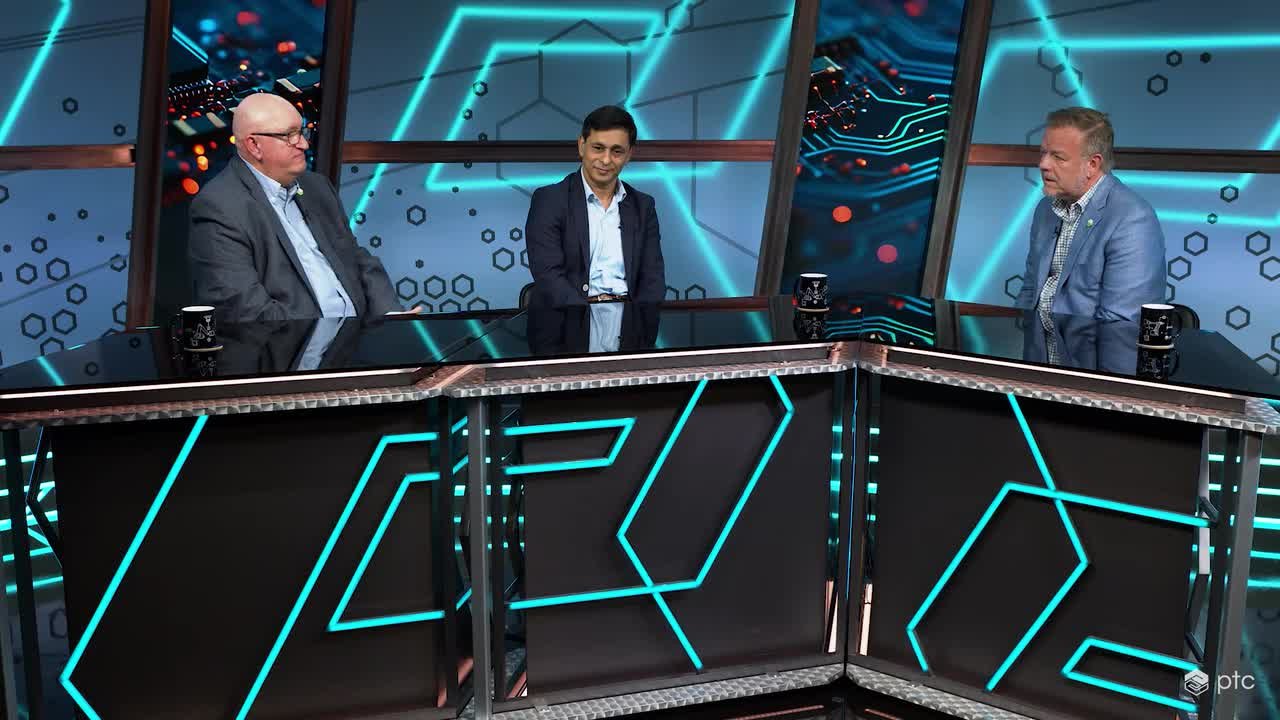
Reimagining PLM for High-Tech Innovation & AI Efficiency
00:05 Hello and welcome. I'm John Haller, General Manager of PLM at PTC, and I'm glad you're joining us for today's discussion, Reimagining PLM for High-Tech Innovation and AI Efficiency. Electronics and high-tech companies are under increasing pressure to innovate faster while managing greater product complexity, stricter compliance requirements, and growing expectations around AI. At the same time, many organizations are realizing that legacy PLM systems can make it much harder to move at the speed of market demands.
00:36 So to explore these challenges and opportunities, I'm joined by two experts, Sudhir Kumar from HCLTech and Tony Funderburk from PTC. Together, we're gonna discuss what's driving the urgency around PLM modernization, the capabilities organizations should prioritize, how AI is reshaping the product development landscape, and what it takes to build a connected digital foundation for the future. By the end of this conversation, you'll have a clear understanding of how modern PLM can help improve efficiency, support AI initiatives, reduce business risk, and enable faster
01:11 innovation without sacrificing quality. So let's get right into it and start with the big picture. So from both of your perspective, why don't you tell me what you think's happening in the market that's pushing PLM modernization now, from a future initiative to more of a near-term priority? So John, if you look at the market today, there are a lot of things happening in the market, you know. And, the most important thing is that products are getting complex day by day, you know. So, if you look at it, you know, products are getting connected.
01:42 They are, getting integrated with mechanical, electrical, electronic, software engineering piece of it, right? And, it's very difficult for legacy systems, you know, to manage such a complex data, and that's where we need a modern, PLM systems to come in play and ensure that there is a seamless flow of, data across the various systems. The other important point also is that, innovation. You know, everyone wants to launch their product faster, you know, so important is time
02:14 to market. When products are getting complexed, you know, there are a lot of, lot of compliance, lot, lot of quality checks which are coming into play. Legacy systems are unable to match that today, you know. And it's very important that we have a PLM system, you know, which can collaborate, which can integrate with various systems across CAD, across PLM, MES, or any of the, you know, ERP systems. And, that's challenging definitely with the, with the legacy systems today.
02:45 The other important point, you know, we talk about AI- which is, which is everywhere today, you know. And, AI needs a quality and trusted data, you know. And, when we look at the legacy PLM systems, one of the challenge was that they were not integrated well with the, with the many systems which existed in, organizations, and, data existed in isolation. You know, so there were many systems, you know, holding the data. There were no seamless flow of data across the system.
03:17 Now, as I said, AI is heavily dependent on the quality of data, you know. And if you don't have the quality data, you know, it's very difficult to scale AI in any organization. Now, that's very important, that we look at the data which exist in the system, and we ensure that, you know, it's seamlessly integrated with various systems across the organizations. That's my view, at this point of time. Okay. Anything you'd add, Tony? Yeah, I, I agree with, with
03:48 everything Sudhir says. I think e- especially at a macro level, what's going on across the electronic spectrum, I don't think it discriminates whether it's a, a telecommunications equipment company or a semiconductor company. It's, it's, it's, it's, it's across the entire spectrum. I think at a micro level, what's happened with a lot of these companies i- or a lot of the companies in the electronic space are You know, a lot of these legacy PLM solutions that we, we talk about, you know, they were implemented 25, 30 years ago.
04:20 Business has changed. Market changed. The complexity issue, I mean, complexity's a, a big thing. But at the end of the day, the, these companies are looking for specific business outcomes, right? They're You know, they'll always be judged by their speed of NPI, you know, bringing those new products to market. But now it's a lot more complicated than it used to be. It's, it's not just about speed, but you've got all these new compliance regulations as an example. You got cost to quality.
04:50 You know, you've got brand reputation. There's a lot of different factors that go into this business outcome category that we talk about that are really, really driving a lot of these, these decisions at, at these companies. I'd be interested in your thoughts also about, do you think the constituents have changed with PLM? 'Cause in the existing PLM implementations, it feels like when they might have started, they might have been very engineering centric, but do you see that changing as well? Yeah. You know, when you look at it today, there is
05:20 increasing demand in connecting engineering systems with the manufacturing- and then other, you know, other ERP or supply chain, systems. Legacy system did not have that flexibility- in past. But today we are flowing your, you know, engineering BOM to manufacturing BOM to service, you know, BOM. And that's very critical for, for any organizations to reduce time to market. All right. So when you talk with customers, where do legacy PLM environments tend to break down? I mean, is there any one particular area, process, maybe it's data?
05:52 Any other areas that you can think of? Yeah, I think, I think there's a, there's a couple of common denominators, with the, with the, with a lot of the companies that we engage with. I would say that- You know, one of the, the areas that, that we always kinda look for is, you know, how customized- are, are their existing systems. And one of the things that's been really kinda eye-opening is that we're finding out that a lot of these legacy solutions are heavily customized. And, and they, they were, they were customized to, again, to kinda just serve a, a, a
06:26 specific purpose, but now that the business has changed and, and maybe acquisition was made, it may not be as pertinent, and it's causing a little more friction. It's causing a little more, you know, headaches for them on a, on an operational basis. I would say because of that, what's happened kind of as a result, the, is a lot of shadow systems. A lot of non-integrated systems have been built, customized to support the, the core
06:57 PLM processes. So you've got a, you've got a lot of friction there. You've got older legacy systems heavily customized, and then you've got these disconnected, non-integrated solutions that are supporting the legacy system. So it's, it's kind of a, a series of dominoes that have kind of fallen over the, over the course of time. Yeah. Everyone's favorite alternative PLM system of Excel. Yeah. All the extra Excel s- sheets added, to support the existing process. Absolutely. And I completely agree, you know, with Tony's view here.
07:29 The, when the legacy systems were built, they were not built for such complex products. Right? And, a lot of customization's done over a period of time. You know, they were built, but if you look at it, today's modern PLM systems, what exists today, including the PC- PTC products here, you know, they are much more intelligent. Mm-hmm. You know, there are a lot of out-of-box functionalities which are available. So when you look at it, legacy PLM, they have grown over a period of time with customization. Now, today's challenge, the customer have invested heavily on these customizations, and
08:02 they're not getting real value out of this because every year they keep on investing on this customization. Sure. You know, and when you look at the modern PLM system, it comes with a lot more functionalities, and it can You know, today, if you want to change it, you will have to work on de-customization, so you invest more. You know, the m- better option could be that, you know, that we relook at the whole strategy of the PLM and move away, and then move away from legacy PLM to modern PLM system. To add also, then there are, systems like, you know, Agile, Oracle Agile, PLM,
08:36 which is, which is coming to end of support- you know, in next few years, and companies will have to really look at their entire, strategy now. It's not just a PLM, or technology transformation or migration, you know, at this point of time. You know, they will have to really look at their strategy and the entire digital transformation journey when they are changing the platform. Yeah. Yeah. Yeah, I would say in my experience, I've seen it just becomes a barrier to innovation because if I have all these customizations, then I can't actually change my process
09:08 because the systems that support those processes are fixed in a very rigid way, right? And just doing a, a simple upgrade is not even possible because of all the weight that a cu- a customer is carrying with, with all of these, individual customizations that have just built like a, a malignancy over time, I would say. Absolutely. Yeah. All right. Modernization can mean a lot of different things. In practical terms, what should a modern PLM strategy deliver for electronics and high-tech companies?
09:40 The most important thing is that, you know, when legacy systems were built, you know, they were built in silos. You know, so they were built for different business unit, different processes. Today it is different, you know? So when you talk about modern PLM system, you need to look at the business processes and the functions together. You know, you need to improve on, the process for the entire organizations. You know, that's engineering, manufacturing, quality, suppliers. Everyone uses the similar data or the same set of data which exist in the system.
10:12 You know, and all the organizations will have to relook at the, the activities which they delivered on daily basis, you know, and which could be their, you know, BOM management or change management, activities which, which cut across various functions. And, they need to deliver it in shortest possible time. Functionally, most of these customers, you know, i- inherently change, change process is really important. It's kinda the heartbeat of an electronics
10:43 company, so good change, configurable, getting that innovation through the cycle, getting it through the organization at an enterprise level as quickly as possible. That, that won't change. I think, again, a lot of these customers want more. I think there's a, there's another piece of this too that's becoming a bigger issue f- that a lot of companies are looking to as must-haves as opposed to optional, and I think
11:13 that's, you know, the quality and compliance piece. You know, so the cost of quality is really high. Brand reputation or access to market's really, really important to these companies, and with all the, the regulations and sustainability initiatives that, that are outside of the United States, that's, that's really important. But I think, I think one of the other things that we're seeing a tremendous amount of interest in is a lot of these companies are willing to take the next step, and they don't wanna be in the data center business or the IT business at all.
11:45 They want SaaS. Mm-hmm. They, you know, so when you look at the electronics industry and you look at our numbers, we're actually seeing a pretty exponential rise in companies that are willing to entertain, a SaaS strategy for, for PLM. So I think it's, it's part functional- Mm-hmm but it's also part technology. Yeah. I, I completely resonate with that. I mean, I think we're seeing- Net new customers to PTC in the PLM space, 80% of them are choosing the SaaS, uh- Yep solution over, over on-premise, which is very different from
12:17 the past. I'd also say though from a modernization strategy, the biggest thing that I hear, and, and actually we're seeing in, in customer RFPs and whatnot, is a whole of enterprise approach to PLM versus, a single function. A, a lot of, of the implementation that I saw in the past were, were for a function. It was either for the quality organization, or it was for the supplier organization, or it was for engineering. But the new way of companies are really trying to approach this is whole of company. How do I communicate all of this across the vastness of the enterprise and make sure that
12:50 we have a single set of product data that's, that's going across this? And of course, you can't, and especially in electronics and high tech, leave out the supplier along the way, 'cause you have to have that seamless collaboration, between, the OEM and the supplier to really take time out of the process and improve, improve quality. Yeah. So you mentioned already, AI. That obviously is a huge driver in every conversation, that I have and, and I'm sure you as well. But, before companies can really take advantage of AI, what foundational work needs
13:24 to be in place? According to me, I think data is the key here. You know, when you look at the legacy systems, data have been stored in silos, you know, in isolations in various systems today. And one of the major challenge, is that retrieving these data when you need it, you know, by engineer, to deliver some value to the organization. Mm-hmm. So the primary task would be to ensure that the data is trustworthy, data is quality, you know, and we ensure that, then we build AI on top of it. Yeah.
13:55 I th- I, I agree with that. I think, you know, o- one of the things that, that tends to get lost in today's world of, you know, everybody's talking about AI, and, and, and make no mistake, every company we engage with is thinking about and acting upon, you know, AI. I think wasn't that long ago that we were really talking a lot about digital thread. Digital thread is still alive and well, and digital thread is very, very important. It's about being connected, and I think that's what Sudhir was alluding to, right?
14:26 So I think that digital thread and, and digital connection are really, really important to get that digital foundation, as we call it. I would say, though, one of the things that we're starting to see too, that a lot of companies are thinking about is it's not so much the what happened and how it happened, but the why it happened. So there's, there's a lot of discussion now, and there's even some terms in our, our business called product knowledge, product memory- leading to product intelligence, and,
14:58 and they all play a role in AI. So for example, there's a lot of decisions about why a specific component is being used or why we made a decision on a specific, supplier. You know, all those decisions that get made hundreds and thousands of times a day, companies want AI to look at this and go, "Why were those decisions made?" So that you can mine that data, and so these models can learn, and so they can make faster recommendations on the back end. So there's a lot of interest in AI, and I
15:30 think it's, again, it's, it's really a lot of it's leaning towards the, the why. Yeah. I would say I, I see the same things. I mean, and this is really, I think, become very apparent at PTC just how important that, data foundation is, right? Well, all these traceability links, the relationships between change objects, the parts, the requirements, the downstream validation and test and quality. You know, we've been putting those things in place for a long time, but now AI just lights
16:00 it on fire, right? Like, it's, it's now suddenly all this rich information and how it's all connected, AI can surf that. I've seen some companies try to, to do things like just dump a bunch of data in a data lake and have, have, AI try to make sense of it, and it can't do it. Like, it's How do, how do you know the Is that the released effective version? Is that something that we did 10 years ago? Like, it's just all, is a jumble in a big data lake. But inside of a PLM system, suddenly it all starts to make sense. Yeah. Does that resonate? Yeah.
16:30 It, it's actually a wrong question to say that what AI can do, you know? We shouldn't really be thinking on that line. We should actually look at the business processes in the organizations- Sure and then decide on that what challenges exist in the system and how AI can help resolve those- business challenges. It's very important that we look at company's strategy for next 5 years, 10 years, you know, how the products are going to evolve over a period of time, and how AI can enable it or how AI can make it faster. Yeah.
17:00 So I mean, speaking of that, I mean, are you seeing any real practical AI opportunities, in the work that you're doing? There are many. There are many. And one of the, the simplest opportunity I would say that today engineer is spending lot, lot more time in, doing a search for the product informations, you know. They figure it out. There are systems existing in different locations, different geographies with different data, you know, and there is no one to help them to, you know, get the right
17:32 informations, which is a big challenge. AI can help that, you know? And modern PLM system can help, bring all these data together and ensure that engineer when he is working on designing or working on product informations, he gets the right data to start with. Yeah. Yeah. 100% agree. I think that there are some really practical applications. One of the things that we're hearing a lot though is, is the, is the, the notion of AI in the future will be the primary UI- Yeah for PLM.
18:05 So you know, I had a, I had an executive, make a really bold statement in a meeting recently where they said, "I, I love PLM. I'm a believer in PLM. We have PLM." But I don't want my people in it all day. And to Sudhir's point, you know, there's, there's a number of things that AI can do even on basic searches. Basic things that, you know, mundane activities, or, or I, I should say activities that can be considered mundane, AI's gonna speed that up.
18:36 It's gonna make it easier, right? And it's gonna make the user, but also those digital workers, those agents around even, even better. Yeah. So I, I think, I think there's a lot of opportunity for AI to become a, a primary UI tool- Yeah in the future. And then there are many other, areas as well, like the requirement analysis- and synthesis, you know, where, AI can help understanding the requirement, identify the gap, you know,
19:06 between the previous and the new requirements, and, you know, agree or disagree on the next steps that what need to be done. There could be area in the test data management. You know, AI, AI can help cover better data, and, there could be a area in the BOM side of it, you know, change management, where, AI can help you with the downstream impact of all these changes which- Sure is happening. All these repetitive tasks, I think we are capable enough now to build, you know, agents
19:36 who can really do these activities of documentation or repetitive tasks which exists today. Engineers should actually value or focus on, delivering values to the company. Values to individual, the- to, you know, organization. That should be the primary focus of them. Yep. All right. So y- both of you mentioned product complexity as a, as a big driver here. So what com- capabilities should companies really be looking for in PLM that helps them manage that product complexity better?
20:06 Yeah, I think, I think there's what I would call core use cases for electronics and high-tech companies, and I think a lot of it starts right up front with product definition, bill of material. We see a lot of customers who wanna not only make sure they can manage BOM, so to speak, but they wanna, they wanna create best practices around how to do that. Mm-hmm. Right? And a lot of that is driven from upstream.
20:37 You know, some of the things that Sudhir was talking about around re- requirements. But I think a lot of it's just, you know, core BOM management, core change management, suppliers, how do you manage the suppliers? Everything now is so supply chain-centric that when you evaluate PLM, you, you have to look at the impact that your supply chain is both making in how you design product, but also how you deliver that product as well, and, and where the constraints are.
21:07 I would say that without fail, if you look at it strictly from a functional perspective, it's, it's product definition, it's change control, suppliers. But the other one that you, you hit on a little bit earlier, which is really, really important, is this whole notion of supplier collaboration. Mm-hmm. The supplier portal, so to speak. Companies are outsourcing more and more, whether it's design, whether it's manufacturer, subcontracting, and I think one of the things that they wanna, they wanna be able to do is
21:40 bring their supply chain closer to them, design reviews, you know, sharing product structures, whatever it may be, in a very secure way. And then kinda going back to the AI discussion, they wanna know what the intent was. They wanna have a record as to why certain decisions were made. If you make something, bring something to market, and maybe it didn't go as well as you want, why did that happen? Yeah. Why were those decisions made? So I think it's, it's really, again, engineering's important, but it's really that
22:12 operational and supply chain aspect that I think really, really should be scrutinized when you're, when you're looking at, at PLM. Yep. So in the PLM world, we've talked about options of variance- Oh, sure and product families for a long time. Do you think that that, that is more important now in this increased complexity world? Yeah. There, there, you know, that complexity that we talk about is driven by the fact that there are more domains, there are more product options. You know, so absolutely it's, it's gonna be front and center.
22:46 We I would say five years ago, it was maybe a nice to have. I would say now it's more of a you gotta have it. Yeah. Yeah. The products have evolved, as I said in the beginning. You know, it was more mechanical, 30 years back, 40 years back, but today when you look at it, you know, they need to seamlessly integrate with mechanical, electrical, electronic software. Everything has to come together. And variance, that's how it changes. You know, and it's very important that, that, we have the integration also with the functions of the organizations.
23:17 You know, whether it's engineering, operations, you know, the supplier part of it, you know, the collaboration and all of them have to come together to ensure that they deliver quality product. Yeah. And I've seen several, customers where, you know, they'll sell the same product to multiple companies, but some of those companies may specify, "No, you have to use this supplier and this module," et cetera. And it's like using that capability of, of options of variance and being able to drive that, those decisions from the requirement stage all the way through, I think is a core,
23:51 thing that PLM really shines at, managing, you know, how do I reuse as much as possible, but get down to that s- specificity of, exactly what this customer wants, for delivery? No, absolutely. In fact, now we have ALM getting integrated with PLM, and then MES data has to flow right from the initial stages of the requirement gathering. It was not the case earlier, though. Legacy PLM systems were not designed for that. Yeah All right, so if I'm a, a customer that's, you know, new to this journey, trying to
24:21 figure out, okay, which, which way do I go? I, I want, I want the vision of, of a enterprise PLM system. You know, what should they be looking at first to, to get going, now so that it's gonna set them up for success over the long term? As I said earlier, the most important part is that I- identify your business challenges. Today you- if you know your business challenges, you can very well define the next set of actions, and then you can de- you know, define your strategy for next five, 10 year.
24:51 Your product is going to evolve over next five, 10 years, and you need to then decide on the technology and roadmap. So the step should be that identify your challenges, address those challenges, define your vision, business strategy, and then work on the roadmap and technology. Yeah, I, I'd say that the organization change management piece of this is always the biggest hurdle, right? Like, I w- I advise all the customers I talk to, do not treat this as a technology replacement, right? Like, you're not just ripping out Agile and putting in something pen for pen.
25:23 Like, you have to look at the business, process, the business strategy. I think you're, you're spot on there. A- if you think of just replacing, your old legacy system with the, with, with a new PLM system, you will actually start bringing in the limitations from the old, PLM system to the new one. Mm-hmm. And that is what you should avoid it at this point of time. Yeah, worst-case scenario is, customizing the new thing to do what you did in the, in the old one- Absolutely right? Yeah, I think, I mean, I think the, the OCM, the change management, is a Knowing that
25:53 upfront is, is critical. Mm-hmm. I think that really kind of lends itself though to something that I always recommend with our customers, which is the governance model, right? It's, it's like you gotta have executive sponsorship, you gotta have the focus on the outcomes that you're, you know, kinda going back to those requirements w- we talked about. I think the, I think the governance model is, is really, really important, and I think the You know, from a technical perspective, you know, one of the things that I think sometimes
26:27 gets lost is make sure that you do your homework on the technology from an openness perspective. Yeah. PLM does not live in isolation, so that integration that's come up a couple of times here, b- whether it's to ERP, MES, you know, whatever upstream, downstream systems are really, really, you know, important, cr- you know, mission critical- Mm-hmm that's really important. All of this kinda leads to, at the end of the day, user adoption. Mm-hmm.
26:59 So you want people to adopt the system as quickly as possible. You want them to be productive. Yeah. So I think the governance model, there's gonna be turbulence. You know, have a good governance model, a good OCM plan. I think that, that goes a long way. I saw one of our electronics and high-tech customers recently present, and I think they ended up They have 50 integrations now, 'cause it's like once you start realizing- Yep I do have this real source of truth of product data across the organization, there's just so many ways it can be used throughout the enterprise, and I think that, that's, that's a really good
27:31 point about the openness 'cause- Yep that's a critical requirement. All right, so now we're gonna ask a couple questions that came in, from the audience. So first up is change management. We've talked about it a few times. It comes up again and again as a top priority. Why do you think it's such a strategic center for PLM modernization? It's the heartbeat, right? It's, it's When you, when you look at a traditional electronics and high-tech company, you know, what i- what is the thing that, that, that gets- that plays such a big factor in, in,
28:04 in NPI, you know, in new product introduction? It's speed. Right? So change management, understanding, you know, the change intent, understanding why the change is, is, is really important, and then having that, that configurable, really easy-to-use governance model to, to make sure that everybody who needs to see it sees it, approve it, approve it. But it, it really is And, and without fail, in every engagement that we're in, every evaluation that we participate in, the folks
28:36 that are making decisions on PLM are really interested in the throughput. Mm-hmm. How easy is it to get from point A to point B, you know, with good governance? Yep. And so it, it really is the, the heartbeat. And that And a lot of times, that'll extend outside of the enterprise. So suppliers will be involved, ma- you know, contract manufacturers. So it's, it's a really important piece. I think the It's very important that, you know, when, when there is a change management happening, it We need to really identify, the impact on downstream.
29:09 And, we also need to look at from the AI angle here, there are a lot of things which are done manually today, you know, with this change management. And it's very important that we figure it out how AI can help with the movement of data between, you know, ALM, PLM, MES, ERP. There are a lot of things which are done manually, but now with AI, you know, a lot of tasks can be easier, and it can be integrated well and seamless flow of data across. Yeah, and then again, I think this is a big area where the enterprise nature of change
29:40 management really comes into, to play. 'Cause I think a lot of previous PLM implementations, again, might have been done on a smaller scale. But one of my favorite, slides that, that we talk about is, you know, change one part, but that part's in four products, and that product's made in- Mm-hmm three factories, and, you know, there's 20 tasks at each factory, and then suddenly you've got, you know, 250, 300 activities that have to be done to, accomplish that change. And again- Yeah this is something, the
30:10 complexity that PLMs- Absolutely was meant to manage. And imagine if all these systems are, working in isolation. We don't have to imagine. We see it all the time, right? Like- Yes. Yeah. So, um- Back to the point of integration, so that obvious- integration obviously creates gaps. I call it the white space, right? It's 'cause things get dropped when, when there's bad handoffs. So, what do you see the biggest challenge is in the, in the land of, integrations across PLM, ERP, ALM, anything else?
30:41 I, I would say f- first of all, I think there's an increasing interest, and I, and I think there is a gap. The, the management of requirements and marrying that to traditional PLM processes, really, really important. This is especially true now that, you know, 80% of the engineers in a high-tech company are usually on the software side. Right? So, so management of, you know, application lifecycle management, as we call it, the requirements, you know, the BRD, MRD, I think
31:14 that's been a traditional gap that was always handled in spreadsheets and, and, you know, SharePoint. I, I think that's one of the, the big opportunities, that, that's, that's in front of us. So I think that's, that's one. I think one of the things that, you know, it, it's Electronics industry's a little bit more challenging because so much of the manufacturing is outsourced. Mm-hmm. Right? Or, or it goes to a contract manufacturer, or
31:46 it goes to a fab. You know, I think that the, there, there's opportunities there again to close that, that gap. So and then, we're, we're working on some things obviously to do that. But the other thing that, that have, that's been mentioned a couple of times that I think is really important is getting the gap between these traditional what was kinda off the, the radar systems like compliance, getting that pulled back into PLM.
32:17 You know, you don't want expensive engineers chasing around full material disclosures- Yeah or supplier information because they're trying to sell something into Europe. Right. You don't want that, right? So I think that's a, a gap, and again I think there's we, we have a good story around that. But I think that, you know, there are some, some key business outcomes you can drive by filling those, those three gaps. When we look at the legacy systems, we had this challenge of integrations. All of, all these systems were developed, you know, only for one set of processes, one set
32:50 of activities to be delivered. But today I think we are far advanced. We have enough connectors to integrate it with, you know, with ALM to PLM to MES, and, other ERP systems as well. Definitely for, you know, high-tech industry we need to evolve ourself much more, but other industries we have done it in past. This is gonna take certain, some more time, you know, but we are, you know, moving much faster than, than what it has happened in the past.
33:21 All right, so we quickly t- touched on agentic AI. But h- how do you see that changing product development workflows over the next few years? As I said, you know, there are a lot of things which were done manually earlier. We don't need a lot of engineers to think on those manual repetitive, tasks, doing a search, doing, you know, figuring it out if there is a change management happening, what's the downstream impact on the product and all that. All these things can be done by agent today.
33:51 We can look at developing the agents who can manage these kind of changes, who can in fact, be assigned certain tasks now. You know, need not be acting as a just bot, you know, but they can be given a task to execute it as well. Yeah, I think it's again, I, I, we use this word a lot, but I think it's, it's a function of, of outcomes. And I think that when you look at the electronics industry, the change, as we call it, if you're going to create a change to an existing product, there's a lot of heavy
34:23 lifting that has traditionally gone on to figure out what the impact of that change is downstream. You know, am I gonna If I make this change, am I gonna eat $5,000 worth of inventory, or am I gonna eat 500,000? Right. Those are big, those are big decisions. Sure. Right? So I think AI actually has a lot of opportunity there to help make those decisions, and, and I think there's, there's gonna be a lot of interest in AI to actually act as an integration layer, you know?
34:56 So I think there's It kinda goes back to that, that foundation piece, right? You know, somebody s- I, I heard a quote the other day that said, you know, "AI, you know, will not allow you to outrun bad data." So we, we've gotta, we've gotta figure out a way to get that da- that digital foundation right, and that's kinda the fundamentals that we keep coming back to. So I think the opportunities are there, but you gotta have that digital foundation we, we talk a lot about. Yeah.
35:26 I think you're, you're right about the integration as well, 'cause I, I can see these agents talking to each other. I mean, we're certainly doing that across PTC products with, agents in CodeBeamer or Orbit or Windchill, you know, being able to talk to each other. But I can see this even across systems with, you know, pulling, having, asking in Windchill if I'm doing that change impact analysis, you know, what's the cost impact, and it goes off and asks ERP, "Well, how many of them are in the field, and what's the cost that, of that associated inventory?" Yep.
35:56 And so, so yeah, I think, that's gonna be, be a, a area ripe for agentic AI. All right, so what should companies be doing today then to prepare for this future AI-driven innovation? First thing first, you know, they have to look at their business processes, where they have the challenges. Mm-hmm. it's very important for them to identify the challenges which exist in their, business processes or the functions. Then only they can, they can work on the AI. As I said earlier also that, um- What AI can do is the wrong question to ask.
36:30 You know, what, you know, how can they resolve their business problems through AI is something which all companies should work upon. Mm-hmm. It's very important, they define their clear strategy, clear roadmap, product evolution, what is going to happen in next five years to 10 years, and then they should work on the PLM system because today what they develop in PLM system is going to be helpful for them tomorrow, you know, in terms of taking their products, to market and reducing time to market. So my suggestion is that, they should really look at the business challenges and work on,
37:04 AI solutions for that. Yeah. I th- I think, I think one of the things that would be really nice to say to, to a lot of the companies is, electronics companies is, be patient, right? But that's, that's never been, you know- That's never been, been the, been the style of electronics companies. They, they're, they're looking for every advantage they can to get product to market, you know, better and faster, and we really have to kinda help guide our customers with some best practices around this.
37:34 You know, there's a lot of companies who can't wait, so what have they done? They've gone out on top of existing systems. They've gone out and built MCP models, as an example. Mm-hmm. Not to get too technical here, but they've done their own MCP model, and that's fine, but how does that work when you have, you know, PLM modernization, right? Mm-hmm. So you've got a bunch of kinda, again, you're kind of going down this custom road. So I think one of the things is is when you're evaluating where you wanna go and what outcomes you're trying to, to achieve, look at it from a, let's get a good You know, we've
38:08 talked a lot about the data foundation, but let's also get, make sure the model is, is really, really stringent on governance, security- Mm-hmm and those types of things. That, and, and, and look to your PLM vendor to put a lot of those things in place, like the MCP models that are native-written for the PLM tool. So that's, you know, we have those discussions all the time, and I, I think there's a lot of interest on behalf of our customers and our prospective customers to see what we're going
38:39 to do there as opposed to, you know, being in a hurry and going out and creating a lot of custom one-off AI strategies. Yeah. So how should organizations then move from some of that early exploratory, that work that they've done trying to build these things on their own, into actually realizing long-term value from AI? I, I would, I would go back to what Sudhir said, and I think it's, it, it all comes back to where's the pain, which translates to where's the value.
39:10 I mean, is it component cost? Is it you got a new strategy for outsourcing to a new contract manufacturer? What, where's the, where's the pain? Mm-hmm. Right? You know, all of these systems, PLM, ALM, AI technologies, there has to be a value associated to it. So I, I go back to, you know, kinda where's the, where's the gap and where's the pain. Yeah. What are you struggling with? Yeah. Companies need to understand where are they spending money and time today.
39:41 Yeah. And once they understand that, you know, they can, I'm sure that they'll find a way to achieve the success. Yeah. To me, it feels like we've, we've seen this story before. Mm-hmm. Like, when additive manufacturing came out, it was like- Yeah great. Well, how do I know I'm actually gonna print the thing, the right thing, you know, right? Well, you gotta have your product data, in order, and, this is kind of that situation on steroids. It's like if you want the best outcomes from AI, you, you gotta get that product data foundation. You have to have those relationships defined. You have to have clear defined processes, right?
40:12 And AI's gonna build on that to, take it to the next level. I think that was a good discussion. I appreciate, you both sharing your, your insights and expertise today. I think one thing that came through clearly is that, you know, PLM modernization's just not simply about a technology upgrade. I think that got said more than once. It really is a strategic business initiative that helps organizations manage growing product complexity. So, you know, the more that we can apply PLM to improve collaboration across the digital thread and create the, the data foundation
40:45 needed to successfully scale AI, I think the more success that our customers are gonna see. All right. So to learn more about modern PLM strategies, be sure to visit ptc.com/eht. Talk to your PTC sales team, and certainly reach out to our partner HCLTech. Thank you again for watching.