Digital Engineering is Transforming NASA’s Strategic Priorities
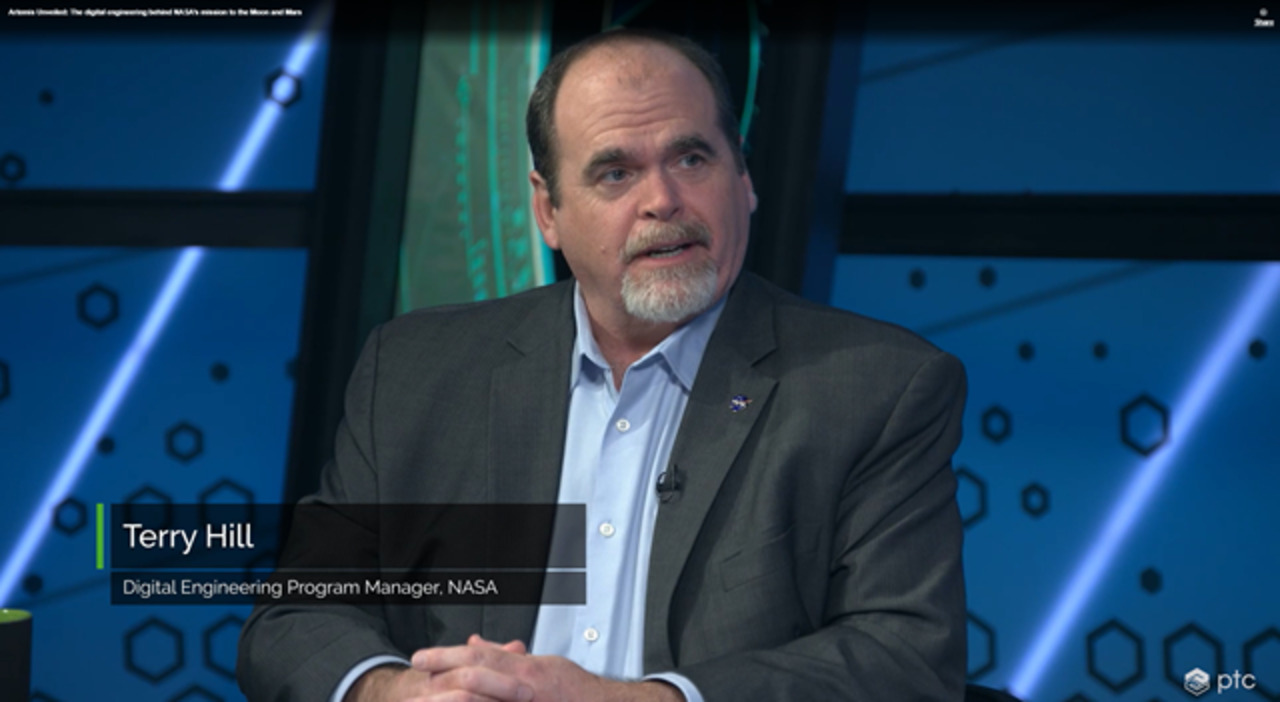
00:00 Hello and welcome from PTC's World Headquarters in Boston. My name is Alex Daly, and I am the Senior Director of Federal Aerospace and Defense here at PTC. I'm joined today by Terry Hill, a Senior Leader at NASA who is responsible for transforming the engineering domain. Welcome, Terry. It's great to see you. Thank you, Alex. His background, PTC is an industrial software firm with about 35,000 active customers across multiple industries. And what we're trying to do as a company is create a new generation of digital technology that offers transformational breakthroughs
00:31 in the way our customers engineer, manufacture, and operate physical products. The companies that make products the world relies on rely on PTC, and in many ways, our federal sector and aerospace and defense business embodies this idea. If you're a defense contractor, that might mean lowering R&D costs within a firm fixed price contract, accelerating product development, or taking down record backlogs. If you're a government stakeholder, that could mean faster IOC of a new platform
01:01 or increasing operational readiness of fielded assets. In the federal sector in aerospace and defense industry, our main customers are primarily the major defense primes in the US and the EU, as well as the Department of Defense, Department of Energy, and NASA. This helps to level set as to why we're here today, which is to explore the role digital engineering is playing in NASA's most strategic priorities. The Artemis Campaign is a multi-year program to return our astronauts to the moon
01:33 as a testing and training ground for the ultimate goal, placing a human footprint on the surface of Mars. Today, we're going to be discussing specific examples from the Kennedy Space Center in Cape Canaveral, Florida, in which digital engineering supports critical functions such as the final assembly of spacecraft and preparation for launch operations. Terry, what was it that brought you to NASA originally? It started with...in graduate school. My professor came to me and said,
02:03 Hey, we've got a project down at Johnson Space Center, NASA. Are you interested? I was like, Well, yeah, I am interested in that. One thing led to another, and I was picked up as a civil servant. As I say, the rest is history for the last 27 years. Wonderful. 27 years. So across that time arc of history, what changes fundamentally have you seen within NASA? The changes have been in the role and responsibility of NASA. Historically, we've been the integrator of all the different components and constituents
02:35 that come together to support the missions, be it shuttle or space station or what have you. Sure. What we're seeing now through NASA's success of reducing the risk and cost of space flight, the private sector now has a way to have this sustainable business model. Now we're seeing, as we return to the moon, the entire model is different, where we're leasing space on rovers and landers that are going to land on the moon. We've got assets that are going to be pushing and pulling
03:06 other hardware back and forth to moon. We're renting those, if you will. The entire business model is different. We are truly going back to the moon with our business partners instead of being the integrator of which they all fed into like we do with the Apollo program. Sure. Well, Terry, it's clearly a very exciting time right now in the space exploration world. I think that's an understatement. We've seen major milestones being hit by companies like SpaceX. Blue Origin just launched. New Glen, for example, very exciting.
03:36 Their Firefly Aerospace just had their mission to the moon. Artemis II is on the horizon in the very near future, about a year from now. A lot of people are thinking in the broader context of what space exploration really is all about. Really, where are we going from here? You think about President Kennedy's famous quote, We choose to go to the moon and do the other things. Not because they are easy, but because they are hard. Because that goal will serve to organize and measure the best
04:07 of our energies and skills. Because that challenge is one that we're willing to accept, one we are unwilling to postpone, and one we intend to win. What is it about the hard things that digital engineering suddenly makes easier? Yeah, it's twofold, really, because we have the capability to simulate create reality much more accurately than we ever could five years ago, 10 years ago, certainly more than we could 50 years ago, or 60 years ago.
04:39 A lot of the inherent risk that was not realized, either positive or negatively until launch day, during the Apollo program, we can now, with the computational capabilities and the simulation capabilities, look at a lot and mitigate a lot of those risks before they ever occur. The other aspect of this is we need to do digital engineering because going forward, the things that NASA are asked to do are not going to get any easier. They're only going to get harder and more complex.
05:09 To manage the complexity, we have to take on digital engineering to be able to do things within even a single career. But what I challenge people from a personal perspective as engineers at NASA, it's like, what if you could do return to the moon in eight years or less, go to Mars in eight years or less, do big projects like James Webb in eight years or less. In one single career, you could have a huge portfolio of really cool stuff that you worked on.
05:39 Makes things much more interesting. Yeah, and exciting, right? Well, as you had mentioned earlier in the Apollo days, we were in a build, test, fly, iterative approach, but now we've got to get it right on the first time. Could you expand on that a little bit? How digital engineering advances that idea? Yeah. Nasa has an expectation by the general public. There's a certain bar of excellence, right? And that's through our successes over the years. Sure. Now, that comes with the price that the public is not as interested in seeing failure, right?
06:11 Because it is taxpayer dollars, and we have to be cognizant of that. So moving forward, digital engineering is going to help ensure that as these missions are harder and more complex, that we live up to that expectation. Right. That's fair. When you think about mission safety, and of course, that's paramount in every mission, how is mission safety instantiated in the product life cycle within NASA? A lot of that has to do with, again, being able to do the simulations and the modeling
06:43 and the analysis that have to take place to ensure that we meet the margins of safety and the overall aspect of it. Now, if you want to talk about crew safety, that's a collection of not just one thing or another. It's an aggregation of the entire system, including operations, hardware, performance, and what have you. Being able to really have from a digital engineering perspective, it allows you to aggregate all of that information at any level to assess the risk and mission insurance
07:14 at whatever level you need to. Having a referenceable database in which you're able to check all of that information, I'm sure, is a supporter of that. Policy was another question that we had. I know the Department of Defense recently had a Department-wide policy for all acquisition programs in which digital engineering was required. Is NASA considering anything similar? Yeah, I guess the digital engineering 5000.97, I believe is what you're referring to. That came out about a year ago.
07:45 And we are looking at that from a NASA perspective, creating a similar, I wouldn't say policy document, we call it a procedural document, where it takes a lot of the language directly out of there, and where this is in the process right now, so that we can show the in alignment with what the DOD is doing, but yet tailor it and add in the specificity that we might need to make it meaningful for NASA. Right. I can certainly see that. Well, we think about all the missions within the Artemis campaign, and I know that they're going out easily into the 2030s,
08:18 it seems, beyond at this point. You think about program schedules and how digital engineering is able to help an agency like NASA meet and attain those remarkable and aggressive schedules. How does that work? Yeah, it's a critical element going forward because, as you can imagine, when you're doing things like going to the moon or to Mars, yes, we went to the moon, 60 years ago. A lot's changed since then. Sure.
08:49 We're not flying the same rockets. Right. So there's still a lot of unknown unknowns until day of launch. So digital engineering helps us with those what-if scenarios, play those out, run them with as high resolution as possible, but also it allows us to catch a lot of the errors and the mistakes before that time comes, because a lot of times what you see in schedule slips, it has to do with unforeseen technical issues that crop up. The more that we can do that analysis
09:19 and do the simulations and do the rack and stacks of the entire system, the more opportunity we have to catch the earlier on. Well, as we go to Cape Canaveral, zeroing in on that right now, you think about the vehicle assembly building, which is where the final assembly of all spacecraft happens. It's by volume, I think, the largest building in the world. You could get four copies of the Statue of Liberty inside this at the same time. That's how big it is. In what ways is digital engineering useful for the VAB?
09:50 VAB, it could be useful in as much that you could create a virtual reality copy of the VAB, which can help with fitting out all the infrastructure needed to assemble whatever vehicle is going to be assembled in there. Because there's a lot of scaffolding and platforms that have to be moved in and out of place depending upon where you are in the stackup and preparation for the mission. Creating that, you can see, "well, is this going to fit?" before you even cut any metal.
10:20 If you need to do logistics, like I need to move this asset over here and what have you, you can do the what-if scenarios with a high-fidelity in a virtual environment. Now, to really take the next step in augmented reality, which a lot of companies are leaning into, software companies, you can now overlay in terms of the facility. You can say, Well, this is where that component resides. This is where that service line, right? So for maintenance or training or outfitting or whatever,
10:50 you can really start linking your paperwork to the actual assets in place. One of those second and third order effects all that is the Crawler transporter, which is a feat of mechanization onto itself, 77.000 individual components in this. How is digital engineering used for that? We use CAD packages from several different vendors out there, and we happen to have the mobile launch platform,
11:20 the launch facility, the launch site, and also a volumetric representation of the SLS rocket all modeled up in Creo in one massive model where we can animate the deployment of the arm, the umbilical arm to the rocket and pull it back, gangway planks and what have you that coincide with the movement of the mobile launch platform. Again, we can use that for training purposes, for what-if scenarios, for safety, fit and form.
11:50 We did that initially really to see would it all fit? Because you don't want to find after you stack the rocket on the mobile launch platform, move it all the way out to the launch pad to realize you're an inch and a half off. That's a four-mile journey, as I understand it. And very, very slow. Yeah, I imagine. Well, so let's fast forward to launch day. I think about Artemis 2 in April of next year is the current schedule. In what ways is digital engineering data actually used in mission operations?
12:24 Right. So moving into the new paradigm, going forward, the plan is to have more and more of the engineering, the digital engineering models and data and certifications, all that available to the mission control staff. Okay. In a normal mission where everything is working as planned, it's always good to be quite boring. You don't want exciting days. Too much. But if you have a situation like Apollo 13,
12:54 where you're clearly off of what was planned, having your fingertips accessible, have that data accessible to you, to those flight controllers, to the replanners, to really see what's going on, what can be done, where things are, is critical. We created a digital twin of the Artemis I electrical power system. Okay. We did a what-if scenario like Apollo 13. What we found was if you know where all the documentation is
13:27 to do a power failure scenario, it could take on the order of a couple of hours to find what the root cause might have been. But what we found with the digital twin, using a systemal model and all the artifacts, we could use the same process and narrow it in on that same root cause in under 15 minutes. You're seeing an order of magnitude difference in terms of build, find the information. Then in critical situations, those seconds count. Oh, yeah, absolutely. Well, as you look across the long arc of the Artemis campaign
14:01 in the future and even beyond Artemis in the distant future, how do you see the role of digital engineering playing strategically within NASA as an organization? I think the digital engineering will help in that area in as much that if what we plan comes to fruition, where we go back to the moon and stay, understanding where all the assets are and all the associated technical information associated with it will help you not only in the mundane maintenance
14:31 and repair of a lunar base, but it also will help in understanding the planning and execution of growth and what-if scenarios, and just really laying out that evolving infrastructure. Is there anything in the mission, the actual conducting of an operation once we're in low Earth orbit somewhere, how digital engineering might be used in those scenarios? Having access all the baseline models
15:02 helps you understand and better inform your maintenance and sustaining decisions. If you need to make a repair or if you want to do an upgrade, you at least know where you're starting from because it mimics what's on orbit. Digital engineering also from an operations perspective could help with in terms of the crew being able to see ahead of time where all the pieces are. Like a lot of the models and capabilities you guys have here, where you can just to explode it and see the inner workings moving before you even take the panel off. Right.
15:34 So from a crew training perspective, a just-in-time repair is phenomenal. It's got phenomenal potential. Well, Terry, one thing we've been also thinking a lot about, of course, is the impulse toward efficiency, especially efficiency within government. In what ways do you see digital engineering accelerating that idea? Oh, that's a great question, Alex, because at least within NASA, we see efficiency being synonymous with digital engineering. The whole purpose of digital engineering and pursuing this
16:04 is that we can be more efficient. Well, it's not the only purpose, but a very big purpose of this is to be more efficient, but also to, again, address the risk, and the unknown unknowns. Try and reduce that as much as possible because, again, like I said, I say to everybody, if we can do more cool stuff in a shorter period of time and still may increase the safety, increase the reliabilit and the quality, then that's what it's all about.
16:34 By using digital engineering, we can do things faster, which inherently is more efficient. That's what we all want to do. We see digital engineering as the cornerstone to achieve that. Right. Many of our customers at the executive level are really focused on three things: policy, culture, and scale. How do I get the ability to roll out the structure and repeatability of a policy? How do I get my culture right to the true north to actually get this done, and then the scale to roll this capability out across all the constituents
17:06 who need to use it, those three things. On the scale front, you've deployed a digital engineering capability within your own engineering organization, but how do you roll that out throughout all of the other NASA centers? Yeah, that's an important question to ask. My responsibility within NASA is to move the needle of digital engineering across all the different NASA centers. Okay. We're taking this journey together. But it's also important that NASA works with our aerospace and defense industrial partners. Okay.
17:38 Also solution providers for the tools that we need. We all need to do our jobs. We all need to take this journey together to be successful because it's a critical element in terms of overall efficiency that we need to gain in terms of schedule and reduction of risk that we've spoken about. But also putting in the infrastructure, the interoperability and the common sources of data and information that all the different parties that are going to be involved in this endeavor to return to the moon have to play.
18:09 Because, again, we're not going by ourselves. Our industry partners are a big part of this return. Of course. We got to share that information from an interoperable perspective and from a common data format so that it builds in all the capability we need. How do you see vertical integration playing out there? I know Dave Limp, for example, at Blue Origin has I've been talking a lot about how his organization has become vertically integrated. B4 is one example, but there's many others. In terms of this work share between government and all the industry partners,
18:41 how do you see digital engineering facilitating that? Having the capability to pull in the data from the vendors, depending on what's put on contract, but assuming that we get receipt of the models, the hardware, schematics, or what have you, we can then pull that in. From a NASA's perspective of playing the role of integrator, we can make sure the different bits and pieces coming from the different vendors fit, and make sure they all operate as expected prior to receipt,
19:13 because in some instances, the first time this hardware touches each other will be on the surface of the moon. So understanding that way ahead of time is critically important. Yeah. So, of course, a very large component of NASA's mission includes national security missions. How are you thinking about your partnership with the DOD as it relates to digital engineering capabilities? Yeah, that's an important part that we're looking at. I'm working with my counterpart at the Department of Undersecretary Defense in the DOD,
19:46 particularly in terms of interoperability, because having our tools work properly and exchange information as expected is going to be critical. There's a lot of industry standards in that area. We are working with them to create what we refer to as the subway map of data flowing between different subdomains with engineering and the appropriate interoperability standard that's out there that meets the needs. The goal is that between NASA and the DOD, we can publish this roadmap,
20:19 if you will, of all the standards that our solution providers need to be compliant with to help ensure our mission objective. Terry, how do you see digital engineering accelerating the strategic goals of artificial intelligence within NASA? Digital engineering is ripe for bringing in that technology and leveraging it in as much that one of the key things we have to be cognizant of as we're building out our digital ecosystem, if you will, and the tools that we put in place.
20:50 But more importantly, how we capture and manage our information, the support of our processes, to make sure that that data and those models are both human readable and machine readable to ensure that we can then leverage the AI technology now and in the future to augment our workforce and to further really develop out our capabilities. Excellent. Is there any plans to use AI within mission operations itself, or is it still early days there?
21:20 Still early days, but a lot of the things that AI are emerging to be good at is to analyze huge volumes of information in times, in the seconds that we can never do as humans, right? Sure. So even at the very minimum, using it to really process data, trend data, see how it compares to our operational requirements and what have you, and just as early warning system, at a very minimum. But of course, the sky's the limit from there.
21:51 Now, the key thing is, figuring out where you can inject that technology in ways that are both ethical and don't sidestep the importance of humans being part of this process. Sure. Thank you. I think we can wrap it there. Terry, thank you again for the continued partnership with PTC. Thank you again for tuning in today. This session has been recorded, and we will be posting it online. To learn more about PTC's capabilities in the federal aerospace and defense sector, please visit our website or hit us up on LinkedIn.
22:23 We hope to see you again soon. Thank you