The Current State of Environmental, Social, and Governance (ESG) Regulations
ESG regulations are constantly being added and updated. Since 2019, 108 new ESG laws have been passed in Europe. In the U.S., 33 states have existing or pending Extended Producer Responsibility (EPR) laws, with California leading the way.
Of these regulations, the most comprehensive is Anti-Gaspillage pour une Économie Circulaire (AGEC) in France and the in-progress Digital Product Passport (DPP) legislation in the EU.
Translated, AGEC stands for “anti-waste for a circular economy.” Any company with annual sales of more than 10,000,000 Euros and 10,000 units must comply with this law. The law is intended to promote a more sustainable economy through greater transparency to consumers about the environmental impact of products sold in France.
At a high level, AGEC focuses on providing the following information to consumers:
- What went into the product and where did it come from?
- What impact does producing this product have on the environment?
- Can the product’s packaging be composted or recycled?
- How can this product be recycled or disposed of?
A DPP will be a digital record providing detailed information about a product's sustainability and lifecycle, particularly relevant within the context of the EU's Ecodesign for Sustainable Products Regulation (ESPR).
The EU has identified four primary goals for its DPP legislation:
- Ensure that actors along the value chain, including consumers, economic operators, and regulators, can access product information relevant to them
- Improve traceability of products along the value chain
- Facilitate the verification of product compliance by national authorities
- Include the necessary data attributes to enable the tracking of all substances of concern throughout the product lifecycle
The EU Battery Regulation 2023/1542 came into effect in 2023, which mandated a future DPP for certain batteries placed on the EU market. The DPP requirement of this new regulation covers electric vehicles (EV) and industrial batteries and is scheduled to become a legal requirement in early 2027, with the intention of being the first of several DPP requirements covering other types of goods.
The EU Commission is still mapping out all the DPP requirements, however, it is expected that this legislation will require the following information for each battery to be electronically accessible to a consumer, most likely through a QR code: material sourcing details, carbon footprint, percentages of recycled materials used, durability, and circularity details. From a reporting standpoint, companies will need to verify that each product complies with ISO/IEC 15459:2015 standards, provide all details about the product’s materials, origin, and production, and then make the information available in a structured format that is readable by a machine.
DPP requirements for textiles, furniture, and toys are not expected to be finalized until early 2027, with enforcement taking effect 18 months later; however, the four goals stated above point toward requiring product information similar to AGEC, including:
- The product’s use of sustainably sourced materials
- A breakdown of the countries of origin of the materials in the product and whether that information can be fully traced throughout the supply chain
- The presence of dangerous substances or microplastics
- Circularity details that focus on product usage and end-of-life details (e.g., takeback programs, reuse, and downcycling efforts)
- Manufacturing processes and dyeing techniques for textiles.
The central challenge: consolidating sustainability data
Industry commentators have stated that: “Sustainability isn’t a software feature. It’s a system architecture challenge. Too many fashion companies are tracking ESG data in isolation—with disconnected PLM, ERP, sourcing, and reporting tools. But ESG regulation (like ESPR and DPP) doesn’t care where your data lives. It only cares if you can prove it. That’s why integration matters more than features.”
The diagram below highlights this complexity. Each arrow represents a data flow that would be mirrored by an integration between different platforms. A product lifecycle management (PLM) solution, such as PTC FlexPLM®, is the ‘glue’ that connects the overall sustainability and compliance landscape because it serves as the single source of truth for this data:
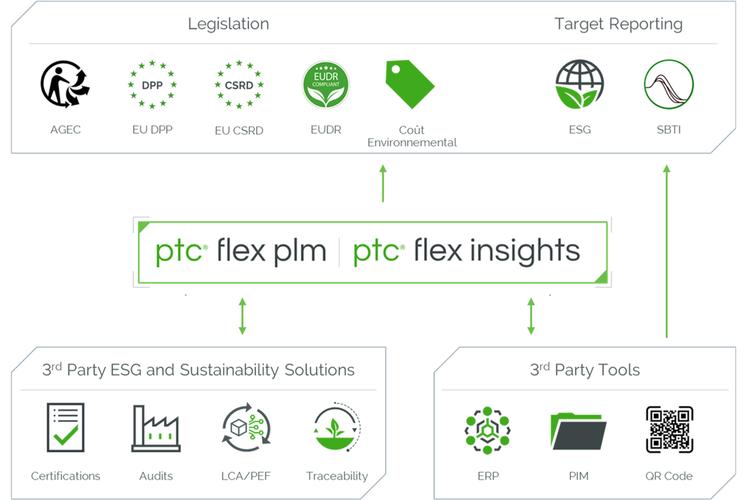
PTC’s FlexPLM solution directly integrates to third-party sustainability solutions, including certification bodies (Textile Exchange, Forest Stewardship Council (FSC), Leather Working Group (LWG), environmental impact assessment tools (Glimpact), traceability solutions (TrusTrace, Made2Flow), material and supplier assessments (Higg MSI, FEM from Worldly, Inspectorio), and lifecycle assessment (LCA) tools. Most of these integrations involve passing attributes and KPIs to FlexPLM, such as:
- Normalized water and energy use and greenhouse gas (GHG) emissions from an LCA
- Facility scores from a social compliance audit or environmental management systems (EMS) assessment
- Material certification details (including expiration date or percent recycled content)
Note that it is important for a PLM solution to have bidirectional integrations to third-party sustainability solutions as part of this overall landscape. As an example, PLM data serves as just one input into a traceability solution, passing its key product, material, bill of materials (BOM), and supplier data since traceability solutions also require purchase order details generated by an ERP system to facilitate the trace.

Connect with us today
Have questions? Contact us today to speak with our sustainability experts.
Contact Us
This blog was co-authored by Brad Thomas.