The French Eco Score, now officially known as Environmental Cost (“Coût Environnemental”) is a labelling system mandated by the French Climate and Resilience law designed to communicate the environmental impact of clothing and textile products to consumers.
The Coût Environnemental came into effect on October 1st 2025. If you are selling apparel with a textile content of over 80% on the French market, this labelling law applies to you. Note that footwear, leather-based products, and accessories are currently excluded.
It will be voluntary until October 1st 2026. After this date, it will remain voluntary, however, at this point, if you don’t label your own garments, other third parties (like environmental groups, journalists, and comparison websites) can submit calculations on your behalf. Though not a legal requirement, this setup creates a strong incentive for brands to calculate their own scores, because scores calculated by third parties may often result in higher Environmental Cost scores, adversely affecting both product sales and the brand.
The scores also need to be displayed on retailer’s websites and be published onto the French government’s declaration portal.
The Coût Environnemental label itself must follow strict design guidelines, and it needs to be tailored to reflect, for example, the potentially different environmental impacts that dyes and dyeing techniques may have on the garment which can affect the overall score between colourways. This means that each colour of a product requires its own score, and the score must also be based on a single representative size which is used as the benchmark for the entire size range of that colourway.
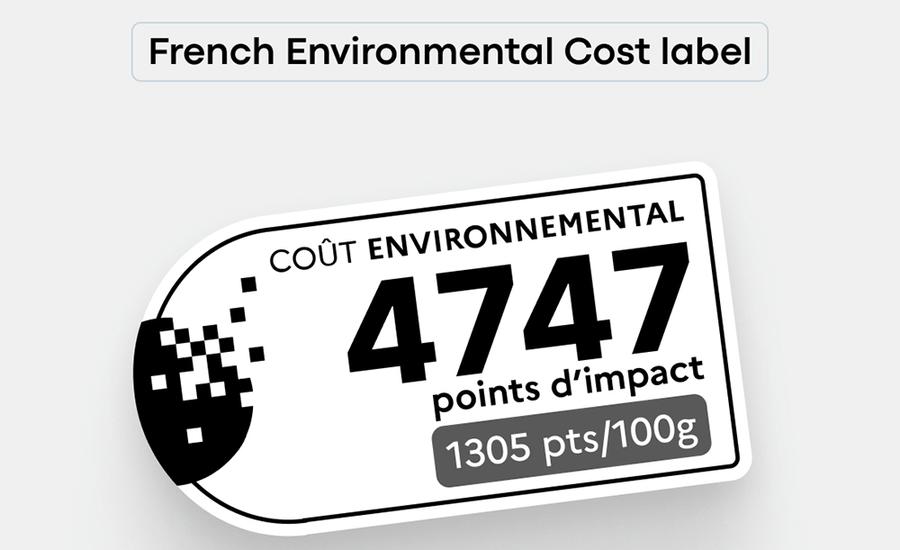
The Coût Environnemental score itself is calculated based on a comprehensive Life Cycle Assessment (LCA) that considers 14 key environmental indicators throughout a product's entire lifecycle, from raw material extraction to end-of-life.
These indicators include greenhouse gas emissions, water consumption, land use, energy use, mineral resource use, impact on biodiversity, microfibre pollution, and toxicity to humans and other life.
It is important to note, however, that in contrast to the Product Environmental (PEF) Framework adopted as a reference by the EU for the existing Ecodesign for Sustainable Products Regulation (ESPR) and the Corporate Sustainability Reporting Directive (CSRD), the French Eco-Score is calculated using an alternative environmental assessment method known as ‘Ecobalyse’ which is an initiative specific to France.
Industry commentators have noted key differences between the PEF and Ecobalyse methods including utilising several different indicators, with, for example, the latter ignoring physical durability and using default, less precise and more generic data.
Overall, the Coût Environnemental has been developed in France as a national initiative (independent of the EU who continue to work towards their delegated act for clothing using the PEF methodological framework through adapted PEFCRs) in an effort to encourage brands, retailers, and manufacturers to adopt eco-design practices by providing transparency about the environmental footprint of their products.
It is also important to note that the EU are planning that their ESPR/PEF framework will ultimately become mandatory throughout Europe and replace national initiatives such as the French Eco-Score and their use of Ecobalyse methods.
How PTC can help apparel brands achieve French environmental cost compliance
Management of many of the key indicators are already supported ‘out-of-the-box’ by PTC’s retail PLM platform, “FlexPLM®,”. For example, information relating to product category, overall mass and recycled content of the finished product, fibre composition, and the nature and percentage of raw materials can be stored (with BOM rollups calculating totals) within FlexPLM, and used not only for Environmental Cost purposes, but also with retailers’ AGEC calculations (France’s already existing “Anti-waste for a circular economy” legislation).
Many retailers already work with sustainability metric providers such as Worldly and Glimpact, and PTC’s unique Flex Connect integration platform can be used to centralise data encompassing all 16 environmental indicators required for compliance within FlexPLM.
Industry commentators have stated that “Sustainability isn’t a software feature. It’s a system architecture challenge. ESG regulation (such as Coût Environnemental) doesn’t care where your data lives, it only cares if you can prove it. That’s why integration matters more than features.”
The diagram below highlights this complexity where the new Coût Environnemental sits alongside existing PEF or Ecobalyse calculations. Each arrow represents a data flow that would be mirrored by an integration between different platforms. A product lifecycle management (PLM) solution, such as PTC FlexPLM, is the ‘glue’ that connects the overall sustainability and compliance landscape because it serves as the single source of truth for this data:
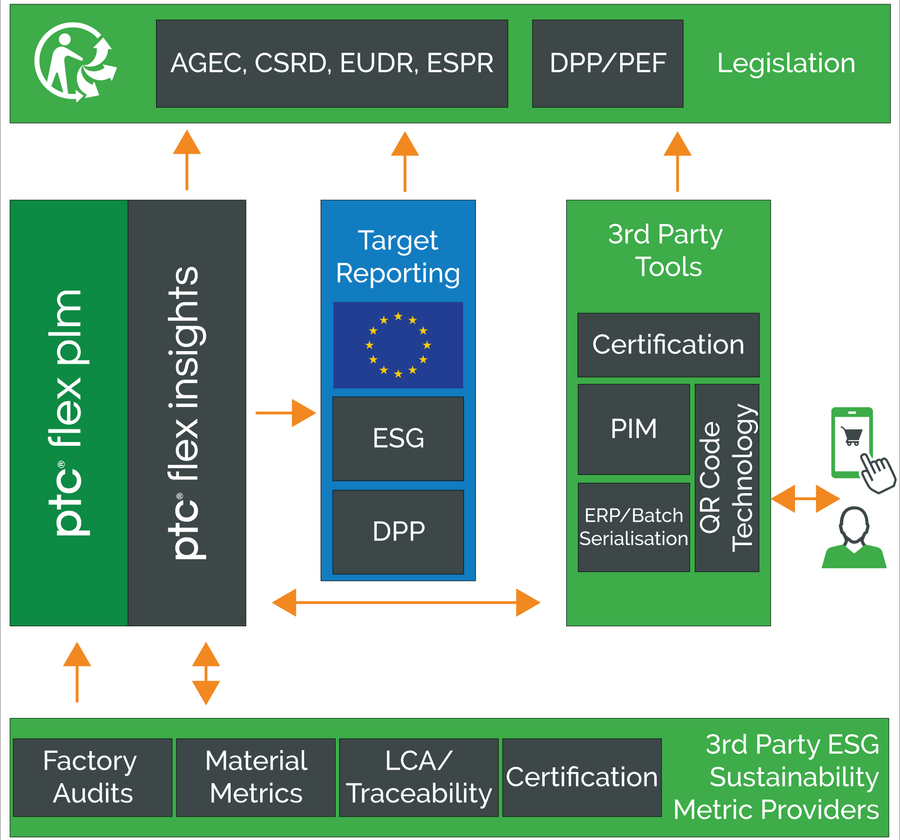
As the final ‘piece of the puzzle’, PTC’s analytical dashboarding platform Flex Insights can be utilised to draw all this information centrally. For example, brands and retailers can use the ‘Environmental Impact’ Flex Insights dashboard to give a top-down holistic overview of all sustainability metrics associated with products, colourways, materials and suppliers, and to drill into and review each of the 16 environmental indicators required for Coût Environnemental compliance.

Connect with us today
Have questions? Contact us today to speak with our sustainability experts.
Contact Us