Tangible Strategies for Improving Product Sustainability
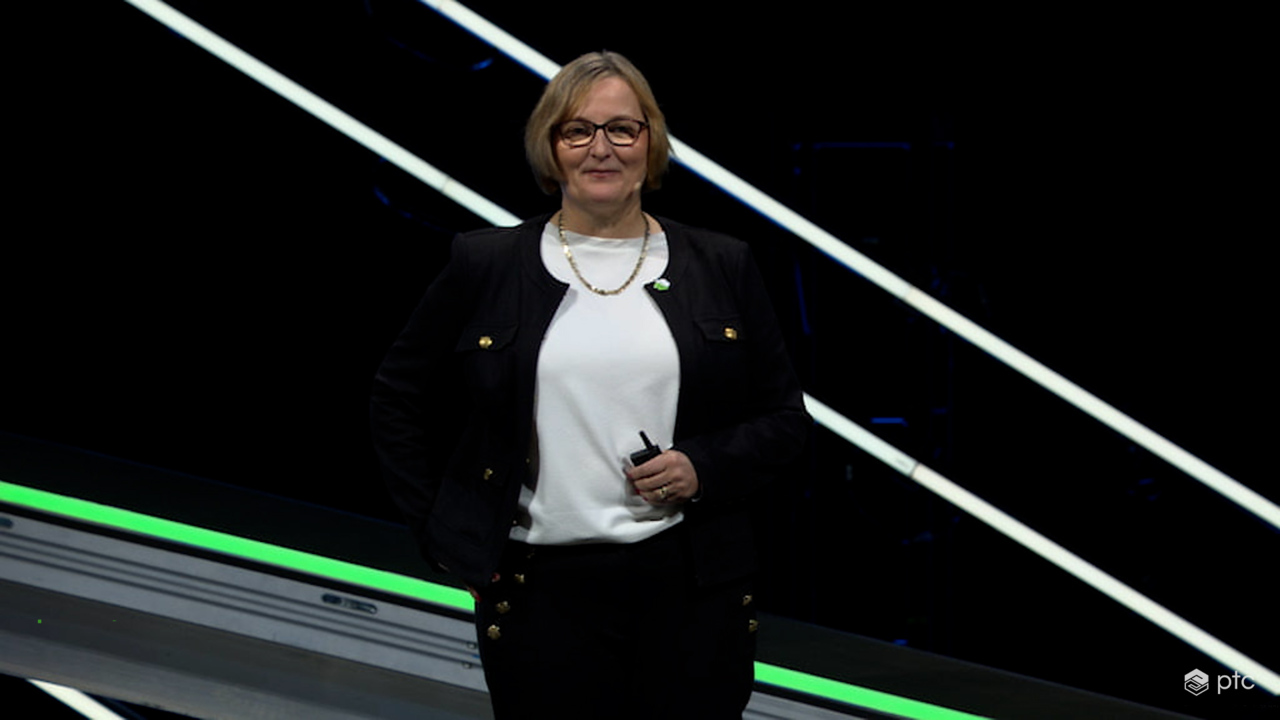
00:08 Please welcome Executive Vice President, Chief Strategy and Sustainability Officer at PTC, Catherine Kinnear and Vice President of Sustainability at PTC Dave Duncan. Wow. I got my groupies. That's awesome. Maybe . Maybe it's a rock concert, Dave. We should. We showed up a little earlier,
00:40 and so great to get a chance to talk with all of you again this afternoon on one of my favorite topics, environmental sustainability. You know, it's no secret that we are at a critical moment in the world where we need to make significant changes to the way we live and how we produce products. You know, the problem probably doesn't need restating with this audience, but put very simply, we're destroying our wonderful planet.
01:13 Now, from a materials perspective, we're using way more than the Earth's capacity, and waste is at an all time high. Hey, you know, for those of us focused on the manufacturing sector, we know that 54% of global energy consumption is consumed by this sector alone. So it leaves huge, huge room for improvement. Now, there is some good news because there is
01:43 an incredible desire out there to solve this problem. Businesses and consumers alike want to buy cleaner products. Employees put sustainability as a top criterion when choosing which company to work for. And manufacturers are really showing that they believe that there's value to be driven by focusing on their environmental programs and their environmental initiatives. And they're focused really on three key areas . The first is D materialization.
02:17 That really means using better and less materials in the products that they build. And the second is energy efficiency. So using more efficient, energy efficient methods in production, in logistics, in operations and in service of the products that they make. And the third is that they're really focused on reducing waste again, reducing waste across production, across the servicing of the products, and actually really importantly, reducing waste at the end of a product lifecycle.
02:52 So I am thrilled this afternoon to be joined here with Dave Duncan, our VP of Sustainability. Dave is our expert and he is driving our strategy here at PTC for both our internal initiatives and our customer facing strategy around sustainability. And I both of us hope that by the end of today's session, you'll be convinced of three things.
03:22 First that PTC is really committed to sustainability. Second, that we actually already have a portfolio of solutions across the entire product lifecycle that are delivering meaningful results and we're investing in other areas. And last but by no means least, that sustainability isn't just good for the planet, it's also good for business. So, Dave, let's dive in and start the conversation.
03:52 Yesterday we announced that we were committed to the science based target initiative for both short and long term reduction. You want to share why that matters to everybody here? Yeah. Yeah, happy to. Let's dive into it. So what you see up here is the science based initiative chart for a rapid decarbonization. And it may be familiar to some, but unfamiliar to others. So I'll take you through the high points which you see on the top left is
04:23 an initial inventory of our emissions that we have at PTC, which we've estimated fairly well. And the first thing that we need to do with this commitment is called the easier half. Effectively, we need to remove about half of that emission emission oceans by 2030, using technologies and commercially practical ways that already exist today. We also commit to the long term target, which is net zero, which takes down the second half and about 10% is allowed for offsets
04:53 on that second half. And some of that will involve some technologies that may not exist today or may not be commercially practical. An SBT will audit on a regular basis to keep everybody honest. Yeah, that's right. So we have up to two years to have our whole plan verified. And then annually after that, they'll do a check in with us to make sure that we're marching down that curve effectively. And yesterday we mentioned that it's really important.
05:23 Our commitment is also really important for our customers. You want to explain why that's true? Yeah, absolutely. So companies need to include some of their suppliers sins in their carbon accounting. So, for example, if we have a customer that say, has R equal to 1% of PTC revenues, they need to score 1% of PTC emissions as part of what they call their scope three. And a lot of our customers are already committed on this trajectory.
05:55 So now that we are, they can score us as hey, PTC proportion that we need to score will go down one half by 2030 and then eliminate on the same slope that we're taking. So we're a supplier that they no longer have to worry about for carbon abatement. Got it. How complicated would you say our measurement and reduction commitments are relative to those of our customers? Yeah, well. We use the same accounting standards, which is the greenhouse gas protocol.
06:26 We use the same reduction frameworks that the science based target initiative guides us on, as well as the same disclosures like CDP, soon to be CC'd in Europe. So that helps us walk in our customers shoes because we're living through it and then we can help our customers with the easier half. And we'll go through a lot of those examples today with technology that already exist and also prepare for that harder half, which will require more thought and development. But yeah, it is easier for us at PTC to do this or a little less complicated
06:57 because we don't manufacture physical goods, so we don't have loading dock at our factories where we're taking on a bunch of embodied carbon from suppliers. And nor are we shipping a physical good that continues to use substantial energy that we ought to have to count. For as well. So for sure, like physical products have larger and more impactful footprints, maybe. I think it would be really helpful. We have a chart on the next slide to walk through what that looks like for our manufacturing customers and give people a sense of of.
07:29 Yeah, yeah happy to. And it kind of from this morning's keynote this would be our contribution to liquid networks. So if you're a sustainability expert, you would look at this chart and say, Aha, that's a life cycle inventory with energy and material flows, which is a type of diagram that they usually start with when they're doing life cycle analysis of products. But for most of us here being digital industry experts, you can look at this say, Yeah, it makes sense to me too. We have buy parts coming from suppliers.
08:01 We have make parts coming from material suppliers. They come together in a factory and it could go through tier two, Tier one, ultimately OEM to operate in service, ultimately to end of life and some circular opportunities to bring that material back. One point there is that in the factory you may think that, Oh, that's where all my emissions are as a manufacturer, but in reality most of our manufacturers, it's on the sides,
08:31 the upstream and the downstream, where 90% that 99% of the total emissions exist. Yeah, it's the place where people. Will see all the energy being used, but it's not actually where the true driver is. So with that framing in mind, I think it would be really helpful to walk through the product lifecycle and really from design all the way through to end of life. And we'll share some examples with you,
09:01 all of what's already been done and maybe some promising areas for further focus as well. And I think any of you that were at the keynote yesterday, Jim, mentioned that 80% of a products footprint is determined by decisions made back up in the design phase. And so maybe explain that 80% , Dave. Like what? Where does that come from? Yeah, we hear about 65% to 85% are with design decisions.
09:32 But overall it's pretty high because products are made out of materials and embodied carbon is such a big piece of that. And for some energy intensive products you have to make design decisions around how they use fuel or energy downstream as well. Yeah. So I mean, it sounds like sustainability is going to make the life of a design engineer a lot more challenging. Yeah, absolutely right. You used to try to balance performance and cost and maybe a little bit of time to market, but now you're adding footprint to the equation,
10:04 so it rapidly becomes a plate of marbles that you're looking to balance in a multi-criteria sort of way. But the good news is, one, there's technology that can help there. And secondly, it's motivating for engineers to do this, like they all want to be able to reduce footprint and reduce costs and measurable ways in their jobs. So definitely a challenge given the importance and the impact of choosing materials supplier. Yesterday we announced that we were expanding our partnership with Ansys. Right.
10:39 Let's give folks here a little more detail on what that integration looks like and why we're doing that. Yeah, absolutely. So, you know, material's front and center in design decisions and has been for a while for performance cost and appearance. But what is really pushed it to the forefront where designers need to get involved earlier in the design process is now because of all the embodied carbon and hazardous material regulations, recycling possibilities that are involved in that now, particularly as companies are making those commitments.
11:09 So Granta offers a curated material database that comes with thousands of reference materials. Customers can add their own supplier specific material variants on that, as well as their custom materials. So it helps engineers find better material and then ultimately better suppliers of that material, because suppliers also innovate in different ways to take footprint out of product. So let's take a quick look at this video.
11:39 So as you see here, there's a user that starts in Creo and then they punch out to the Ansys Material Gateway database, which is purpose built for design engineer to use. And they select parts that the material engineers allow them to see based upon whatever criteria they want to like density or footprint. And you see here a list of candidate materials return and they take a closer look at titanium, where they could see attributes, gross appearance,
12:09 performance, footprint, other things. And they say, okay, great, you know that titanium is something that I want to use in this turbine part. So they select it to go in their project and then they subsequently add that to the specific parts that they want to include that titanium and to include this turbine. So next they go back out to Creo. And within Creo. Now you can see that the grants material ID is properly linked. And part of the digital threat is as a high quality reference on that Creo design.
12:42 And this integration works similarly from Windchill as well. Great. So Grant definitely helps with sustainability for these. I'll say make parts, but what about pre-built components or buy parts, right? So there's been a strong market of supplier component databases for a while that both Arena and Windchill have integrated with. Some of these include ascent compliance map silicon expert octo part,
13:14 which is now part of Altium IHS Markit and this the trigger for design engineers get involved with this earlier were hazardous materials like reach and rose compliance but more and more the these electronic suppliers are including embodied carbon in their data as well. So that helps with the footprint roll ups and decisions that designers can make. And it's mostly electronics focused now with these catalogs.
13:47 But now that embodied carbon is such a big deal. We expect this market to expand into other areas and we'd be able to integrate in similar ways for sure. So with environmental impacts of mining and material processing, it's great to see that this is now like an integral part of the digital thread and digital transformation decisions, but it'll also drive other values like performance, simulation and manufacturability planning.
14:18 Speaking of manufacturing, yesterday we also announced that we had expanded our partnership with aPriori, and this complements what we're doing with Ansys really nicely. You want to take everybody to that ? Absolutely. So granted, does a good job of giving you your cradle to gate footprint that you get from your material as it gets to your shipping dock and your factory. And where aPriori helps is in several ways, not only estimating the footprint that would have happened during the manufacturing,
14:49 but also is it manufacturable to begin with and how much will it cost? So it helps you with those trade offs. And the way it does that is it takes material definitions and geometry from CAD and PLM, and it runs a simulation with our digital factories and returns a scorecard that tells you how well you're doing. But more importantly, it prescribes ways for it to improve. So let's show you an example here. So in this scenario, aPriori can run a batch job.
15:21 It could be daily, it could be more frequent. That's based upon checked in or state changed parts within Windchill. And here you can see most of the chart, Most of the parts come back. Okay, but there's one that has high risk. So here the part owner in Windchill can look at this report and they can click on a hyperlink that takes them into the aPriori AP design product, which is also purpose built for a design engineer and figure out, well, you know,
15:51 why is it why is the score high on this? And here it's because the inside diameters too tight for quality milling which can result in unwanted scrap rates. So it recommends here that a sounder quarter diameter to be made, they go back into Creo and reasonably quickly they can make a better inside angle that's a little more gradual on the inside there so that the scrap rates will go down and interactively they can punch right back into a design and rerun.
16:23 It said, okay, you asked me to fix this. I fixed it. How does it look? Great. The red is gone. So they fix that problem and subsequently they can look at all the other data that they get back from that simulation to see if there's any other tweaks that they want to make to it. They can look at Manufacturability cost footprint and here they find a less severe but a tweak that might be worthwhile in terms of potentially removing some material to get a smaller angle on the on the part, which makes it easier to manufacture and dematerialize a little bit, frankly.
16:56 So there's great there's a lot of value here for running this subroutine. Definitely worth investing in. All right. So Granta or Ansys, Granta and aPriori both help with material selection, but reducing the amount of material is also another significant driver of sustainability. Yeah, it sure is. And let's show an example. Here's a 44 pound motor mount of a Volvo truck.
17:29 Its supports at 11 liter engine that weighs about 2,000 pounds. It's made out of iron to functions really well, but I can barely lift this thing. It's a beast. I don't actually know what's wrong with you, Dave, because I can lift with one hand, no problem. The exact same part that takes even more peak stress than that old fashioned mount that you have. It uses the same material, same casting process, and, and it's using our generative design technology.
18:02 I want to explain a little more other than the fact that you need to go to the gym. Yeah. Yeah. I mean, I could probably skip the gym and just hit that generate generate button a little bit more because I mean, here what you did here is you removed between 50 and 60% of the embodied carbon of that part. But more importantly, you took 26 pounds out of the truck that's going to drive down the road hundreds of thousands of miles. So that's going to reduce either fuel needs, if it's diesel or electric needs or hydrogen needs, if it's an alternative powertrain for sure.
18:35 And like speaking of that, like it's not that hard for design engineers to actually leverage these tools. And yesterday, for those of you that had a chance, Dave Gentry ran a fantastic breakout session talking about what Cummins is doing with their Planet 2050 initiative. But maybe rather than listen to me, why don't I show you a quick video of what they're already doing in design and the kind of results that they're they're getting?
19:09 Designing for sustainability. It has many flavors to it. The place where I'm placing a lot of my emphasis is to make sure that when we design a product, we don't design it with any more material than is required to attain its strength or stiffness goals. So it's really looking at at the full lifecycle of the product and making sure you're not using any more material from cradle to grave. And to do that, you need special tools like Creo generative or things that help,
19:43 tools that help you to understand where you are potentially putting wasteful material into the product. Some of the analysis tools within Creo enable us to do is to do the iterative work up front within design, where it's the most efficient place to to do that type of work. Design. Engineering really does have a very, very important role to to play when we're trying to meet our sustainability goals.
20:15 We now know that when you apply these techniques, you can expect to save between 10 and 15% material use, and you can pretty easily understand or calculate what those benefits will be from a total Co two perspective. But one thing really, nobody, nobody knew until we did that work is how much that would translate to in terms of like overall cost savings over the course of the year.
20:47 There was not only a big impact on the environment. When you take that 10 to 15% savings and multiply that by the number of components that you make annually, but there's also a cost savings that comes with that too. And in a weight savings, obviously, and the weight savings has compounding effects when that engine goes to work in a truck. So the less an engine weighs, the better fuel economy it gets. It really has a compounding effect. From a design engineering perspective.
21:18 It really allowed our designers to go home at the end of the day saying that I saved I saved half $1 million today or I say $200,000 today. And it really provided some value to the role that that they had difficulty making tangible before we started this work. Fantastic. I mean, there's a superb story. Not only is he achieving a Cummins achieving their sustainability goals, they're also driving costs down and actually energized
21:50 and motivated engineers in the process. So a triple win. Let's move on to the manufacturing side. We discussed several ways that engineers can set up the factory for success through materials and materials, supplier selection, lightweighting and manufacturing simulation. But there's a lot more that can be done. And one of the areas that there's a lot of folks out here talking about is energy management or energy efficiency.
22:20 Right. Talk about some of the the the products that we're seeing and the partners that we're working with. Yeah. So energy management, we mentioned earlier that the factory is the minority of emissions for our manufacturers, but it's your scope one and scope two. It's the direct energy that you can affect. So the science based target initiative and others prioritize bringing that down. So this is absolutely a priority
22:50 for companies to do in their in their doing it. And energy management is really a derivative of ThingWorx digital performance management that finds hot spots, if you will, like a DPM classically does bottleneck analysis off of time loss, but through censoring energy management finds like literal hot spots and where too much energy is being consumed or water is being leaked or items like that. We've evaluated several ThingWorx based partner solutions that
23:21 are based on the DPM framework and lt's calypso part of Rockwell transition Technologies connect all have proven solutions there and they're seeing between 10 and 15% energy efficiency improvements when they deploy this. And the other area where it helps too is they can get more precise about the product level footprint transparency that their customers are asking for from the factory. So energy management that can be done independently in factories.
23:51 The other area that we're seeing in manufacturing is a collaboration between manufacturing and engineering, which is manufacturing process management. You want to tell us a little bit about Vestas ? Sure. Vestas, as you probably all saw, showed up here in a big way at LiveWorx. But they have more than 150GW of wind turbines in over 80 countries around the world. And so they have by far installed more wind energy than any other company
24:23 in the world. Now, some things that you might not know is for Vestas. Each wind turbine is unique because it's unique for the location and it's unique for the wind pattern. And on top of that, the factory for Vestas is actually the operating location. So they are making extensive use of this, you know, tying manufacturing process planning and modular design so that they can actually sustainably
24:54 and with cost efficiency build these turbines. So by combining the modular design and and process planning, they're able to provide the assemblers with up to date configuration specific because I just mentioned everyone is unique and visual work instructions so that the assemblers can assemble with high quality even in the harshest, most remote locations. On top of that, they're leveraging Iot to actually verify that the assembly was done correctly
25:26 and then later in operations, actually make sure that the ongoing service of the turbine, they get the information. Now, Vestas is not the only company in our customer base doing this. I mean, another example is. BMW, right? Right. Yeah. So Vestas does this and Vestas generates clean electrons through wind generation. And BMW has this new I line series of EVs that are making a splash that can use those clean electrons to power cars as well.
25:58 So similar to Vestas, we're Vestas uses modular design as well as MPM for mass customization and distributed manufacturing. BMW does the same thing just for a mobile asset. So if you think of vehicles and how they mass produce them, they weigh about 5,000 pounds. So classically, if you look years ago, BMW would have built cars in Germany and then shipped them around the world
26:28 and maybe have different suppliers that contribute that are shipping in in Germany towards that. But more and more with distributed manufacturing, they're able to. Regionalize their factories and portions of their supply chain. But with that comes added variances beyond just the product variances. You have different production lines with different equipment, some different local supply chains that are contributing, and you still need to produce a highly configurable vehicle with the quality that has given BMW such brand recognition and they're able to use NPM
27:01 for that and reduce a lot of shipping emissions as a result. Right. Maybe we should move on to the next phase of the the product lifecycle. So they operate in service phase. And during this phase, there's really two big large footprint items. The first is shipping or transmitting service workers or technicians to location to service the product or shipping the product back to some central location.
27:33 And the second large footprint activity is all that embodied carbon that's tied up in spare parts networks for the just in case stocking. And here we have lots of examples of companies really using our current service products and solutions to both get great business results as well as really do good for the environment. Maybe we should just talk about a couple one, one,
28:03 and I take the first one. Sure. Mezzo is a mining equipment provider and before you all say something, mining equipment provider at a sustainability talk, you know, the truth is there's going to be a spike in mining for renewable energy infrastructure over the next decade. And so working with our Servigistics team, mezzo has been able to permanently drive out for over 40 million of spare parts. So a lot of embodied carbon just completely eliminated and business wise,
28:36 they've been able to improve their fill rates by over 3% . So and because they have much better spare parts planning, you don't have any of that expedited shipping that happens when you have poor parts planning or errant parts identification. So really good, good story that's good for business and really good for the environment. Similarly, three D systems from a field service perspective. Right.
29:08 Great results as well. Yeah. So like our other customers that we talked about that are helping with the transition, three D systems is a leading additive manufacturing solutions provider and the way they help move the needle is in a couple of ways. One is 3D printers by nature dematerialized because you don't have the same subtractive manufacturing constraints that you would otherwise have. But secondly, which many people don't know is they also deploy 3D printers to remote sites. Think like a mining pad that's in a remote area or
29:40 a large ship that's out at sea so they can print critical parts on the spot rather than have that asset down for a long time and spend all the fuel to helicopter parts and is an emergency. But three D systems is deployed through ServiceMax and asset centric field service. And if you think of field service classically , it was more appointment based. So if you think of cleaning services or your cable company, it's a foregone conclusion that you're going to roll a truck to to the equipment or the customer site. And it was more of
30:10 a problem of how do you efficiently move people. But with asset centric field service, kind of like with Servigistics, you order a new part and manufacture new part as a last resort. You send that dispatch as a last resort. There's so much that you can do remotely to resolve issues either through software updates or helping the customer out remotely. And if you do have to roll a truck, you can prepare much better remotely so you fix it in the first trip. So what 3D Systems has been able to do in in
30:42 the results that they've seen has been astounding. I mean, 62% fewer parts used because they have precision diagnostics. And when the text shows up 39% lower chance that they're going to have to come back because they couldn't fix the issue the first time. And that second one is resulted in an NPS jump leap from 22 to 70. And if you're not familiar with Net Promoter scores, anything over 50 is considered superb. So I think this can tie to end of life recovery as well.
31:13 They can drive parts and acids returns and and as we come to the end of life phase, product circularity becomes a critical need now. The reality is only 6% of the world is circular today. So we have a long ways to go. And but there's a lot of both opportunities and challenges here in this end of life cycle . Maybe challenge and an opportunity. Yeah, yeah. So the opportunity is huge because
31:44 the idea is either one of parts end of life or an assembly or the entire asset. If you can reuse pieces of it and not have to send it back to the factory or remanufacture it and not have to reprocess the material. Or if you do have to reprocess the material, go ahead. But at least you're not taking it out of the ground. Again, one that's good for sustainability reasons, but more and more that also makes commercial sense to do. And the technologies are largely there to be able to do that, like modular design with euphoria, you can have disassembly instructions,
32:18 but to date it's mostly been commercial hurdles because it's difficult for manufacturers to retain contact and relationship with whoever owns that asset as it gets near end of life. But that's changing rapidly because of one a lot of the sustainability drivers that we talked earlier, but also regulations such as in the European Union with Digital Product Passport and the battery directive that's coming up. So manufacturers should view this as an opportunity. They should welcome this because services such high margin and this gives
32:52 a really good reason to extend your business into into service. Great. All right. I think maybe a round of applause for Dave sharing all his insights. Really fantastic. We know who the expert is here on the stage, but I hope during the conversation that, you know, we did a very quick tour around the product lifecycle and there's lots more examples that obviously we couldn't share in a in a half
33:22 an hour. We highlighted that we spend a lot of time in design because that's where 80% of the footprint is created by the decisions made there. And we talked about the new work that we're doing with Ansys and a priori that we're excited about what the future holds there. We also made the link between engineering and manufacturing, and by being able to use these modular approaches with manufacturing process planning, you can really achieve some great results.
33:53 And we showed you some really good business, good for business and great for the environment. Stories in the operate and service part of the lifecycle and kind of highlighting the need that we've still a long ways to go on the circular element so that we can really reuse remanufacture and recycle in that order versus throwing stuff into landfills.
34:23 You know, I hope that through the conversation, the three things that I said at the beginning are very obvious to you. If they're not, we did something wrong. And the first is that PTC is committed to sustainability and we're really leaning in hard. We didn't talk to you about the Green at PTC, almost volunteer army that we have. We have 30 ambassadors across the globe now all leaning into
34:56 and activities around the globe that are really pushing this agenda forward. And super thank you to to all of them. But we're leaning in both internally and externally. Hopefully, we showed you that we already have products and solutions that help our customers throughout the lifecycle and with more investment coming with our work , with our two partners and that. Sustainability is not just good for the planet, it is really good for business.
35:30 And so, you know, we are super energized about this work and the work that we can do alongside our customers. And, you know, I'll leave you with one final thought and kind of thought from the thought from the head and the heart. And let's not just imagine a better world. Let's help create it together. Thank you and have a great LiveWorx. Okay. Thank you, man. Thanks.