Planning for Success: How Howden Built Their AR Adoption Program
Download the slides here.
00:00 So just so you know where you are. Today's presentation is about the Howden. Augmented Reality Adoption Program. If that's what you're here for, you're in the right place. If that's not what you're here for, please stay. All right. Let's go ahead and get started. All right. By the numbers, does anyone have a guess as to
00:30 the percentage of innovation projects that actually succeed in an enterprise? Any guesses? Yes. Ten. And what's your five? Oh, I thought you were just waving at me. Okay. Two. Two. All right. Well, according to at least one research agency, ten is the right number. Why is that, do you think? My feeling about it is that in industrial manufacturing
01:07 in particular, there is so much value put on stability and throughput that it's very difficult to introduce and sustain a transformational change. And that's what we're going to be talking about today. Howden ran into some little bits of obstacles around that too, and you could say maybe fell into that 90% . But what we're going to learn about today is how they became part of the 10% . Okay?
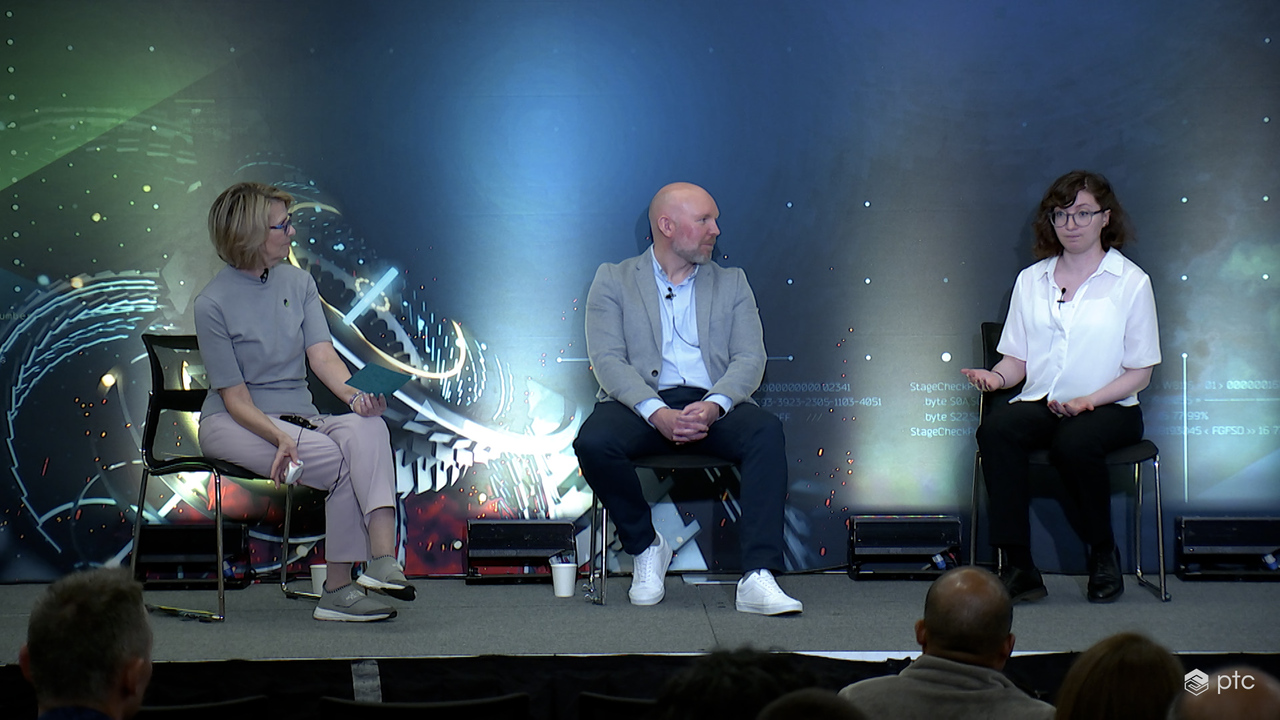
01:44 In today's world, companies really must do this in order to gain or maintain competitive advantage. We can't can't stay still. So I am Liz Purdy. I am the journey lead for augmented reality and digital thread here at PTC. And I'm very, very pleased to have with me today Graham Russell and Ellie Smith from Howden to tell their story about how they got past the inertia of change in
02:18 a transformational advanced technology rollout. First and foremost, Graham, I'd like you to introduce yourself and tell us a little bit about Howden. Sure. Thanks. Thanks, Liz. So my name is Graham Russell. I'm the global lead for data driven advantage within Howden. Howden is a world leader in air and gas handling products. We've been founded for over 170 years.
02:48 We design, manufacture, install and service a range of products from fans to compressors to turbines. And in our history, even as far back as 1882, we developed the force draft system for steam engines on ships, on steamships. We worked with the shipbuilding industry in Glasgow, in Scotland, and even today we are now helping support
03:20 the energy transition by using our products to support the production of biofuels and renewable hydrogen. So our vision remains true to this day, which is helping to advance a more sustainable world. Okay. So I'm promise I'm going to get to Ellie in just a minute. But Graham, maybe you can tell us a bit more about how Howden is organized and the role of your data driven Advantage team. So like many large global industrial companies,
03:54 Howden is comprised of a number of product units or product teams which have a lot of expertise in a particular product line for the design and manufacture. In addition to that, our we have a number of regional divisions which support customers locally. Howden's business is almost a 5050 split between new build equipment supply and aftermarket service. So it's really important for us to have good customer attachment.
04:24 And what we mean by that is good, strong, long lasting relationships with our customers where we are providing advice and support and guidance throughout the whole life cycle of the product. So to do that, we need to ensure that our local teams have the the, the backing and the knowledge and expertise of our global engineering business. We have to find ways of overcoming that challenge, of sharing this knowledge from product units to regional teams. And we make use of data driven technologies to do that,
04:57 things like industrial Iot and more recently augmented reality. So the data driven Advantage team is a global function where we have responsibility to lead the strategy of digital transformation, enable and support the transfer of knowledge from product experts to the regions to ultimately help our customers. And augmented reality is one of the main tools we use to bridge that that gap
05:28 and help transfer that knowledge. Okay, Ellie, let's dive into your role now in data driven advantage and then maybe you can tell us some of the specifics around your initial launch of expert capture. So I'm the product manager for augmented reality at Howden, and which means I'm sort of setting the strategy, investigating new technologies and doing a bit of development work and driving adoption of the AR tools that we use within the business.
05:58 So that's Vuforia studio for sort of custom experiences for our customers. And we use chalk to support our customers in real time as well as our field service engineers. And we also use Vuforia expert capture, which is what we're mostly talking about today. Our team really exists to, as Graham mentioned, support customers better and make sure we're delivering the service that they need. And that could be directly through technology that we apply to their machinery, or it can be indirectly helping our service technicians provide a better service.
06:31 And so, as Graham explained, one of the challenges we face is cross training between our product experts and our regional teams of field service engineers, because they're not necessarily in the same place and often aren't. So, for example, our Screw Compressors team are based the product experts are based in the UK, but we have customers using screw compressors all over the world. And one of the issues we were having, we were getting requests for seal replacement task for our screw compressors and we were just having to turn down a lot of that work because of just
07:05 a lack of trained resource in those regions. And so that was what really sort of kicked us off along this journey. And we knew we wanted to use expert capture because we'd seen in pilot projects before and what great sort of training output it could result in. But we had a few concerns based on our previous experience about how we were going to scale up and be really successful in that. Yeah. So tell us a little bit about that experience. SaaS And, and what happened happened next.
07:36 And so the concerns we had were around making sure we could scale this up and get widespread adoption. So the previous pilots we'd run and we'd put in quite a lot of sort of hands on effort. We'd create the training, we'd deliver it, and we'd get some initial usage, and then that would kind of be it. The project would end and we'd have a little bit of usage, but nothing long term. And so we wanted to take a different approach this time. We wanted to make sure we were building something that would last and be sort of a repeatable process that we can use elsewhere in the business
08:07 so that our product experts can be creating this training without creating a huge burden of effort for them, but something that they can create really high quality training and quite independently almost. And so in order to achieve that goal of having that scalable process, we knew we needed a different plan to what we'd been doing before. And that was where we started to engage with PTC and their adoption program, and they were able to give us a lot of advice and expertise on driving adoption and change management.
08:37 Yeah, so they were in that 90% bucket that maybe some of the rest of you have experienced as well and took it took a different approach. So the question is, Ellie, how did you get buy in and support to ultimately to make that change? So we decided one of the things we needed to do differently was getting people involved at all levels of the business. So that meant having involvement from an executive sponsor who could set
09:09 the direction. And we're putting communications out to the business saying this is what we're doing now and please support this. Please provide the resource that we need to support this initiative, which is really important. And our team were taking on sort of the program management role. So taking responsibility for that kind of entire process and managing and overseeing it. And it was also really important to get the process owner involved. So the person who'd initially bought this sort of pain point and raised that to our team was involved and for overseeing
09:42 the day to day making sure those activities happen. We also felt it was really important to engage at the other end of the process as well. So our subject matter experts and incredibly important, we wanted to make sure they were on board and they understood this wasn't just a load of more work that we were dumping on their desks. This was something that was going to be really helpful to them and not be a huge burden to them instead. So that was really important to have those conversations and end users, of course. So our field service engineers who were actually consuming the training content
10:13 and we were careful to sort of engage with them, warn them that this change of process was coming and make sure they had everything in place they needed to do that. And the final people that were really important to the process were our field service managers. So they were kind of our eyes and ears on the ground. If there are any issues coming up, they'd be the ones that could gather that feedback. Tell us we needed more support or more resources in any particular region. So having those people on board make a made a really big difference. Yeah. So interestingly, what Ellie is talking about is SaaS software,
10:48 and you would think a lot of people are under the impression that you just go in, you train people and things just kind of take care of themselves. But when you're really looking to transform and change the way people behave and even some of their roles, there is some more structure that's needed and buy in and involvement at various different levels around people, processes and tools.
11:18 So that is what Howden has done very, very successfully. Ellie And speaking of successfully, maybe you could tell us a bit about the results. So I think there's kind of two areas mainly that we saw results in. The first was the immediate uptake on this set of instructions. So we're really pleased with how it worked out. We'd initially identified two of our business regions where we knew there was an appetite for this training. We knew they needed these people to be qualified, so we engaged with the field service managers there and laid that groundwork,
11:51 and those were the teams We really wanted to complete the training. We actually ended up publishing the training on our global learning management system because that's just the easiest way for everybody to access it in our business. Because of that, that meant it was available to all of our field service engineers, not just the ones in those two regions. And we were really pleased to see that within the first month I think we had field service engineers in every single one of our business regions had completed the training, which is really fantastic news for us because that was our main goal,
12:22 was making sure we had people in every region to be able to do this. And so that was fantastic. Yeah, that's a pretty fantastic result to introduce something new like that and basically have it take off almost on its own. I mean, that's not quite true, but a lot of effort went into it, but that's really fantastic results. So let's hear a little bit more about how that was done and the key factors of success to make a program like this work.
12:55 And I'll hand the microphone to you, Graham, to discuss. Okay. So you know, you mentioned that this is software as a service, which means for a company like Howden, it's really easy for people to access it. But really to get sustainable adoption, you need a robust change management framework. And PTC worked with us here to develop a framework which would become a self-sustaining initiative for for Howden.
13:26 This we didn't want to have to keep driving the development and the capture and these work instructions from our data driven Advantage team. We really wanted to establish a process that our product units and regions could pick up themselves. So as we walk through the development of this framework, the vision was always to create a process which we could embed in the organization. As we went through this for the first time, designing and refining it. We also were bearing in mind that this would become the template.
13:58 So the first step really started with identifying the correct opportunities and the correct use cases. For us, this meant pulling together experts from the product units as well as our regional aftermarket sales managers looking for areas in the business where there was either a knowledge gap or knowledge was constrained, or there was something limiting our ability to serve customers in a particular geographic location.
14:30 That gave us a number of opportunities which we were then able to prioritize, understand which ones are easier to measure from a direct benefits perspective, map these out and create our first pipeline of opportunities and and essentially a road map for augmented reality work instructions, which was based on on business outcomes for us. We prioritize them based on our company's strategy around customer attachment
15:00 and after after market growth, which then made it very easy for us to get executive level sponsorship. So the next stage in this process is all about getting the right level of sponsorship for top down commitment. We were really fortunate that our CEO got behind this particular initiative and provided any opportunity where there was a town hall or some sort of corporate communication. The.
15:30 Was always an update on the progress from the data driven Advantage team. So it made it very clear to the business that this was important to our strategy and we got a lot of support and commitment from from that. Then from the bottom up, Aly was able to act as an execution lead for this initial project for the initial use case. Part of that requires the business change impact assessment, so standards change management processes around stakeholder management impact
16:05 assessment, but using templates and standards that can be followed by other colleagues and people that would come next. One of the things there also involved the core project team training them in this change management process as well, as well as training them in the technical side of expert capture and how to plan out the capture of tasks and publishing of of work instructions. So the change management piece was part of
16:36 the project we developed when it came to business readiness. We developed some tracking mechanisms to measure key KPIs around the business readiness to adopt this. So had the regions received the training, have we gone through the possible ways that they will consume these work instructions? What hardware will they use? What devices, wearables, etcetera? So that all the as Aly mentioned, the end users were involved in that planning process and we were able to fine tune
17:07 the project prior to rollout to ensure that there were no concerns. One surprise was actually that we did see some concerns from the product experts within the company. I think because their concerns were around the fact that they are passionate about going out and being on site with customers, helping customers to solve problems. And they saw this having a potential impact on on on their role as product experts. So we were able to listen to them
17:39 and address some of their concerns by firstly recognizing them as product experts and changing their job titles and roles to reflect the fact that we and recognize them as as experts and wanting them to share their knowledge, but also helping the business to understand that by capturing this knowledge and being able to serve it on demand, that actually frees up more time for our product experts to spend on
18:09 the more complex tasks which require more ad hoc and one off type troubleshooting and investigation. So that was one of the things that came out of that that business readiness assessment. And then finally post rollout the in order to become a sustainable process, it's very easy to underestimate the amount of effort that it takes to to keep tracking and trending post rollout. So again, putting in place some dashboards and KPIs that will track some leading indicators of
18:41 the eventual business benefits that we want to see. And even a year after rollout, we still track these things within Howden and track the uptake and track the those those KPIs through that dashboard and that actually helps identify the next iteration of improvement as well. For example, one region now in particular has asked us to look at providing these work instructions directly to end user customers, which is quite an interesting idea that we're looking at just now.
19:13 All right. Well, that was a lot. So what I just wanted to point out there is that really strong and active sponsorship, executive sponsorship. I think also the some of my observations, the the DDR team, while it's not it's a strategy organization, it's also very practically plugged into the business as well. And I think that's a big takeaway that, you know,
19:45 sometimes there are teams that are going out and looking at software and solutions and then recommending it for for global rollout or trying to sell it within the business. And I think that, you know, Howden has this team that's really looking at it and embedded in the business and focused on business outcomes alongside and making adjustments to to the plan as things go along. So those were some of my observations that might be helpful to
20:15 you guys as well. Basically, it's just showing that this process can be used in a repeatable way as a template for additional augmented reality or even other innovation projects. And that. Approach can definitely work and can get you to being part of that 10% . So, you know, Howden has has launched this structured programmatic approach with strong sponsorship involving the right stakeholders. They have clear goals and measures.
20:48 I heard you mentioned that several times and adjusting and and getting feedback from those stakeholders as you go to continually improve. So really excellent work by this team and I think we can all learn from it. I want to thank both of you so much for sharing your story with all of us and congratulations on your really stunning results. Thank you.