Engineering teams are under more pressure than ever to develop better products faster, with fewer resources and tighter development windows. AI product design is fundamentally changing what's possible. According to McKinsey, companies that embed AI into their product development processes can reduce time to market by up to 30% while simultaneously improving design quality. For manufacturers in aerospace, automotive, medical devices, electronics, and industrial equipment, that's not an incremental improvement; it's a structural competitive advantage.
This article breaks down what AI product design is, how the workflow unfolds in practice, which industries are seeing the most impact, and what challenges an organization needs to address before scaling adoption.
What is AI product design?
AI product design refers to the use of artificial intelligence, including large language models, machine learning, generative algorithms, and AI-assisted simulation, to support engineers at every stage of the design process. Unlike traditional CAD workflows, where a designer manually defines geometry and constraints, AI-driven product design tools can guide, suggest, generate, and evaluate design concepts at a speed and scale that human iteration can't match.
The shift matters because design complexity is growing faster than engineering capacity. A single component in an assembly may involve thousands of intersecting constraints, including structural loads, thermal requirements, material availability, manufacturing tolerances, and regulatory certification demands. AI for product design does not replace the engineer's judgment; it scales it by helping teams move more quickly and confidently from early design concepts to production release.
Real-time guidance
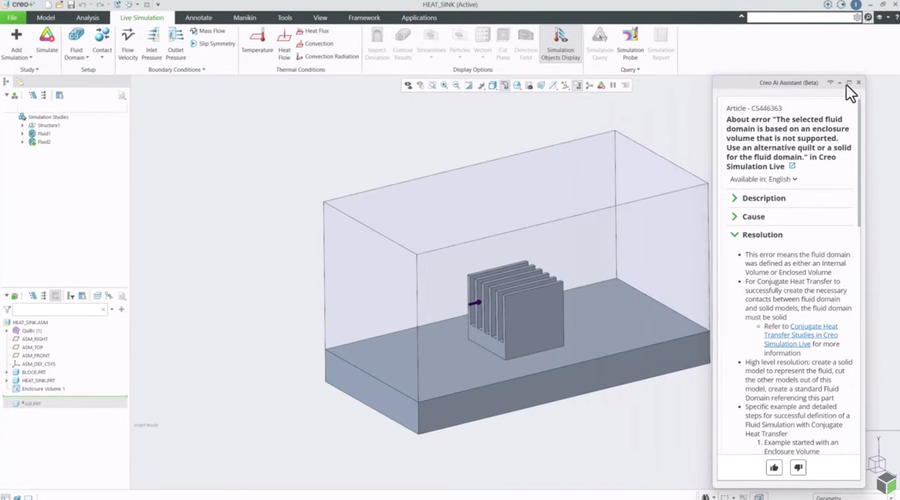
AI can provide in-the-moment guidance on how to perform workflows, aiding both new and experienced engineers with step-by-step instructions. AI tools can analyze a design as it takes shape, performing structural, thermal, or modal simulation and identifying manufacturing, tolerance and interference issues before they require expensive rework. This continuous feedback loop gives engineers accurate information at the moment decisions are being made, not after a design review many weeks or months later.
Design optimization
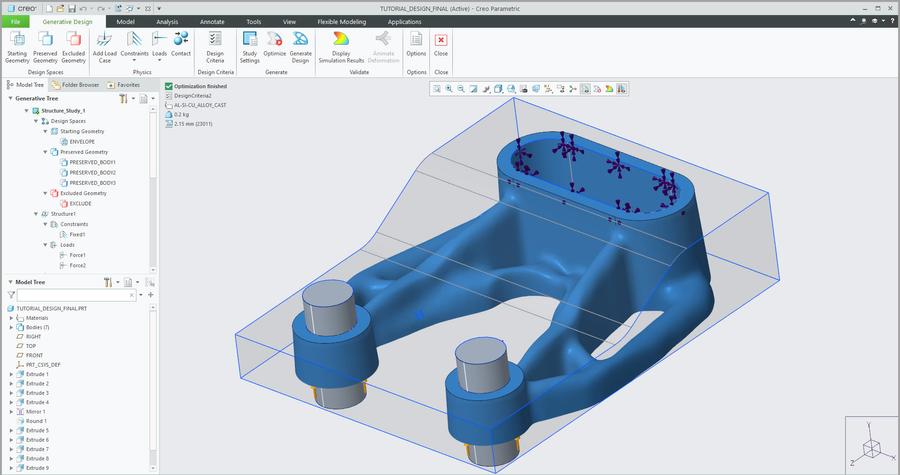
AI design can evaluate thousands of design configurations simultaneously, identifying geometries that satisfy structural, thermal, or modal requirements while minimizing weight and material use. The engineer identifies design objectives, constraints, materials, and manufacturing processes, and AI generates one or many design options for consideration. This approach, commonly known as generative design in CAD, consistently reveals solutions that may not have been considered otherwise.
Performance analysis
AI in mechanical engineering extends to embedded simulation capabilities that predict how a design will behave under real-world conditions, including stress loads, displacement, thermal behavior, and fluid dynamics. Engineers with AI can assess multiple scenarios faster than traditional finite element analysis (FEA) and focus their time on the most promising candidates.
Automation of design work
AI transforms engineering workflows by managing repetitive tasks like tolerance analysis, feature look-up, part generation, and variant configuration, freeing engineers to focus on high-value activities. By eliminating the cognitive strain and potential errors tied to routine processes, these tools ensure consistency and precision while significantly boosting productivity. Engineers gain valuable time to engage in creative problem-solving, innovative design exploration, and meaningful cross-functional collaboration. This shift not only enhances individual performance but also fosters a team dynamic geared toward innovation and productivity, where deadlines are met without sacrificing quality.
How does AI product design work?
AI product design is a rapidly evolving process, with some aspects available today and others coming soon. It's also a structured collaboration between the engineer and the AI system, where each brings distinct strengths: the engineer provides context, constraints, and judgment; the AI provides computational scale and speed.
For example, a typical generative design workflow may follow these five stages.
1. Engineer Defines the Problem, Goals, and Constraints
The process begins with the engineer specifying what the design must accomplish. This includes functional requirements (load capacity, thermal performance, target weight), manufacturing constraints (preferred materials, production processes), and any regulatory or certification requirements imposed by the target industry.
2. AI Explores and Generates Options
With constraints in place, generative CAD tools leverage simulation to explore the design space, producing hundreds or thousands of geometry candidates, each satisfying the specified requirements to varying degrees. The best options are delivered to the design engineer for evaluation. Algorithmic methods may produce options that may fall outside conventional design thinking. That's the point.
3. Engineer Narrows Options and May Use AI for Simulation
The engineer reviews the generated options and applies judgment to narrow the field, weighing manufacturability, cost, aesthetics, downstream assembly, and other considerations that the AI cannot fully evaluate on its own. Short-listed designs can then be further refined and run through high-fidelity AI-assisted simulation, for a more precise performance evaluation.
4. AI Assists in Modeling Workflows
In the near future, AI tools will support the transition from conceptual geometry to detailed models, potentially automating feature creation, tolerance propagation, and drawing annotations. AI-based prototyping tools may be able to identify the fastest path from CAD model to physical prototype, recommending manufacturing strategies or tooling approaches based on design geometry and production requirements.
5. Engineer Approves Final Design
The engineer makes the final call. AI-driven product design augments human decision-making; it does not replace it. The engineer validates the final design against all requirements, resolves outstanding conflicts, and releases the model for manufacturing or for further governance within the organization's product lifecycle management (PLM) system.
Benefits of AI Product Design
The business case for AI in product design is well-established and growing. Organizations using AI-assisted design tools consistently report improvements in cycle time, defect rates, and engineering capacity. The benefits concentrate in four areas.
Faster Design and Time-to-Market
Generative design and AI-assisted simulation compress design cycles that traditionally span weeks into days. Parallel automated exploration replaces sequential manual iteration, allowing engineers to evaluate more options faster and arrive at stronger solutions sooner. As manufacturers deal with compressed development windows, this speed advantage compounds across the product portfolio.
More Innovation and Optimization
Human engineers tend to rely on established geometries and design patterns based on experience and past success. Generative design explores a much broader set of possibilities, frequently identifying optimized solutions that would be difficult or unlikely to develop manually. The outcome is not only accelerated design exploration but also superior product performance.
Error Detection and Avoidance
Catching a design error in a CAD model costs a fraction of what it costs on the production floor or in the field. AI tools that analyze designs in real time can identify structural weaknesses, tolerance issues, and assembly conflicts before they propagate downstream into tooling, procurement, or manufacturing. Shifting quality upstream is one of the clearest returns on AI investment in engineering.
Increased Engineering Productivity
By automating time-consuming repetitive tasks, variant generation, documentation, and drawing creation, AI frees engineers to focus on high-value work. According to McKinsey’s superagency in the workplace report, organizations that effectively deploy AI see employees reclaim 20% - 30% of their working hours for higher-value activities. For engineering teams managing growing design complexity with flat headcount, that reclaimed capacity directly accelerates development programs.
How Is AI Product Design Impacting Different Industries?
AI product design is being applied across the manufacturing landscape. AI-driven guidance can drive increased engineering productivity, with step-by-step advice on new and infrequently used design processes. For AI-powered generative design, the impact is most pronounced in sectors where design complexity, regulatory pressure, and competitive speed intersect.
Aerospace and defense
Manufacturers are using generative design to reduce structural component weight, directly improving fuel efficiency and payload capacity. AI simulation is also accelerating the analysis phase of flight-critical part certification.
Automotive
OEMs and Tier 1 suppliers are beginning to apply AI-driven product design to internal structures, drive train assemblies, electric motor mounts, and thermal management systems, areas where weight, safety, sustainability, and performance trade-offs are extraordinarily complex and tightly regulated.
Medical devices
AI tools are enabling faster design iteration on implantable components and surgical instruments, where dimensional precision and performance are non-negotiable. AI-based prototyping is measurably compressing design verification timelines.
Industrial equipment
Heavy equipment manufacturers are using generative CAD tools to optimize frame structures and part geometries, reducing material use and machining time without sacrificing structural integrity.
Electronics and high-tech
Miniaturization pressures are pushing design teams toward AI for thermal and performance analysis at the component level, where manual approaches can't keep pace with development cycle speeds.
What Are the Potential AI Challenges?
The benefits are real but, so are the adoption barriers. Organizations that move into AI product design without addressing these challenges may see limited returns and frustrated engineers.
Data Quality and Readiness
AI systems learn from existing design data. If a CAD library contains inconsistently modeled geometry, incomplete metadata, or legacy files the AI tools can't parse effectively, the outputs will reflect those deficiencies. Depending on the discipline, standardization, and structure of the CAD systems used, data preparation can be a time-consuming phase of an AI product design implementation.
Integration Within CAD and PLM Environments
AI tools don't deliver value in isolation. They need to be embedded in the workflows engineers already use, ideally within the CAD environment itself rather than a separate application requiring data export and re-import. Integration with PLM systems ensures that AI-generated designs are managed within the same change control, configuration management, and approval workflows as all other product data.
Trust, Skill Gap, and Change Management
Engineers need to trust what AI provides, and that trust is earned over time through explainability, validation, and hands-on experience. Many design engineers are initially skeptical of AI and generative design outputs precisely because the geometries look unfamiliar. Addressing the skill gap and investing in change management are prerequisites for successful adoption.
Technical Limitations of AI in Engineering
Current AI systems perform well within well-defined problem domains but struggle with highly novel design challenges, incomplete requirement sets, or trade-offs that require broad contextual knowledge. Engineers should treat AI as a capable collaborator with documented strengths and clear limits, not a design oracle.
Privacy, Compliance, and Governance
Manufacturers in regulated industries, like aerospace, defense, or medical devices, face strict requirements around design data access and processing. When AI tools operate in cloud environments, organizations must verify that data handling meets applicable export control, intellectual property, and data residency requirements before deployment.
The Future of AI Product Design
The trajectory of AI in product design points toward tighter, real-time integration between AI systems and the complete engineering toolchain, from early concept through production release. Autonomous design assistants that understand a product's full specification, regulatory context, and manufacturing environment are already emerging in research settings. Within five to ten years, they may be standard across advanced manufacturing.
For organizations building a foundation now, the most important step isn't adopting the most sophisticated AI tool available; it's establishing the data infrastructure, workflow integration, and engineering culture that will allow AI capabilities to deliver compounding value as the technology matures. The manufacturers who invest in those foundations today will be the ones who move fastest when the next generation of AI-powered CAD tools arrives.
How Creo Supports AI Product Design
PTC leverages a framework of ADVISE, ASSIST, and AUTOMATE to govern AI capabilities in Creo. In this framework, AI takes on additional responsibilities in the product design workflow. In all cases, the design engineer must review and approve any AI-driven changes before implementation.
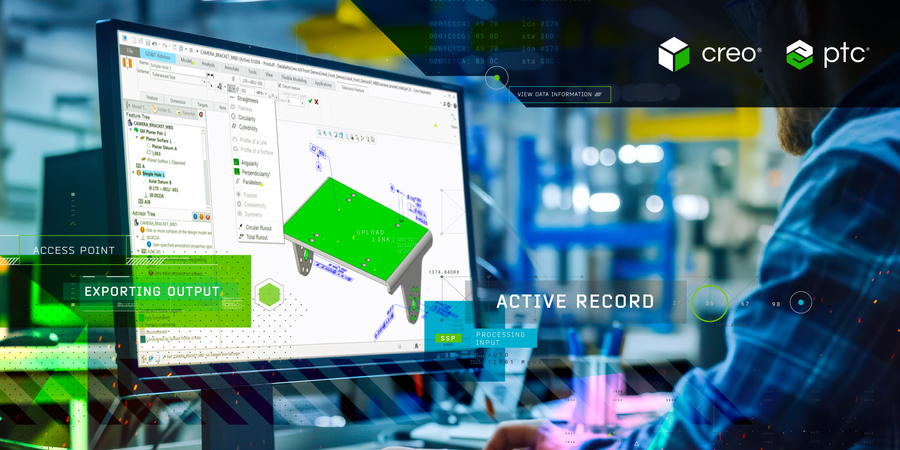
PTC's Creo embeds AI assistance and generative design capabilities directly in the design environment engineers already use. No separate tools; no data to export and import; no workflow disruption. Creo's generative design lets engineers define performance targets, materials, and manufacturing constraints. AI explores thousands of geometric options and ranks them by performance. Real-time design guidance and AI-assisted simulation can surface issues before they reach manufacturing.
Creo’s rich, consistent data maps directly with PTC's Windchill, the industry-leading PLM platform, ensuring that AI-generated designs are tracked, versioned, and managed within an organization's established change control and configuration management processes. That connection between AI-driven design and PLM-governed product data is what makes AI product design operationally sustainable at scale.
Ready to see what AI product design looks like inside your engineering environment? Request a personalized Creo demo and explore how AI-driven guidance, generative design and simulation can accelerate your next development program.
Topics
Artificial Intelligence
Engineering Collaboration
Generative Design
Up Next
Try Creo for AI-Powered Product Design
Explore Creo’s design, simulation, and generative tools with a free trial.
Start Free Trial