From Variant Complexity to Governed Lifecycle Control
00:00 Thank you very much, Daniel, for the for the introduction. And, good morning. Good afternoon. Good evening. Depending on where you have tuned into the session today. As Dan Joe just said, my name is Ren Zoelfl I'm working as a global industry advisor for Medtech at PTC, and I would like to talk a little bit about today how Medtech companies can move from uncontrolled variant complexity to governed life cycle control. So I will talk a little bit about how,
00:31 configuration or that configuration actually is a strategic capability that every organization should have. And it's not just an engineering task. And although I'm dealing a lot with medtech organizations, I think there's a lot to learn or a lot of information also that, is applicable for, for other industries for other manufacturing organizations. So to start with, I created a little bit of an agenda for today. I would like to start first with a very brief introduction of who PTC is,
01:05 then, talking a little bit about what we see as the configuration challenge. Then how and why actually, product lifecycle management and configuration lifecycle management are better together. Then I took some slides from just recent webinar that we did together. And so Configit, Philips and PTC. And I was talk a little bit about the story of Philips and how they turned complexity into an advantage.
01:35 And I will close with how hopefully some lessons learned, that you can then use in your own organization. So to start with, very brief overview, as promised, keep it very short. We are a software company. We are headquartered in Boston, Massachusetts. We represent actually 40 years of innovation, especially in the field of product life cycle software. We have across the globe, and we are operating in more than 35 countries.
02:06 We have, more than 7,000 employees, that day in, day out, we work with customers, but also, improve and innovating our own solutions for the benefit of our, our clients. And we have a strong partner ecosystem where Configit is a, technology partner that we have working with, for us and our clients. Now setting a little bit the scene, and what we also hear from the industry.
02:42 So to sustain growth but also competitiveness product OEMs, across a range of industries need to improve the speed of product development while reducing the costs and also improving quality. And that's true for all industries, I would say. So it's not that is just very specific to the MedTech industry, but this is something really that and we heard that yesterday during the conversation and during the presentations of the different organizations that were here. So in the organizations, they face, a range of market dynamics
03:16 that make this need both more urgent and more challenging to achieve. Including workforce shortage, for instance, or supply chain disruptions and also sustainability and regulatory pressures. They are also evolving towards new models that, achieve these outcomes more effectively, like, product servitization or software, embedded products and platform modularity.
03:47 And now and we will hear that today and we heard it yesterday. Now also layer AI on top of that. And where our customers are really waking up and asking and thinking, thinking how will AI impact their business and their operations, but also asking us as a software vendor how we can help them to, leverage AI within their processes to, you know, solve some of the urgent business problems they have, but also make them more efficient
04:19 and more effective in the way how they work and operate. When we look into, the market situation, there are, I think specifically especially for, organizations that are developing configurable products, and especially in the, in regulated industries, they face, a convergence of challenges that, traditional product lifecycle management approaches struggle to address, effectively.
04:49 First, there's the regulatory fragmentation, which is, intensifying, as a product must comply with multiple regional standards, and frameworks, each with distinct requirements and that really vary also, across the different markets, medical devices approved in the European Union, for instance, under the MDR, face different requirements than those devices approved by the FDA in the United States.
05:21 While markets in parallel markets in Asia Pacific really introduce additional layers of compliance, and complexity. Second is the increasing or increasing product complexity. This is, in our view, primarily driven by software integrations. And that's software integrations has fundamentally changed the nature of product development. What our products are no longer just a physical piece
05:51 of pure mechanical assembly, they are sophisticated systems, sophisticated systems where hardware, embedded software, firmware, but also, cloud services must work in concert. A single physical button, for instance, on a medical device. And I will explain that in, in a minute. May trigger dozens of different software functions, depending on the configuration, creating really an exponential increase in potential states
06:23 that, must be validated. Third variant proliferation proliferation, which is driven by market specific needs and creates really enormous strains on consistency and control. What appears to be a single product line may actually represent hundreds of thousands of distinct configuration. When counting regional regulations, customer preferences, optional
06:54 features, and market specific requirements. But in a regulated industry, each variant must be traceable, must be validated, and must be maintainable throughout its lifecycle. The fourth thing we see is there is or what it causes is slow validation and, approval cycles. And those compound these challenges by extending time to market, but also increasing the cost
07:25 When configuration logic is not governed centrally every change requires manual reconciliation across engineering, commercial, manufacturing and service functions. This creates bottlenecks that delay product launches, slow responses to market opportunities, and also increase the risk of error reaching customers. So together, these challenges reveal a fundamental gap.
07:55 Traditional product data management focuses on what the product is, but struggles to govern how the product can be configured, who can configure it, and what the downstream impact of configuration choices will be across the entire product lifecycle and value chain. So here's the before mentioned. Example I want to visualize how easily or how how products become complex very, very quickly.
08:25 Even the very simple or rather simple medical device like a glucose meter in that example is not one product, right? So it is made of many components. It's consists of hardware, software and has regional options in it. So take the button as an example. As I mentioned earlier, physically it's just just a button. But in software that same button can trigger many different functions. Calibration, measurement, or even the settings.
08:56 Now add to the regional regulations to it. Different markets require different behaviors, labels, limits, or approval. Suddenly this one simple product becomes many variants. But the challenge for organizations is not creating the variants. The challenge is controlling them and making sure that hardware, software, and regulatory intent stay aligned across to different markets.
09:26 And this is where unmanaged complexity starts to break down. Engineering, validation, and the change control process. Now we as PTC, we drive to drive and work with our customers actually to unify the complete product lifecycle from definition, design, plan, production, service and sustain. And we want to use the organization. We want to enable organizations to use the data that are flowing in a connected life cycle thread.
09:59 We govern the product data as the single source of truth for requirements configuration and also for traceability. Now you can also layer AI on top of it. That helps and actually really to accelerate decisions and execution which improves orchestration, which means be able to build the right product, but also improves the collaboration, which means lets you organizations build a product right.
10:29 So PLM and I hope that this, visual I just showed, make that very clear. PLM is absolutely essential in modern organizations because it provides the strong foundation. It manages product data, product structures, but also the change, control and even quality data across engineering, quality, manufacturing and service. And that part is absolutely not in question. But as soon as
11:01 products become highly configurable PLM alone, starts to reach its limit. What we typically see is that configuration and tend to the rules, the constraints and the logic that define which variants are allowed lives outside of PLM. Those rules might sit in excel, sales configurations, they may result in ERP logic or even in, institutional knowledge.
11:33 So as a result, the same product is interpreted differently depending on where you are in the lifecycle. Engineering reason it's in one way sales has another. Manufacturing applies its own constraints and service discovers issues only after the products are in the field. Because this logic isn't governed centrally teams end up doing manual reconciliation. Whenever something changes.
12:03 Imagine requirement update or regulatory constraint changes, or a market specific variant, and that slows down change implementation. But it also increases the risk, and breaks the continuity of the digital thread. And this is exactly the gap that, configuration lifecycle management addresses. It doesn't replace PLM, but it acts as a complementary layer on top of it where PLM manages the product definition.
12:33 CLM governs configurable product knowledge, the configuration rules, the constraints, and the allowed combination. Across the different variants. And with CLM then there's a single governed source for configuration of logic variant definitions. The right conditions are synchronized across the lifecycle from engineering for manufacturing to sales and service. And when a change occurs
13:04 CLM enables also control change and impact analysis. So you know exactly which variants, which markets or configurations are affected. And this is why CLM is not another silo. CLM is helping to enable the digital thread by aligning configuration intent end to end. It ensures that every function is working from the same logic, even though they consume it in a different way.
13:37 So to summarize and to take away from this slide is very, very simple. PLM manages a product data and is essential. It's the foundation for every organization. But CLM governs the configurable product knowledge and together they allow organizations to scale customization without losing control. So now from theory, let's get a little bit or from concepts. Let's dive a little bit into a real world example I mentioned earlier that we,
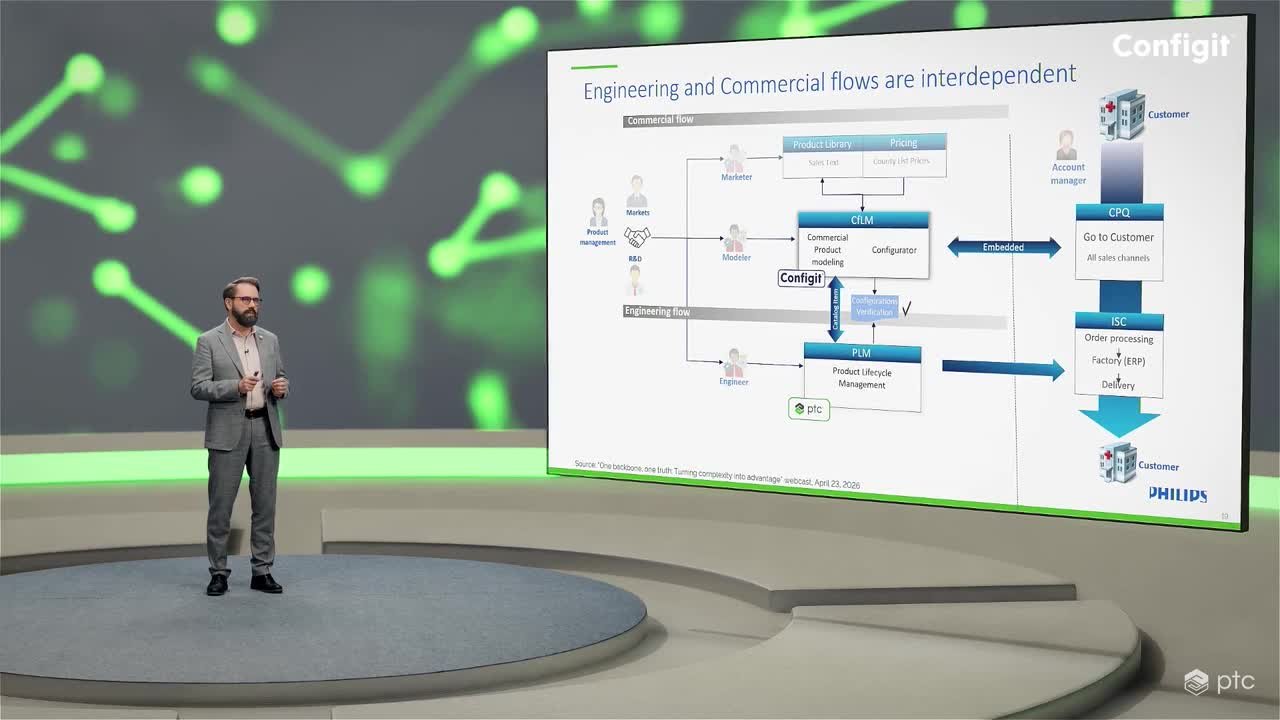
14:08 just a couple of weeks ago, we had a joint webinar with Configit and Philips where we talked about Philips' journey, and how they tackled configuration complexity across engineering and commercial operations. And this case, what I'm what I will explain now really shows, PLM and CLM working together in practice at enterprise scale. So to start with, so Philips has been thinking about configuration lifecycle management
14:39 and why CLM has become a such an important complement to PLM in a complex, global environment. At Philips product complexity is not an abstract concept, right. So they develop highly configurable systems that must be prepared for very different market use cases and also commercial models. So the challenge is not just building the product, but preparing how those products can be offered, configured, and governed across markets.
15:11 And doing that consistently over time. That is where configuration lifecycle management enters the picture. So when they look at their landscape, they distinguish, two major flows that need to work together seamlessly. The first is the engineering flow, which is a little bit shown on the at the bottom of that of that slide. This covers the product development but also lifecycle control. And this is where PLM plays,
15:41 the central role. At Philips They're relying on on two solutions here from PTC. One is Windchill and that that they are using for managing product data and product structure and then change information and Codebeamer, PTC Codebeamer, which is used to manage requirements. But also traceability. And this flows this flow ensures engineering intent traceability and lifecycle rigor.
16:12 The second shown on the top of the of this picture is actually the commercial flow. And this is where products are prepared for the market. So offers, the product descriptions, sales tax, promotions, and country specific pricing. This flow deals with complete different kind of complexity and gets with market rules, country constraints, and commercial variability. For this, Philips uses Configit to model complex commercial
16:45 configurations across all markets, and Configit Ace in particular allows them to handle very high configuration complexity in a controlled and scalable way. What is important here is not just that these flows exist, but that they are clearly distinguished and deliberately connected. So. Philips aligned this approach several years ago with PTC and also with Configit and there was a clear recognition that the PLM solution, they had alone cannot and actually
17:17 should not handle the full scope of configuration complexity, especially when commercial and market rules come into play. At the same time, configuration logic cannot live independently from engineering intent, and this is where configuration lifecycle management provides the missing layer configuration lifecycle management governs how configuration knowledge is defined, maintained, and reused across the lifecycle. It connects engineering definitions with commercial configurations
17:50 without duplicating logic and or creating inconsistency. So in practice, this means that engineering and commercial teams work from aligned configuration models, each in their own flow, but grounded in a shared understanding of what is valid and allowed. Today PTC and Configit complement each other well. PLM governs the product structure,
18:21 the requirements, and also the change where CLM governs configuration rules and variability across markets. Together, they support a scalable and future ready operating model. So and but also to to when they started their their journey at first they did not start as one single project. It became important over time as product but also business complexity increased. Like many large companies
18:52 And that we had we have heard some examples today we will hear some examples today, but also had some examples yesterday, Philips was running several transformation programs in parallel. There were initiatives for PLM, for commercial processes, and for the supply chain. Each program was improving. Part of the situation, but the configuration was spread across all of them. And over the years many different tools were used. You see that on the left hand side for many to the tool we are used
19:23 for configuration, where other parts of the organization had already simplified their tool landscape. So configuration lifecycle management, however, was not addressed in the same way. And one key reason was ownership. Configuration sits between innovation, sales, and supply chain, where innovation focus on PLM and product development, supply chain focus on ERP and execution,
19:53 and sales focus on CRM and CPQ tools. Configuration was important for all but owned by none. So because of this, configuration models were maintained and several tools and some updates were still done manually. To speed up catalog release many small fixes were added and these fixes helped in the short term, but they did not solve the real problems. So as a result, catalog updates were
20:24 slow. Data quality issues remained. Errors moved downstream into ordering or even into production. In some cases, sales offered features that were no longer technically supported or approved, or not yet available. So this created rework, waste, and sometimes even lost sales opportunities. The turning point really came when Philips clearly recognized that commercial configuration is a business responsibility.
20:57 The businesses must own and maintain configurable product models, and they are accountable for data quality, lead times, and continuity. With this understanding, configuration lifecycle management became essential. And as I mentioned earlier, they you know, they intensified the definition of the clear two flows. They had the engineering flow based on the PLM solution that controls product development, but also requirements and lifecycle changes
21:29 and the commercial flow that, supported by Configit and controls, how products are configured, priced, and offered across the different markets. So in that in that example, CLM connects these two flows without mixing them. It allows faster catalog updates, which of course pleases the customers. It allows better products, or better reuse across different product families and consistent configurations. Without control, without creating uncontrolled variability.
22:03 So this reduced the lead times, but it also improved the data quality and aligned engineering and commercial teams better. Most importantly, it created a shared understanding of what can be sold, built and delivered. And this experience that I shared with you here, directly leads then to my next slide. And because that what Philips learned and I made that in the beginning. What Philips learned can be a, it can be,
22:34 applicable for any other organization. And I believe that many organizations, many companies faced the same challenge as Philips did. So. But the question is always, what are the lessons learned for the industry? So I'd like to highlight why CLM must be treated as an organizational capability, but also why PLM and CLM together offer the biggest promise for success.
23:06 Again, I'm not stopping to reiterating that PLM is essential, it's foundational and it manages the product. It manages product data, the product structures. It manages changes, quality, and compliance across the lifecycle. But for highly configurable products, PLM alone is not enough. So configuration is not just an engineering output. And especially when you look into regulated industries, it is regulated content.
23:36 So rules, options, and variants must be governed, owned and auditable just like requirements or quality data. That is where CLM really complements PLM. PLM manages what the product is, and CLM governs how the product can be configured consistently across engineering, sales, manufacturing, and service. And this is why governance matters more than tools alone.
24:06 Technology enables PLM and CLM, but success really depends on clear ownership, shared rules, and aligned operating models. So in my view, when PLM and CLM work together, organizations get one configuration intent across the lifecycle, not multiple local interpretations. That again reduces errors, speed up change, and lowers regulatory risk. And this foundation actually does not slow innovation.
24:40 It accelerates it. Strong configuration discipline enables faster decisions, safer reuse, and ready for AI automation and analytics. So in short, PLM provides life cycle control. CLM provides configuration control and together they enable scale, speed and intelligence. So let me close with some simple, some simple thoughts.
25:11 The future operating model for organizations that have highly configurable product is configurable by design, not configurable as an add on. Not configurable after launch. But built that way from the start. So what we've seen across the industry is that complexity isn't a real problem. The real problem is uncontrolled complexity, and configuration logic is scattered, implicit, or locked inside individual systems or teams.
25:44 That's why this takeaway that I put in the middle here really matters. If you cannot explain your configuration logic, you cannot scale it and for regulated industries you cannot even regulate it. So I'd like to leave you with three practical leadership questions. First, where does your configuration tools live today? And I really mean I don't mean where we think it lives, but where decisions are really made. Second, who governs configuration access
26:16 across the lifecycle from engineering for commercial, manufacturing and service? And how confident are you in variant traceability and impact analysis then regulations, markets, or customer needs changes? I believe that organizations that get this right treat configuration like quality or requirements. It is owned. It is governed and it's auditable. And fourth, it's lifecycle management.
26:49 That's what it means to be configurable by design. And that's what enables speed, scale, compliance and ultimately confidence. With that, I want to thank you for your for your attention. And turning over back to, to Dan Joe. Oh thank you, Rene, that was a great presentation. I especially like your last statement.
27:20 If you cannot explain your configuration logic, you cannot scale it. And you can't regulate it. That is, that's definitely true. Rene provided a great explanation of the value of combining PLM and CLM approaches for manufacturers of configurable products and customizable products in general. I just had a couple of other questions for you, if you don't mind. Rene, so I think, the first question I'd like to ask you is,
27:52 I know that you have some AI initiatives at PTC that you haven't covered in your presentation. Would you like to tell us a little bit more about what you're doing there? Yeah. So that's a very that's a very excellent question, Dan Joe. So we are we have embarked on the journey, and we are applying a framework that we call assisted wise and automate. And we started we have actually heritage in deploying AI in our solutions. But specifically when it comes to PLM. We just recently, launched two,
28:22 two capabilities within our PLM landscape. One is identifying parts that are duplicate or that are duplicated parts. So driving parts rationalization to giving organizations the the chance to understand which parts are really used what are duplicate parts to also lower the management of parts along the value chain. Right. That's one thing. The second thing is that we just recently released our our
28:52 kind of copilot agent, which helps you to understand the data that is managed in the Windchill database more consistently. So getting, you know, getting summaries of documents that you have or getting an understanding on how things are interconnected. So those are the first things we deliver. We have in the other solution areas we have, additional capabilities. But for Windchill, I think those are the the two ones that are available now, but there are also coming new ones over the, over the next couple of months.
29:23 Very good. I have one more question for you that's come in from our chat. It's actually a question that was asked yesterday as well, but I think you're the perfect guy to answer it. Because I think you've actually covered this a little bit in your presentation. Do you see the need also for a distinction between technical configuration and commercial configuration to keep engineering and manufacturing shielded from sales dynamics? I would say it is it is important to keep that a little bit, distinct or the deliberately, some let's say.
29:54 Yeah, a little bit distinct, because I think that, the engineers are also maybe, focusing more on what's technically feasible. Right. And maybe the sales teams are more looking into what else can be sold. What how can I maybe drive also the, the, the market potential or the market, coverage for our, our solutions. But they need to be interconnected. Definitely because they benefit from each other. And they avoid, risks and they avoid, inefficiencies,
30:27 along the complete, life cycle.