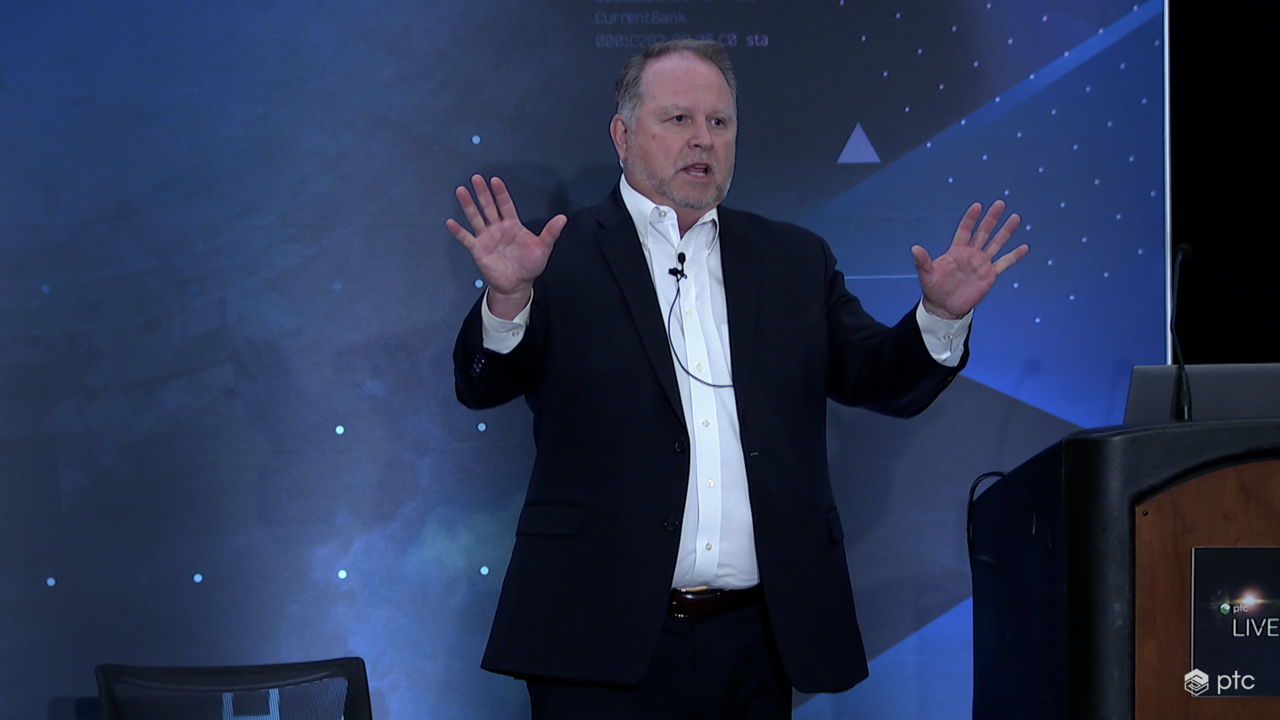
Can You Predict the Profitability of Future Production?
00:00 Hello, my name is Jeff Dimon. I'm CTO at Dell Technologies for manufacturing. There's a lot of CTOs at Dell, so that doesn't really mean much. But I'm old, so I've been around manufacturing in oil and gas for 37 years. I come up from the OT world. So operational technology, not the IT side but the OT side and been working doing that for the 37 years, mainly in oil and gas, but then the last probably ten in manufacturing.
00:30 So I've worked on projects from diapers to nuclear fuel rods and everything in the middle. And at Dell, we're a little strange from the fact that we call just about everything manufacturing. There's heavy manufacturing, light manufacturing, CPG, consumer packaged goods, right, food and beverage, pharma. And we even put mining under manufacturing. Oil and gas is separate, but they can almost bulk chemicals, chemical control, specialty chemicals, bulk chemicals. They are under manufacturing.
01:00 Also, I should mention that mining is a little bit different because they do make a product. Obviously AI is used in mining, believe it or not, that we have some of our customers. They'll shine, especially on an open pit mine. They'll take a lighter of a wall, blast it and then do a lighter again and use AI to determine the yield that they got off that wall, which is kind of odd. I mean, you wouldn't think about that. Tons of dirt is tons of dirt. But they know the yield, the ore content that they're mining.
01:33 If it's copper or alumina or whatever, then they can tell the yield by just doing two different sets of pictures and and running AI on that. AI is easy to bat around. There's lots of different types of AI. What I'm talking about is Gen three AI right now, Gen four is where everybody on the press is saying stop. The reason why it's getting a little bit unwieldy, but I don't think people are stopping in Gen four.
02:03 I can look at 1.75 trillion bits of data. So what the whole thing is about AI that you have to remember that we don't talk about a lot is somebody it's a human looks at the object and says, this is good, this is bad and open. AI, which started was one of the starters of all this, has another company that works under them that has 250,000 employees that do nothing. But this is good. This is bad. You have to tag those datasets.
02:36 Each element in those datasets. It kind of reminds me of when I was younger, when we had people that were data analysts, right? We take we took paper and typed it into computers and there was people that had a job role. That was I'm a data analyst. I take data and I type it into some type of mainframe back in the day, Right. They have people all over from Somalia to the Eastern Bloc to South America. They go in and teach them, here's some laptops. We're going to do an Internet connection to you,
03:07 and you tag data based on these parameters. And so they have these pockets of people that that tag, that data. What I'm talking about. Yes, you're going to have to do that a bit, but I think maybe you'll see a little bit different way to do that. The purpose of this paper is can I predict my profitability of my company in the future? What is the future, though? I've had executives give me feedback on the paper that I wrote, which is five years from now, three years from now, one year from now, this year.
03:42 There I liked it. They said, we don't have our jobs that long. We think your timeframe is too long. They we're worried about next quarter. You know being the CIO of the of a business there is strategic and corporate planners and I'll go into that a little bit and they're saying the only thing I can say is if you can get that shorter. And that's the whole point of this is speed and the agility of taking outside disturbance variables and predicting profitability of your company. And this is all written around production.
04:15 So obviously production assurance I so what we're trying to say is that with the new Gen Gen II, especially Gen three, Gen four processes, you can train the models with outside disturbance variables added in who doing corporate strategy would have predicted the pandemic, right? So there's geopolitical outside disturbance variables. There's things like pandemics. Now you can go back in history. Everything is based on history, and that helps predict the future, helps predict the future. Is that how many of those disturbance variables happened
04:47 over the last ten years? Probably four. Right. And you could say it depends on your business . It may be more or may be less. But for instance, during the pandemic, there wasn't. Any fewer trees. There wasn't any fewer paper mills, But we're standing in line at the grocery store for paper products. Who would have predicted that something like that broke our supply chain? We've leaned it out enough that production companies have leaned it to where any type of outside disturbance variable they've got to adjust and they've got to adjust fast.
05:21 So that's where I think that we can apply AI and ML to be able to adjust quickly and then to use the tools that are provided to risk mitigate risk intervention tools and then be able to look how we're doing to that future business plan. So some of the things on there, I'm not going to read these slides, obviously, but some of the steps. And so what is it? Here's a production AI map and it all depends
05:52 on how much you want to eat of that big elephant. Are you going to do your entire corporation's business plan or just a piece? But everywhere from what's my product mix? Am I making the right products today that I need to make in five years? Kodak How much film and Fujifilm do they make today than they made five years ago? Could they have predicted digital photography? Well, yeah, they did because it's been around longer than that. But back when that was coming about,
06:22 how did they change their product mix to stay in business, Right. So all the way from financial planning. So there's there's GDP of countries. So are you a global country is making sure that I'm making the product for that country and am I going to be profitable in that part of the world? Do I need to close that business, open up another business in a different part of the world, both from manufacturing side, but also from the selling side where I sell my products? The digital twin people says, Well, that's digital twin, right?
06:52 Well, there's about six different types of digital twins. And this gentleman right here knows that some of those digital twins are PLM on steroids, right? So that's another word that just gets batted around is digital twin. But this would take an output of a production from a plan from a digital twin, especially if it's a greenfield. But even when I start looking at brownfield plants, which there are obviously a lot more of those than brand new plants being built, this is an aggregation of that data that's just one input is from
07:26 the digital twin warehousing, logistics, gas prices, diesel prices. You might changing the way I get my product to my customers. Am I going to go ship truck, rail that might switch? And so usually what happens and I don't like these presentations when you just ask a bunch of questions, you don't give a lot of answers. But in a corporation that's of fairly some some size, those are separate spreadsheets and there's corporate analysts that that are putting those together.
07:57 I'm in charge of M&A strategy for my corporation. I'm in charge of logistics for my corporation. Okay. So that strategist that's in charge of logistics, for instance, is going to look at past what we're going to do in the future. But how are those spreadsheets linked together? It's called collective consciousness, and that is people doing that and that involves mistakes and of course, it has politics involved with it. Well, a Gen three, Gen four AI model can add in those weighted factors.
08:32 You can add in those disturbance variables and it's in there. There's no politics involved in that. If that happens, then this is going to happen, right? That can be built into the model. So when you look at these in the past, the way it's done today is with those are separate spreadsheets all the way to inventory my vendors. Do I need to change vendors? Where do I get my raw materials? Geopolitical outcomes that we see today may change where your raw materials come from.
09:02 Are we going to get lithium from China from now on? I don't think so. So that's going to change the way a battery business does. Business supply chain ATP is available to promise. Cptpp is capable to promise. There's another one called Profitable to Make, and that's really what you're trying to help them profitable to make. And a supply chain world is the biggest. Problem to solve because can I make that product and be profitable now?
09:32 So I don't make it if I can't sell it for what I need my margins to be. And that's what the model can help you do. When you look at all of these and I'll show you about what this model kind of looks like, business processes in the workforce. Now I'm old. I'm going to retire soon. I know I look young, but I'm old. But but in reality, we used to have apprentice level people out in an oil refinery. I've got oil in my boots. I've been in the oil business for a long time.
10:03 Somebody that's out there in the refinery walking around, they know what 56.7 psi means on that tower. They know what some temperature means. You either run or they need to start to quench, pump or control the process, keep it within its constraints. There are companies today that are making control rooms called Aiops command centers. Aiops command centers are 20ft from the process, 2000 miles, 20,000km.
10:35 But around the world, it doesn't matter how close you are to the final element now, but when you're removed from the process, you need to be able to communicate and understand what's going on. So spider graphs. Jarvis in the ceiling is coming Jarvis in the ceiling is now telling new operators that are usually engineers they haven't been to the plant. They're trained to look at patterns. And Jarvis with AI does the triage, if you will, of the alarms you know,
11:06 high temperature tray six start quench pump. You know the operator normally has to concur say yes Jarvis goes does that that's fairly inexpensive to do today and the idea is that you give whoever controls your process, your plant, the tools that they grew up with, and AI is just going to be there. It's going to be as common as the radio. You know, back when we radio somebody out in the plant, you know, is it on? Yeah, it's on. Right. AI is going to be so prevalent along with
11:37 the edge solutions that use AI that that's how not only to be informed the business but also how to operate the process. So we see that coming with AI. I was speaking earlier before we started that computer vision is a lot of usually where people start if they're manufacturing a process and that computer vision doing production quality, not product quality production quality is an overfill under fill and a bottling plant. Do I have the labels on it in my package? Right.
12:07 According because I can read the label now and decide that if the products in that box matches the label on the outside and does it need to go rework or does it go to the final products warehouse? And I need to keep analytics on that. AI is doing that around that production quality probably is the number one use case for CV. We also have with our partners at Dell, some at a brewery. I'll tell you which one that doesn't rhyme with Budweiser.
12:37 But anyway, the cans you get aluminum cans, they come in sleeves of paper, they take those cans out, they stick them in a hopper and they start flying. The first thing they do is they wash them and then they try to blow all the water out of it. But they're still water droplets on the can that can needs to be looked at for anomalies, cuts, dents, scratches. And if they can catch it up here, it's a lot cheaper than catching it after they fill it full of beer and it's running all over the place, obviously. Right. So you put it up here.
13:07 They need to look through the water to be able to tell because water looks like an anomaly because it's not any standard shape. Right. How many droplets are on it, what the shapes look like. So do I speed it up or slow it down? I speed it up. I'm catching less anomalies. I slow it down. I'm catching all of them, but I'm slowing down. And as you guys know, manufacturing time is currency. So the faster I can go and the more agile I can go, probably the more profitable I'm going to be. If I can cut my variable costs out,
13:37 if I can increase production by doing more first pass yields on my final product, which means my testing is faster, I'm starting to fill orders more. Maybe I can sell more product. There's a lot of people today even that can sell more than they make and they're looking to increase their production. There's other folks that are maybe in a flat market that they want to take the variable costs from electricity, energy, people, those variable costs the raw materials down.
14:07 So I can get that product cost accounting to where I need it to be to make that profitability. So the product map the around there, there are steps and believe me, there's a couple of hundred between step two and step three here. I can't fit it all on a slide at the end. I'll show you the address where you can go get the. White paper and read more of it. It's like it's 15 pages, but it has lots of pictures, so it's not that bad. There's things that you need to do. The obvious step is get enough history across your enterprise
14:40 for what you're trying to do. You may not want to do that whole production. I map I just showed you may just want to do it for your M&A strategy. You may want to do it for your product mix. But if you start doing that, where you start is history. How far you go back is how fast your business runs. For instance, I would say a slower business. Nothing wrong with that is steel. I pour steel, make molds pretty. It's not necessarily simple, but they've been doing it the same way for a lot of time.
15:11 For a long time. Right. To somebody that's making TVs, refrigerators, something that every year there's a new model changing coming out. So my business is faster. So how much history do I need to go look at? Depends on what's the speed of my business, if that makes sense. How fast do I have to change to be profitable in my business? So get that history. Define those strategic outcomes. What do I want to be in five years? Do I still want double digit growth? Is my board of directors going to tell me that I need to do that?
15:41 And every year I got to deliver ten plus? Or am I growing where it's the slow curve, the hockey stick, stick curve, all that depends on what the products are I'm making and that profitability of each one of those products define that. And then when you start looking at I've created this business plan in my following it, I have to have the tools to be able to look at what if tools, right? So if I did this, what happens if I bought this company?
16:11 What happens if I changed out this production line and upgraded it? What happens? I need to upgrade my workforce now. I'm a little bit more complicated in my processes and something I tell my customers a lot when I'm doing edge solutions, especially in plants, technology is 50% . The other 50% are the people because unless they buy into it and understand the new workflow, the new business processes, you put all the technology in there you want to, and unless you fire them all and do lights out manufacturing, they affect that.
16:46 You know, in Texas, they say ain't never done that before. You know, when when something moves the way, they're not expecting it to move. So you have to take the people part involved in that. So how much goes to I how much do you lose? Using the people depends on your business again and the complexity and maturity of your technology in your business. Again, inputs some supply chain energy, M&A, strategy, manufacturing and execution.
17:16 They're all the way down to gross domestic profit. So if you've got a worldwide business, you have to look at the economies of the countries that you're in. That brings a whole new element into your profitability. Do I move? As we know now, the US is moving a lot of manufacturing back to the US. Five years ago, ten years ago, would we have thought that? No, we were going the other way. Let's get it out of here because it costs too much money to create that product here in the US. Let's put it somewhere where I can get maybe closer to the raw materials,
17:48 maybe closer to a cheaper labor pool, geopolitical reasons, all those kinds of things are bringing it back. Even logistics, cost of fuel. That's where it all kind of ties together. Again, this is too much to go through all today, but especially this one. So Workstreams you need to look at is there enough words on that slide? I could have put more, but that's what's in the paper. So if you look at optimization and that's all kinds of optimization from energy to people to your overall business
18:20 strategy optimization, but how do it to OT operational technologies, the people that are down on your plant floor Those are some of the things you need to think about. And that's what I mean about changing the workforce, changing. Do I need a new production line, upgrade my PLCs or control system that is down on the plant floor all the way to what are my servers look like now? My personal opinion. I always throw this out there because then it's my opinion. I don't think it's necessarily Dell's opinion,
18:50 but the world over rotated to the cloud. I'll just state that I love cloud. There's nothing wrong with cloud. Every customer we have has a multi cloud strategy. That's not it. The thing why why Edge is about came about in manufacturing and Edge is the compute and storage resource that's closest to where the product or the data is generated or created. And people have decided that not every piece of data has to go to the cloud. There's workflows and you call them use cases, workloads, workflows,
19:25 whatever you want to call them, kind of the same thing that can just stay in the plant to run the plant. They don't need to go to the cloud. You may want to send the results to the cloud or the answer to the cloud because you're running macro analytics or I'm looking at analytics across several of my plants or several of my businesses, but I execute the model down on At the Edge. And I'm not saying that just because we sell edge products partly, but also it's because that data down there has to generate value.
19:57 And one of the things that we talk about and I get across to my customers is we do a free service called It's Not an Advertisement. It's called a Discovery. And that's when I come and bring some people to your plant and I turn my hat around backwards and become a pure consultant and say, What are you trying to do if I don't know it already? Right from the ten K or something like that. And what have you tried and what's worked and what hasn't. And I can help you or not help you as simple as that, right? Nope. Can't help you. Or that's great.
20:27 But other people doing these type of things in that in maintenance get this type of payback or ROI or whatever it is, right? How you count your money. And we try to help customers do that. That's where AI is going to come in, where you're going to be able to say there's these standard architectures that we've we've decided that's our North Star. This is going to be how we lay it out. Most people are growing through acquisition than they are through building new plants. So they get individual works of art. And can I it's hard.
21:00 I mean, people have struggled with that ever since I was a young engineer looking at how do I make a standard common design pattern across my IT landscape. And now it's and it always changes. It'll never be one, right? You can get some design patterns, some guidelines. You can get it to where corporate it is dictating down to the plants what it should be. But the plants are always going to do what they have to do to make the product and that it OT convergence happened 30 years ago when Honeywell's and
21:31 the Emersons went from proprietary hardware and software and operating systems to Dell workstations. And I had a plant manager at Dell at excuse me, at Exxon Chemical, Baton Rouge. They make 25,000 pounds. They have 20. 5,000 pound hydrogen reactors. And he says, my family lives outside the gate and we've launched a couple of those reactors already. Would your family live outside the gate running on a Dell workstation that makes you think a little bit right?
22:01 I mean, it went from built for purpose type hardware to commercial off the shelf hardware. It still had some of the it has to be deterministic and all that. The answer was yes and that's everybody in the industry has changed from the Honeywell's to Emerson's Yokogawa to Siemens. It doesn't matter what the process is. They're looking they're running mostly on commercial, off the shelf systems that are large control systems or individual ones that are still proprietary . But the larger ones are. I is going to be the same way pretty soon.
22:33 You're looking at the control systems for manufacturing are going to be in our data centers and then the I o will be out there in the field. But what controls the process in the data center will be more than 50% . I it's not set point process variable and output anymore. It's going to be inferencing engines that are go way above what advanced control is today. We did step models before where we always step the plant to get the outputs,
23:05 but I with inferencing engines and we started adding gen type Gen four type algorithms to it. Control is going to be much different than it is today. So all the way. That's the process and automation and reliability because. You may do all that stuff, but it's still got to be safe, right? There's no engineering unit for safety. But you still have to make everything have that reliability availability five nines to the right of the decimal or more.
23:38 One of the things about Gen II is it's not trained the model once it's first stage, second stage. So in production, I might look and this isn't this is not exhaustive. I took a sample here because it fit on the slide. But the idea is that I look and I train the model based on history that I have today because I'm looking at production, right? That's what I'm production assurance. I that I'm profitable. So this is all production. I may have the same type of thing I'm doing for something else that's pure M&A.
24:10 If I'm in a different type of business, this happens to be like oil and gas manufacturing type businesses. But I want to look at what that data is from history and bring it to where I get that total production, how much I think I'm going to be, who's going to make it? How am I going to make it? And what are my what is my profit need to be as starting the baseline, the add the model to to create the plan to that baseline. Second stage of that is you have to take each individual one of those and do a model
24:42 on each individual one of those, and then link those individual ones to the first stage. This is a stack of what production I could could look like. Obviously operational databases that have process data, there's analytical data that's out there bring that together. In the old days that was a data lake, but you're going to have that that data somewhere. That's where you start looking at transformation and rationalizing and normalizing that data. So everybody understands that a gallon is gal and it looks like this and there's this many digits to it, that piece of data.
25:15 But that's where I'm starting to do all the first and second step models are to that data set that's in there or actually it's a bunch of data sets. When I start looking at then the decision engine on that, I make that look really easy. But that's the that I platforms that inference in the deep learning. That's the hard part. That's where the algorithms that come in that use that data below it. But that's where the models being built, that's where you tune the models.
25:46 And again, one of the fastest things or one of the things you need to do is it needs to be fast. Spreadsheets are not fast. When you look at data and you can tune the model fairly quickly to go out and look at the data set. But changing the model isn't that hard as far as speed goes. You can do that fairly quickly and then you have to have the tools and that's that presentation layer where you get the risk analysis, the mitigation intervention. And then of course that intuitive business plan based upon
26:16 the time frame that you want. And I always iterate that plan on whatever the speed of your business is. Is it once a quarter? Do I do it daily? Daily is ridiculous, but how often do I do that is how fast your business is moving. You've got to understand financials. I know in a lot of my world and control systems, I don't know what IRR is. Why do I need to know that? Well, when I start justifying everything in business today, it's all based on it either makes you money, it saves you money,
26:48 or it helps you work safer. If it doesn't do one of those three things, don't do it. That's kind of my mantra. Don't do it if it's cool, it's got blinky lights. I don't care. Raspberry Pi, it came out. Every engineer, not every engineer. A lot of engineers bought them and put it in their garage refrigerator to tell if the light went out. Really went out when they shut the door. That was cool. I really know the lights out. When I shut the door, I took it to work and it failed. Iot is almost got a negative connotation.
27:19 The term it's really means it's only talk is what Iot means. But the reason it got a negative viewpoint is because it didn't scale, it wasn't secure, and nobody wrote a business case around it. Makes you money, saves you money, helps you work safer. If it doesn't do one of those things, don't do it. I'm saying it again. Know how your company counts its money. You don't need to use all of those. It's how your company counts its money.
27:50 And so if you don't know that you need to work with whoever you're consulting agency is, I bet you they've got some beancounters that can help you write that business plan. That business plan based on financials is what the end result is going to be because you get the business plan, but it's all based on makes you money, save you money, helps you work safer. This is Eva. I love Eva and it goes from right to left, not left to right. This is what your economic value added is now. I'm not an economics person.
28:22 I don't even do math that well. The idea of this is understanding what comes in that affects my Eva. So it's production cost. Accounting is another way to look at that. There are software like SAP that does that today, but I need to put those inputs in to understand to create my business plan. It's got to be based on something. So what I'm getting towards the end here, there's benefits to this and I think I've said these throughout. So one of the things is I don't like siloed analysis of anything they don't tie.
28:57 They're not influenced by a different silo. If I'm looking at M&A strategies, I also need to look at logistics. I need to look at personnel. If I look at product costing, I need to look at where my raw materials are come from, plus logistics, those type of things. You have to interconnect those those silos of data. And like I said earlier, that today is called the collective consciousness. If we all did something different in spreadsheets and did analysis of something and it was a different part of my business and we all got together in this room,
29:30 how do we know whose is more important than another based on what? Right. So that's what the model does, is it brings those silos together. So does it reduce spreadsheets? No, you've got to have some way. We all think that spreadsheets old but you know how many supply chain how many companies is a better way to say it? Use spreadsheets for supply chain a lot A lot . Right and even maintenance planning. The three M's sticky notes were a technology technology boom
30:02 because that was really cool that I could put a sticky note versus a whiteboard or a chalkboard and a whiteboard. Then Gantt charts on a spreadsheet. But the sticky notes are still used a lot today because when I do my maintenance planning, it's all about making my product. That critical asset goes down. I don't make the product and how do I get that critical asset to keep it from going down? Or if it does go down, there's three things the the part to fix it, the technician to put the part in at wherever the machine is, the location.
30:33 So it's a big scheduling issue to get all those three things there or work doesn't get done. If I can predict when that or at least get a trend, if anybody says they can predict something's going to fail sooner than six weeks question that heavily, it's really the way we can do prediction algorithms today is you're looking at a slope. And the idea it gives you is when in the next six weeks it's going to fail. Can I limp along to my next turnaround or to my next plant outage?
31:03 I is one of the inputs to that because then you can wait. How much metal particulates are in the lube oil, how many times it was turned on and off. Like if it's a like a pump or a compressor or something, how long does it run Time, hours? How many times does it failed in the last five years between failures, you know, time between failures and all that in I can take that in the model and give you a prediction of a slope. It's up or down. One of the new inputs, believe it or not, are acoustics. I don't know if any of you folks use acoustics in your processing plant,
31:34 but it's bad if it's too noisy and it's bad if it's quiet. Right? And so those and it's fairly non-intrusive to the process, I can screw it on a beam or a wall. I'm not penetrating pipe or a pump casing or something like that. In manufacturing, I didn't think about using acoustics. We're probably 5 or 6 years ago we started looking at what a bearing goes out on a pump or a conveyor belt. It makes a lot of noise before it goes. It doesn't just immediately cease. I know you guys want to write all that down,
32:05 but if you go to Dell.com and search for the article, you can find it or the white paper. The article is on cio.com. And if you type in production assurance, it's a shorter version that. But if you can't fall asleep, like I said earlier, you can read the white paper and it's it's good ways to to to fall asleep. But the idea I think I was trying to get across and this was just very glossy right a half an hour the paper goes a little bit deeper about how and what
32:38 and then there should be more after that because it only goes so deep. I appreciate you coming. I know it's been a long show. This is the last slot for I think maybe it's not. But I appreciate you all coming. My email is Jeff Dimond at dell.com. It's pretty easy. I'm on LinkedIn and happy if you have any more questions. If you say, you know, how would we do this or where we would start,
33:08 if I can't help you, I know a lot of people that probably can and I'm happy to refer you to anything I can do to help. Really appreciate you coming. Thank you.