Depot Repair & Service Logistics Software  

Manage repair intake, workflows, and turnaround time in one application built to protect SLAs, control costs, and scale service logistics operations.

Overview Capabilities Solutions Benefits Resources FAQ
Contact Us

What is depot repair software?


Depot repair software gives repair centers a single system to manage every step of the repair lifecycle, from RMA intake and receiving through triage, execution, and quality inspection. Instead of relying on spreadsheets, homegrown tools, or ERP workarounds, depot and repair center managers get full visibility into installed base history, service contracts, and warranty entitlements the moment a unit arrives. ServiceMax connects depot repair with the rest of your service logistics operation, so technicians, planners, and logistics managers can track work orders, assign queues, and manage repairs, replacements, exchanges, and returns from one application. The result is faster turnaround, protected SLAs, and repair quality you can prove.

How depot repair works in ServiceMax

A guided, step-by-step workflow that takes every repair from intake to inspection with full visibility and control.

ServiceMax Depot Repair guides every unit through a consistent, auditable workflow. From the moment a customer request or RMA is issued, work is routed, triaged, and assigned to the right workstation and technician. Task-level work plans keep repair, replacement, exchange, and return activity on track, while quality inspection and testing confirm each unit meets standard before it's put back into service. The result: predictable turnaround, protected SLAs, and full traceability from request to release.

Customer request & RMA issuance

Service reps and field technicians can create depot work orders and RMAs in seconds. ServiceMax confirms product and coverage details up front, then routes equipment to the correct depot so repairs start without delay. Accurate intake data captured at this stage speeds every downstream step, from receiving through repair execution.

Inbound receiving

When equipment arrives at the depot, ServiceMax matches it against the original RMA and confirms condition, accessories, and documentation. Receiving teams log the unit into the queue immediately, giving managers real-time visibility into what’s on-site and ready for triage.

Triage & queue assignment

Each unit is assessed and assigned to the right workstation and technician based on skill, workload, and priority. Rules-based assignment with manual override keeps queues balanced, so repair centers can meet SLA commitments even as volume fluctuates.

Repair execution

Technicians follow task-by-task work plans covering repairs, replacements, exchanges, and returns. Kanban-style status views support self-assignment, while managers track workstation, technician, and component status across every depot in real time.

Quality inspection & testing

Before a unit ships back into service, it passes through quality inspection and testing to confirm it meets repair standards and compliance requirements. Full task and status history gives managers an audit-ready record of every repair, start to finish.

Outbound shipment

Once a unit clears quality inspection, ServiceMax coordinates outbound shipment back to the customer or field location. Shipping details are tracked automatically, giving managers full visibility from repair completion through delivery and closing the loop on every work order.

Key capabilities

Depot work order creation

Instantly create depot work orders from customer requests or field service jobs, with product and coverage details confirmed automatically to keep intake accurate and fast.

RMA management

Create RMA’s automatically from work orders and track them from issuance to resolution, with configurable workflows that keep replacements, exchanges, and returns moving without manual follow-up.

Queue-based workflows

Route repairs into rules-based queues by workstation and technician skill, with manual override when priorities shift, so every job is worked in the right order.

Workstation assignment

Give technicians a clear, self-service view of assigned work with Kanban-style status boards, while managers monitor workstation and component status across every depot in real time.

Configurable logistics: repairs, replacements, exchanges & returns

Configure service work plans to cover repairs, replacements, exchanges, and simple returns, so every job follows the right process.

Connected to installed base & service history

Every repair draws on full as-maintained installed base data and service history, so technicians and managers make decisions with complete asset and customer context.

Depot repair as part of your service logistics operation

Returns & reverse logistics

ServiceMax manages the full reverse logistics process. Depot teams can route units for repair, replacement, exchange, or return, while keeping visibility into every product or part in the process. Connected service history and warranty data help teams make faster return decisions, reduce unnecessary shipping, and recover value from parts and equipment that would otherwise sit idle in a queue.

Service parts logistics

Repairs and replacements depend on having the right part in the right place at the right time. ServiceMax connects depot repair to service parts logistics, so technicians and planners can check availability, assign parts to work orders, and track shipments without leaving the application. Tighter coordination between repair queues and parts inventory means fewer delays, less excess stock, and repairs that move from triage to completion on schedule.

ServiceMax depot repair vs. ERP-only approaches

ERPs are built for financial and inventory transactions, not day-to-day repair operations. ServiceMax fills the gap with queue-based workflows, task-level work plans, and full installed-base context, giving repair centers the operational control that ERP-only approaches can’t provide.

See the Difference

Scale depot repair operations

As repair volume grows, ServiceMax scales with you. Standardized workflows, configurable work plans, and depot-wide visibility mean new technicians, workstations, and repair centers can be added without adding complexity. Managers keep the same level of control over cost, quality, and SLAs today as they will at twice the volume tomorrow.
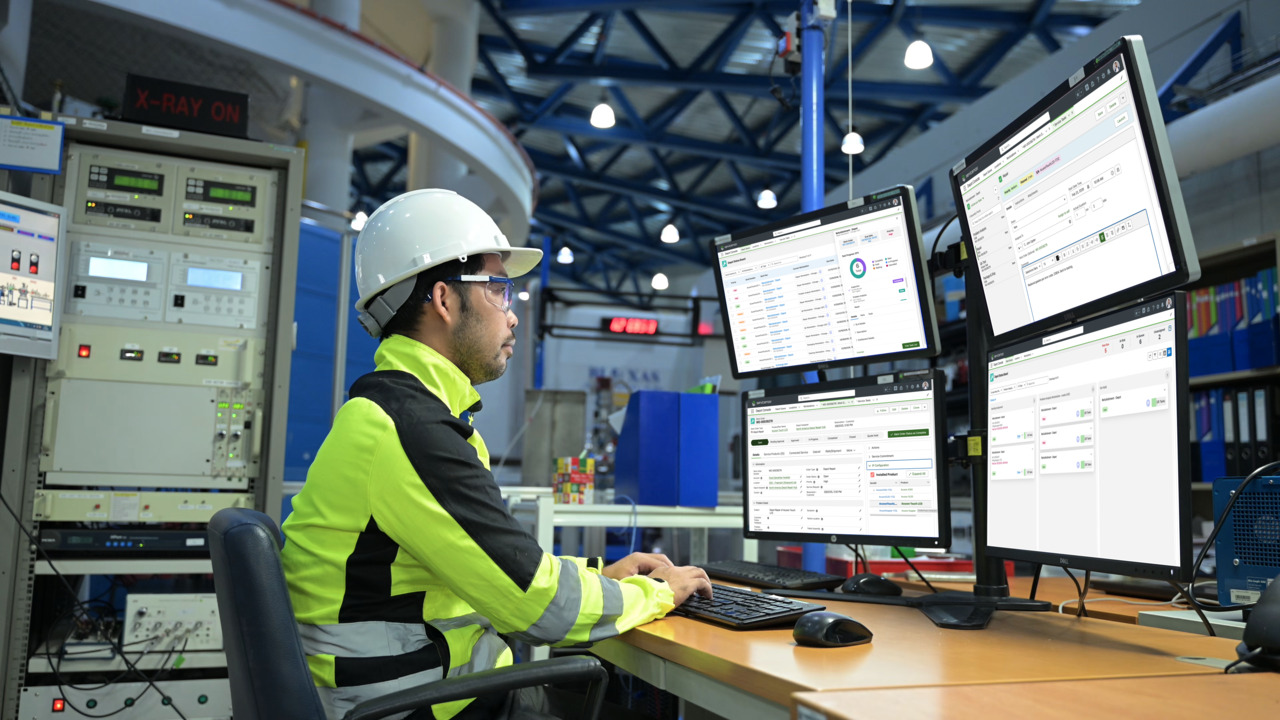
Explore ServiceMax Core
null

Real-time control with ServiceMax

Asset-centric intelligence

Every repair decision starts with a complete picture of the asset. ServiceMax connects depot repair to installed base data, warranty entitlements, and full service history, giving technicians and managers real-time context the moment a unit arrives. That visibility helps teams triage faster, avoid duplicate work, and make accurate repair, replacement, or return decisions without hunting across disconnected systems.

Production-level repair execution

ServiceMax brings production-level control to repair operations, with configurable work plans, workstation assignment, and task-level tracking across every depot. Managers get real-time visibility into technician workload, queue status, and repair progress, so they can balance capacity, protect SLAs, and keep throughput predictable even as volume grows.

Featured benefits of ServiceMax Core’s depot repair & service logistics software

ServiceMax Core gives depot repair teams the tools to work faster, stay accurate, and keep every repair on track, from intake through completion.

ServiceMax Core gives depot repair teams the tools to work faster, stay accurate, and keep every repair on track, from intake through completion.

Turn service calls into repair action, fast

Convert service calls and RMAs into depot work orders instantly, with product and coverage details confirmed automatically so repairs start without delay.

Convert service calls and RMAs into depot work orders instantly, with product and coverage details confirmed automatically so repairs start without delay.

Control repair intake and stay accurate

Capture accurate intake details every time, from RMA issuance through receiving, so repair centers avoid rework and keep every unit moving through the right process.

Capture accurate intake details every time, from RMA issuance through receiving, so repair centers avoid rework and keep every unit moving through the right process.

Run your repair center with real-time operational insight

Get real-time visibility into workstation status, technician workload, and repair progress across every depot, so managers can balance capacity and increase throughput.

Get real-time visibility into workstation status, technician workload, and repair progress across every depot, so managers can balance capacity and increase throughput.

Be empowered by clear workflows and ownership

Give technicians clear, self-service work plans and Kanban-style status views, so every team member knows what to do next and takes ownership of their queue.

Give technicians clear, self-service work plans and Kanban-style status views, so every team member knows what to do next and takes ownership of their queue. Learn More

Frequently asked questions

Answers to common questions about depot repair, service logistics, and how ServiceMax fits into your service operation.

What is service logistics software?

Service logistics software helps organizations manage the movement, tracking, and coordination of service-related assets, parts, and repairs across their lifecycle. It connects functions like depot repair, parts inventory, RMA management, and reverse logistics into a single system, giving teams real-time visibility into equipment and parts at every stage. Applications like ServiceMax bring these processes together so managers can protect SLAs, reduce turnaround time, and control costs across the service supply chain.

How is depot repair different from field service?

Field service focuses on repairs and maintenance performed on-site, at the customer’s location, often on equipment that can't be easily moved. Depot repair, by contrast, involves shipping equipment to a centralized repair center, sometimes called a shop, bay or hub. In these facilities, technicians can access specialized tools, parts, and testing equipment. Depot repair is typically used for smaller, higher-value, or more complex units that benefit from controlled repair environments, while field service handles issues that require on-location attention. Many organizations use both models together, routing work to whichever approach best fits the asset and the issue.

How is depot repair related to maintenance management software?

Maintenance management software helps organizations schedule, track, and manage preventive and corrective maintenance for assets, typically at a customer site or facility. Depot repair software is complementary: it manages what happens when an asset needs to leave the field and go to a centralized repair center for more extensive service. When depot repair connects with maintenance management and installed base data, teams get a complete view of an asset’s history, from routine maintenance through major repairs, replacements, and returns.

What is an RMA, and how does it work in depot repair?

An RMA, or return merchandise authorization, is the approval and tracking record created when a customer or field technician needs to send a unit in for repair, replacement, or return. In depot repair, the RMA process starts as soon as a service call or request is issued: the system confirms product and coverage details, assigns a return number, and routes the unit to the correct depot. From there, the RMA stays linked to the unit through receiving, triage, repair, and shipment, giving teams a single record to track status and confirm resolution.

How does depot repair software integrate with ERP?

Depot repair software typically integrates with ERP systems to keep financial, inventory, and operational data in sync. While the ERP handles transactions like invoicing, general ledger entries, and inventory valuation, depot repair software manages the day-to-day operational work: queue-based workflows, task-level work plans, and technician assignments. Integration lets repair centers pass information like parts consumption, labor, and billing events back to the ERP automatically, so finance and operations teams work from consistent data without duplicate entry.

What is supply chain traceability?

Supply chain traceability is the ability to track a part, product, or asset as it moves through every stage of the supply chain, from manufacturing and shipping to service and repair. In a service logistics context, traceability means knowing exactly where a unit is, what work has been performed on it, and which parts and components were used, at any point in time. Strong traceability supports compliance and warranty claims, speeds up root-cause analysis, and gives depot repair teams the history they need to make faster, more accurate repair decisions.

What is supply chain management (SCM)?

Supply chain management (SCM) is the coordination of all the activities involved in producing and delivering a product or service, including sourcing, manufacturing, logistics, and distribution. In service organizations, SCM extends into the service supply chain: managing spare parts, repair logistics, and reverse logistics so that the right part or unit is in the right place at the right time. Effective SCM reduces costs, shortens lead times, and keeps repair and replacement operations running smoothly.

What is remanufacturing?

Remanufacturing is the process of restoring a used product or component to like-new condition, often through disassembly, cleaning, replacement of worn parts, and rigorous testing, so it meets the same standards as a new unit. In depot repair, remanufacturing gives organizations another disposition option beyond simple repair or replacement, extending asset life, reducing waste, and recovering value from returns. ServiceMax supports remanufacturing workflows alongside repair, replacement, and exchange processes within the same configurable application.

Speak with a ServiceMax expert

Please wait while your request is being submitted...

Hi {name}, welcome back.
Not you?

  • Country
  • Afghanistan
  • Albania
  • Algeria
  • American Samoa
  • Andorra
  • Angola
  • Anguilla
  • Antarctica
  • Antigua and Barbuda
  • Argentina
  • Armenia
  • Aruba
  • Australia
  • Austria
  • Azerbaijan
  • Bahamas
  • Bahrain
  • Bangladesh
  • Barbados
  • Belarus
  • Belgium
  • Belize
  • Benin
  • Bermuda
  • Bhutan
  • Bolivia
  • Bosnia and Herzegovina
  • Botswana
  • Bouvet Island
  • Brazil
  • British Indian Ocean Territory
  • Brunei Darussalam
  • Bulgaria
  • Burkina Faso
  • Burundi
  • Cambodia
  • Cameroon
  • Canada
  • Cape Verde
  • Catalonia
  • Cayman Islands
  • Central African Republic
  • Chad
  • Chile
  • China
  • Christmas Island
  • Cocos (Keeling) Islands
  • Colombia
  • Comoros
  • Congo
  • Congo, Democratic Republic
  • Cook Islands
  • Costa Rica
  • Cote d ivoire
  • Croatia
  • Cuba
  • Cyprus
  • Czech Republic
  • Denmark
  • Djibouti
  • Dominica
  • Dominican Republic
  • East Timor
  • Ecuador
  • Egypt
  • El Salvador
  • Equatorial Guinea
  • Eritrea
  • Estonia
  • Ethiopia
  • Falkland Islands (Malvinas)
  • Faroe Islands
  • Fiji
  • Finland
  • France
  • French Guiana
  • French Polynesia
  • French Southern Territories
  • Gabon
  • Gambia
  • Georgia
  • Germany
  • Ghana
  • Gibraltar
  • Greece
  • Greenland
  • Grenada
  • Guadeloupe
  • Guam
  • Guatemala
  • Guinea
  • Guinea-Bissau
  • Guyana
  • Haiti
  • Heard & McDonald Isl
  • Honduras
  • Hong Kong
  • Hungary
  • Iceland
  • India
  • Indonesia
  • Iraq
  • Ireland
  • Israel
  • Italy
  • Jamaica
  • Japan
  • Jordan
  • Kazakhstan
  • Kenya
  • Kiribati
  • Korea, Republic of
  • Kuwait
  • Kyrgyzstan
  • Lao Peoples Dem. Rep.
  • Latvia
  • Lebanon
  • Lesotho
  • Liberia
  • Libyan Arab Jamahiriya
  • Liechtenstein
  • Lithuania
  • Luxembourg
  • Macau
  • Macedonia
  • Madagascar
  • Malawi
  • Malaysia
  • Maldives
  • Mali
  • Malta
  • Marshall Islands
  • Martinique
  • Mauritania
  • Mauritius
  • Mayotte
  • Mexico
  • Micronesia
  • Moldova, Republic of
  • Monaco
  • Mongolia
  • Montenegro
  • Montserrat
  • Morocco
  • Mozambique
  • Myanmar
  • Namibia
  • Nauru
  • Nepal
  • Netherlands
  • Netherlands Antilles
  • New Caledonia
  • New Zealand
  • Nicaragua
  • Niger
  • Nigeria
  • Niue
  • Norfolk Island
  • Northern Mariana Islands
  • Norway
  • Oman
  • Pakistan
  • Palau
  • Panama
  • Papua New Guinea
  • Paraguay
  • Peru
  • Philippines
  • Pitcairn
  • Poland
  • Portugal
  • Puerto Rico
  • Qatar
  • Reunion
  • Romania
  • Russian Federation
  • Rwanda
  • S.Georgia and S.Sandwich Isles
  • Saint Helena
  • Saint Kitts and Nevis
  • Saint Lucia
  • Saint Pierre and Miquelon
  • Samoa
  • San Marino
  • Sao Tome and Principe
  • Saudi Arabia
  • Senegal
  • Serbia
  • Seychelles
  • Sierra Leone
  • Singapore
  • Slovakia
  • Slovenia
  • Solomon Islands
  • Somalia
  • South Africa
  • Spain
  • Sri Lanka
  • St. Vincent and Grenadines
  • Sudan
  • Svalbard and Jan Mayen Islands
  • Swaziland
  • Sweden
  • Switzerland
  • Taiwan
  • Tajikistan
  • Tanzania United Republic of
  • Thailand
  • Togo
  • Tokelau
  • Tonga
  • Trinidad and Tobago
  • Tunisia
  • Turkey
  • Turkmenistan
  • Turks and Caicos Islands
  • Tuvalu
  • Uganda
  • Ukraine
  • United Arab Emirates
  • United Kingdom
  • Uruguay
  • US Minor Outlying Islands
  • USA
  • Uzbekistan
  • Vanuatu
  • Vatican City State (Holy See)
  • Venezuela
  • Vietnam
  • Virgin Islands (British)
  • Virgin Islands (U.S.)
  • Wallis and Futuna Islands
  • Western Sahara
  • Yemen
  • Zambia
  • Zimbabwe

Click the button below to continue.

Contact Us