A retailer submits a fleece jacket to an LCA tool.
They include the minimum information needed to generate a footprint: a bill of materials with explicit material and fiber composition, product weight, country of manufacture, cut-make-trim factory, transportation assumptions, and a designation that the garment contains recycled polyester. The calculation runs successfully and produces environmental impact scores.
Missing data doesn't stop the calculation. It simply forces the tool to guess.
When it doesn't have product-specific data, it substitutes global averages. The more it relies on averages, the greater the uncertainty becomes.
For this fleece jacket, the LCA doesn't know:
- Whether the recycled polyester came from a mechanical or chemical recycling process
- Which dye house processed the fabric
- What energy sources powered those facilities
- How efficiently water and chemicals were managed during production
Those details matter. Mechanically recycled polyester can have a footprint of approximately 1.8 kg CO₂e/kg, while some early-stage chemically recycled polyester processes can exceed 7.2 kg CO₂e/kg.
This single missing data point introduces nearly a 4x variation in calculated environmental impact.
By stopping at "recycled polyester," the retailer gets a score. By identifying which recycled polyester, which processor, and which facility, the retailer gets a more accurate score. That's the difference granularity makes: less reliance on assumptions, less uncertainty, and greater confidence in the result.
The Growing Cost of Missing Data
Sustainability frameworks are becoming increasingly unforgiving when data gaps exist. One example is Ecobalyse, the methodology underpinning France's Environmental Cost (“Coût Environnemental”) initiative. When key product information is unavailable, the model applies conservative default assumptions rather than assuming best-case performance. In practice, products supported by limited data can receive less favorable scores than products supported by complete, product-specific information.
The message is clear: if you leave out details, the system will assume the worst rather than the best.
This represents a broader shift in sustainability measurement. Historically, organizations could rely on industry averages and generalized assumptions to support sustainability reporting. Increasingly, regulators, consumers, and investors are demanding product-level transparency backed by product-level evidence.
The result is that data granularity has become just as important as data availability.
Where Granularity Matters Most
Not all data gaps have the same impact.
Some missing attributes create relatively small variations in an LCA result. Others can introduce significant uncertainty and mask meaningful differences in environmental performance. If you're investing in better materials, cleaner manufacturing processes, and more sustainable suppliers, you want those investments reflected in the results. Otherwise, the value of those investments can be lost in the averages.
The chart below highlights where additional data granularity can have the greatest impact on reducing uncertainty in sustainability scores.
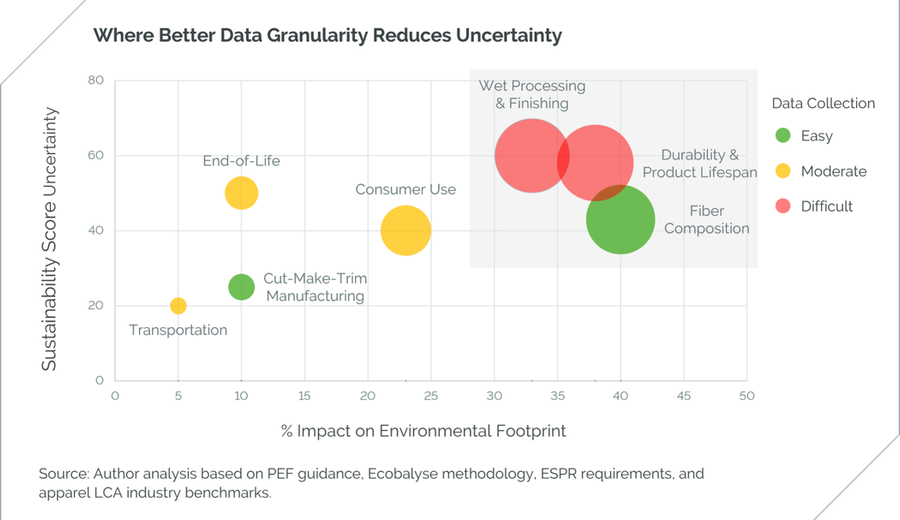
Notice what stands out.
The same data points that have the greatest influence on environmental performance also tend to be the hardest to obtain. Fiber sourcing, wet processing, and durability sit in the upper-right corner because they combine three characteristics: high impact, high uncertainty, and limited supply chain visibility.
That's why data granularity matters. If brands can't capture these details, meaningful sustainability improvements can disappear into industry averages. The companies that can access and validate this information are better positioned to reduce uncertainty, substantiate their sustainability claims, and differentiate their products.
Why This Matters Beyond Sustainability Scores
The business case for granularity extends beyond improving LCA accuracy.
As regulatory scrutiny of environmental marketing claims increases, brands must be able to substantiate the sustainability benefits they communicate to consumers. Better product and supply chain data not only improves sustainability calculations but also strengthens an organization's ability to demonstrate how and why one product performs differently from another.
This is becoming particularly important as regulators increase their focus on misleading or unsubstantiated environmental claims. The more granular the underlying product data, the easier it becomes to support claims with evidence rather than assumptions. Conversely, claims supported primarily by averages and proxies become increasingly difficult to defend.
Put differently, better sustainability outcomes increasingly require better evidence.
Whether the objective is supporting sustainability reporting, preparing for product transparency initiatives, building future Digital Product Passports, responding to customer inquiries, or substantiating environmental claims, the underlying challenge remains the same: confidence in the data.
The companies that invest in greater product and supply chain visibility today will be in a better position to support future regulatory requirements while also ensuring that meaningful sustainability improvements receive the recognition they deserve.
The Executive Takeaway
The sustainability challenge facing retailers is no longer collecting more data. It's collecting the right data at the right level of granularity.
A sustainability score built on assumptions may satisfy a calculation. A sustainability score built on granular product and supply chain data provides something far more valuable: confidence.
Because in a world increasingly focused on transparency, sustainability investments only create value when you can prove them.
Up Next
Retail’s addiction to virgin polyester
In an age of sustainable development, why is only 12% of the polyester used to make products recycled?
Read the Blog